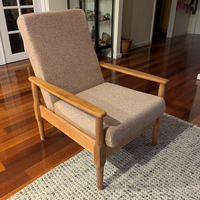
Steps
Step 1
Prepare your work area and make sure you have enough room to work in. The area must be well ventilated as the sanding will create a lot of sawdust.
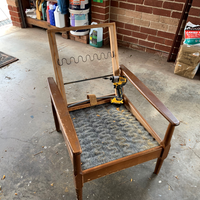
Inspect your armchair for any damage, such as cracks or chips in the frame. Remove all seating and fittings, including the upholstery. Place all screws into a jar.
Some armchairs have a recliner feature. Take photos or videos for reassembling in the final step.
 .
.  .
. 
Step 2
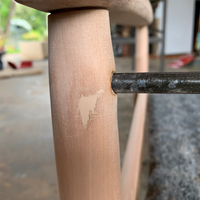
Repair any cracks. You can use wood glue, but for this repair we used all-purpose Gorilla Glue). Use a chisel to open up the crack, then add the glue straight into the crack. Clamp the area together and leave overnight to set.
Fill in any chips using wood putty. Simply clean the surface, apply the putty with a scraper and let it dry.
 .
. 
 .
.  .
.  .
. 
Step 3
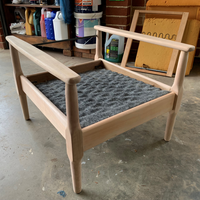
Most armchairs have varnish or some form of wood stain. This can be easily removed with an orbital sander. Start sanding the arms and legs of the chair using an 80 grit sheet, then finish off with 120 grit.
For difficult areas such as curved legs, you will have to do some hand sanding with sanding sheets. Start with either 60 or 80 grit, cut the sanding sheets into strips and use a sawing motion on curved surfaces to remove the stain or varnish.
Complete the final sanding by hand with 240 grit sandpaper over the whole chair.
Don’t forget to wear a mask and safety glasses as there will be a lot of sawdust. Make sure you are happy with the finished surface before beginning the staining process.
 .
.  .
. 
Step 4
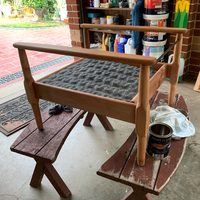
To highlight the grain and the natural colour of the wood you can use furniture oil or indoor furniture varnish. Apply the first coat with a soft cloth and wipe off any excess - this will slightly darken the wood. Let it dry overnight and reapply oil until you achieve the desired wood tone. For this restoration, we applied four coats of oil to achieve the colour we wanted.
 .
.  .
. 
Step 5
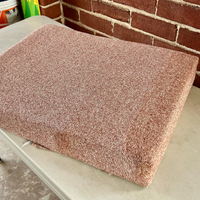
Replacing the cushion foam is easy. Remove the old foam and measure the sides using a measuring tape. Confirm your measurements by measuring upholstery such as the backrest because old foam can become compressed over time.
Order the foam to your specifications. We chose a medium-firm feel with memory foam. If you need to cut the foam, mark out the area and cut using a bread knife. For round edges, mark the curve with a marking pen and shape with your bread knife. Wash your upholstery and insert the new foam.
The back section of the armchair usually has a wooden support frame that goes inside the upholstery with the cushion foam. You will need to glue the foam on to the wooden frame using a spray adhesive such as Selleys Kwik Grip Spray.
Spray the adhesive on to the foam, firmly press the wooden frame on top of the foam, place a weight on the wooden frame and allow to set. Insert the new foam backrest back into the upholstery fabric and reattach to the wooden frame using a staple gun.
 .
.  .
.  .
.  .
.  .
.  .
. 
Step 6
Reassemble the chair and reattach any moving parts. Staple the upholstery on to the wooden sections of the chair and place the seating back into position.
Enjoy your newly restored chair.
 .
.  .
.