I want to share with you how I redid the paving of the side walk next to our house.
Here is the end result:
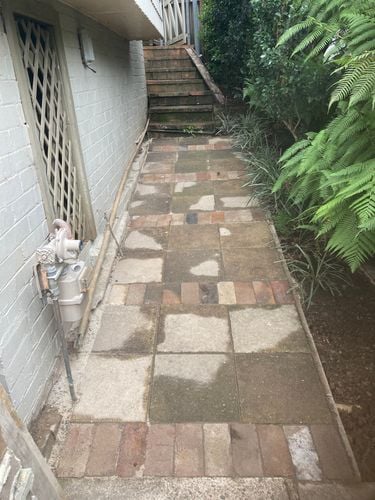
The previous paving was loose in parts and very slippery in wet weather, so I decided to replace it.
To keep costs down, I
- reused concrete pavers that were left over from a patio upgrade,
- used bricks recycled from a demolition,
- used sand left over from the patio project, and
- only bought a ton of road base and three bags of mortar.
First I removed the old pavers and added edging where it was missing using the mortar to bed it down. I let the mortar set for a few days to make sure it was hard.
The next steps were a bit complex as I had to consider the different height of the pavers (40mm) and bricks (about 75mm) which I wanted to use.
Step 1: Lay base layer of road base
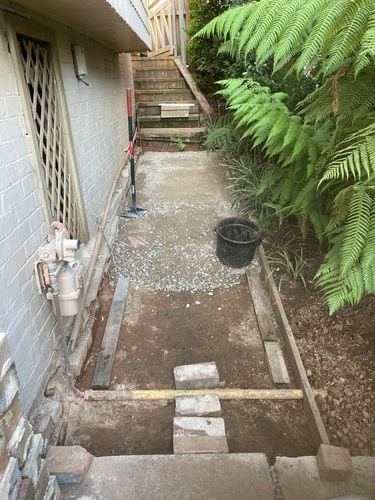
Since both materials were of different height I first laid the road base at the height for the thicker material, the bricks.
As you can see from the photo below, I used timber on both sides to control the height of the layer. I then compacted the layer with a hand tamper.
Step 2: Lay pavers & bricks
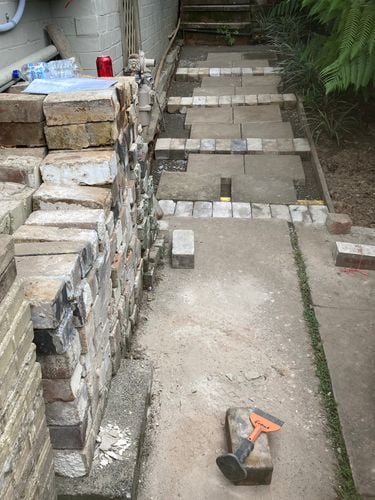
I laid both materials so I could execute the next steps for only the pavers since they needed additional road base. This enabled me to already know where they would be situated and not having to touch them later. During this step I found out that some bricks were shorter than others, which enabled me to select the shorter ones and make a single line of concrete pavers fit exactly at the end of the path.
Step 3: Remove pavers only
I then removed the pavers to expose the areas that needed additional road base.
Step 4: Add road base
I added enough road base to lift the base for the pavers and compacted the area with the hand tamper.
Step 5: Add sand layer
Now I added the layer of sand to the area of the pavers. Since I only had a limited amount of left-over sand I only added 10mm. To screet such a small height I found two lengths of rebar (10mm diameter) worked perfectly as guides.
Step 6: Lay pavers
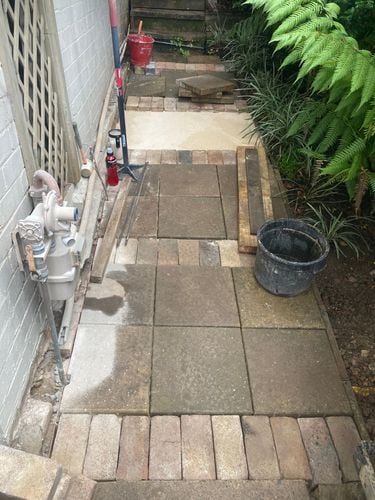
Then I laid the concrete pavers and cut to size where needed.
Step 7: Remove bricks
Now it was time to carefully remove the bricks.
Step 8: Add sand to bricks area
Then I added the same sand layer to the brick area. As the area was small, I used one brick to control for correct height to the pavers on each side.
Step 9: Lay bricks
Now I could lay the bricks and ensure they lined up with the pavers.
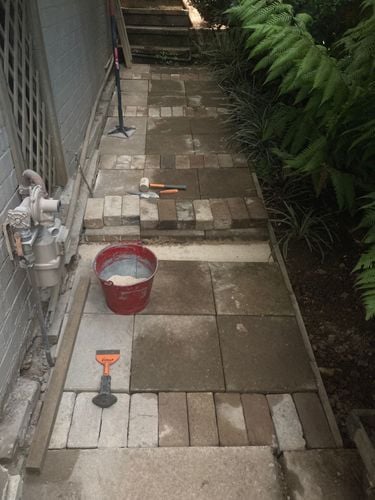
Step 10: Compact entire area
With the hand tamper I carefully compacted the entire path.
Step 11: Apply gap sand
I had half a bag of gap sand left from a previous project which I now distributed across the path. With a broom I moved it around until all gaps looked full. Using the soft hammer, I lightly tapped each paver and brick to make the gap sand fall further down and fill the gap completely, sometimes adding more sand until I was happy.
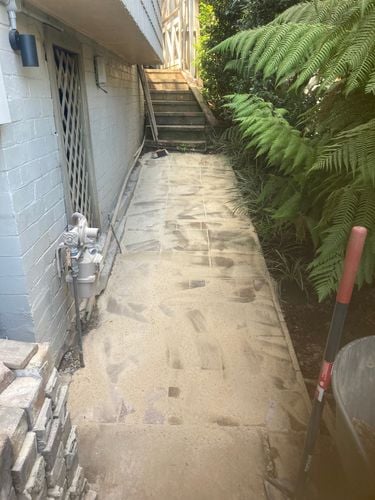
Step 12: Finish
The last step was to sweep the path and then lightly shower the entire area with a mist of water so that the gap sand could bind and harden. Then I blocked the path for two days so this process would not be disturbed.
Et voila. C'est fini.
Tips:
- I found several services (copper water pipe, cable) which I will mark on the edging for the day when they might need to be accessed.
- I used ANL for the road base as they offered a very competitive delivery.
- My sand was dry which made it a bit harder to work with. Ideally, work with moist sand.
- Shower the road base with water once laid. This helps the smaller grains settle in and make it even more compact. (Or use one of those rainy days to work for you)
- Calculate the amount of road base (and sand) you need using one of the online calculators
Tools needed
- Angle grinder
- Hand tamper
- Soft hammer
- Chisels
- Measurement tape
- Sharpie
- Broom
- Shovel or spade
- Bucket to carry sand
- Spirit level
- Safety gear


