Steps
Step 1
Tidy the hole
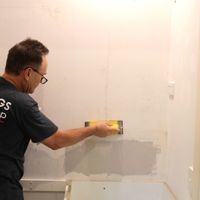
Use your utility knife and straightedge to bring the hole to a tidy, even shape. Remove all waste pieces of plasterboard. If present, use a paint scraper to remove any old stud adhesive from the timber frame and use your drill driver to remove any screws.
Step 2
Measure and mark the hole
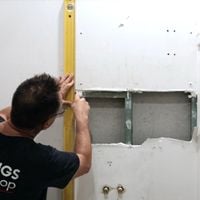
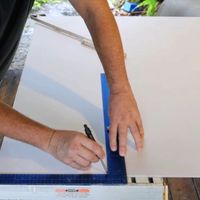
Accurately measure the hole and place light pencil marks on the wall above and below stud locations. Using the builder’s square and straightedge, transfer the measurements to your plaster repair panel.
Step 3
Cut the plasterboard
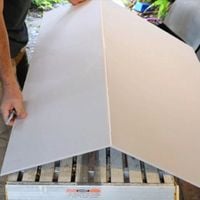
With a straightedge as a guide, use the utility knife to cut along the marked lines. You may need to make a couple of passes. Always cut away from yourself or stand to the side of the cut.
Extend one cut from edge to edge, then lift at this point. Holding the section to be retained, use the utility knife to cut the paper on the board through the open cut. Repeat for the shorter cut.
Step 4
Apply adhesive to framing and fix plaster in place
Use the paint scraper to apply small blobs of stud adhesive to the frame near the top and bottom of the hole and also the middle for larger holes. With the printing on the plasterboard facing inwards, press the cut repair panel firmly and evenly into place.
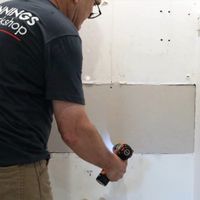
With your drill set to screw and on slow speed, use the pencil marks as a guide to drive screws into frame. Only drive in until the head is just below the surface of the board.

Step 5
Apply jointing tape
Use the utility knife and the razor scraper to tidy up all of the edges.
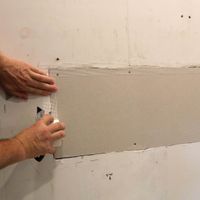
Apply jointing tape evenly across all joins pressing firmly onto the surface. Tape can be folded into corners if needed.

Step 6
Apply plaster to tape
Use the filling blade or joint knife to apply a generous layer of plaster compound over the taped areas. Ensure it is pushed well into all gaps. Allow to set before sanding to smooth.
If required, repeat with a lighter, second skim coat before sanding to a consistent finish.
Allow to dry before painting.
Your repair job is now complete.