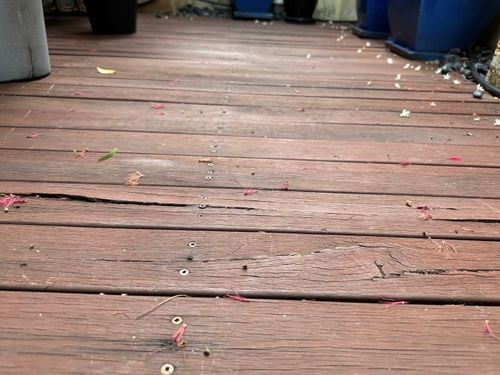
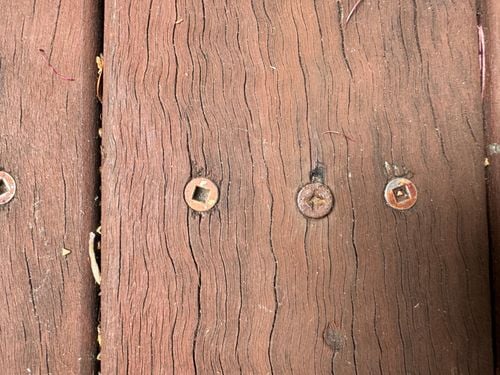
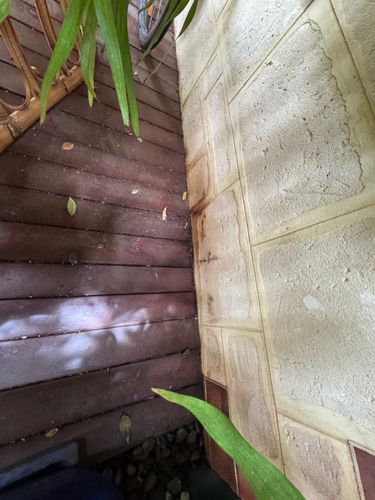
I've got a deck that was installed poorly. It was installed directly onto concrete with jarrah joists that are as thick as the boards. Some segments are only 150 to 200mm lengths of joist supporting the deck. Each place the boards are screwed into the joists only had one screw with not enough spacing between the boards so in winter they would pop the screws and warp the boards. The deck screws of course where incorrect type (not wood screws) and had completely rusted.
I’ve had my house for 11 years now. Initially I removed and replaced the screws with stainless steel deck screws. Some screws snapped when I removed them (it took an average of 5 mins per screw to unscrew so they didn’t snap - I am extremely patient. Haha) so some boards have up to three screw holes where the screws were particularly rusted - one for the snapped screw and two on either side to reduce warping of the wood.
It has gotten to the stage that the “joists” have rotted completely and the screws no longer hold the boards in place.
I was thinking of replacing the deck but jarrah is so expensive and it seems a shame to throw the wood out. Solid jarrah is so hard to find in full lengths (not joined) that I was thinking of restoring the wood if possible.
To restore the deck, I was thinking of purchasing a wood thicknesser from Facebook Marketplace and then on selling it afterwards. And then there are some planks that have wood rot, but I think that the wood thicknesser would remove majority of the rot and remove the distortions. The other thing, he didn't allow spacing between the deck planks, enough spacing. So some have popped and warped quite significantly, but this should be restored with the planer because it’s not too extreme.
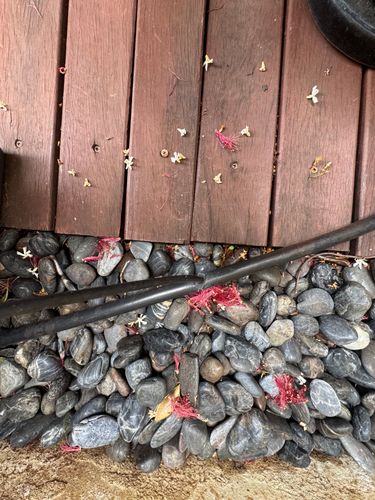
I was thinking of spacing the joist correctly and using aluminum tubing 25mmx25mm on short plastic feet. I’ve seen engineered aluminium with 5mm feet for decks being sold in Australia so it must be allowed. But it’s so expensive. If I do regular feet the tubing should be adequately supported as long as it’s thick tubing. It would still be on concrete. I would make sure the water flows correctly to fix the damp issues against the house and remove the rocks to keep the roots and dirt out of the deck and install a drain. And the feet I could use 5-10mm spacers which will allow space for water to go underneath.
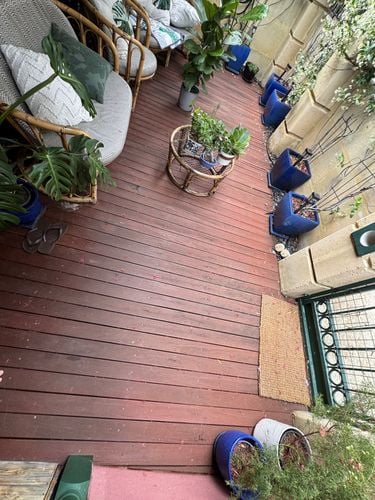
The limiting factor is the height of the area is minimal due to a step and doors opening, so it can only be, 50-60mm tall. So it's not standard, but it's the area that I've got. My house is low heritage listed so the street front is meant to stay the same (local listing not state listing). The deck is 2.2x5m and it’s a small terrace house so very limited in options to run water away or dig down etc. difficult work site due to no space!!
Repairing the wood - because there are multiple plants with too many unusable screw holes - can I drill drilling out the rusted screws/unusable screw holes and putting dowels in to fill them? I probable would need to support these sections if they’re not strong after restoring?
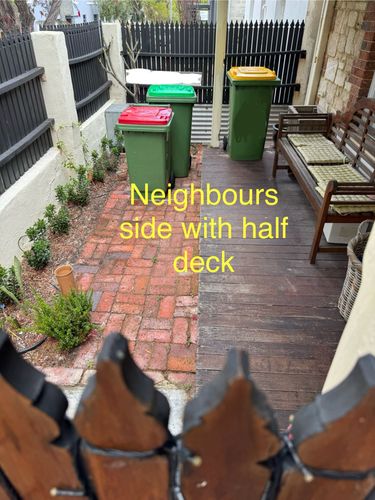
The other option I’ve got is to cut the deck in half so it ends where the veranda finishes like my neighbours does. That way I cut away the planks with multiple holes. But because it’s such a small area I worry it’ll make the space feel smaller.