Our original fan was over 30 years old and getting louder, operating at over 80 dB. Regular cleaning didn’t help reduce the noise, so we decided it was time to replace it with a quieter model that also had a lower profile. Most extraction fans are designed to plug directly into a socket, making installation a manageable DIY project for anyone. The entire replacement process took about 90 minutes, and we now enjoy the benefits of a much quieter fan.
Materials
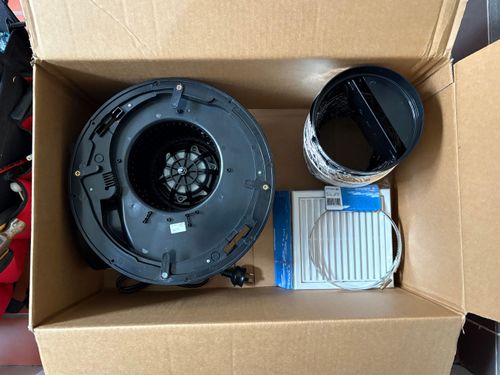
1. Bathroom extraction fan. We decided on a fan with 35 dB and a low profile. We decided on the Fanco Hybrid 250, but Bunnings also has a wide selection.
2. Optional: For external ducting
- Flexible Duct (150mm)
- Metal Worm Clamp (Set of two) 150mm
- Vent Fixed Flyscreen 150mm
Tools
- Screw driver
- Ceiling paint
- Paint brush
Steps
Step 1
 Old unit
 Take off cover and measure
Measure the size of your old fan, and buy a replacement unit with the same cut out size. For us, our cut out was 300mm and we choose a fan with the same size. To measure your fan, remove the cover and measure the diameter directly.
Step 2
 Removing the old fan unit
 Ceiling cut out for fan
 Electrical socket for fan
To remove the fan, start by unscrewing the ceiling clamps to loosen the unit from the plasterboard. Once the clamps are undone, gently ease the old unit down from the ceiling. Once the unit is off, remove the electrical socket. Most of these extractor fans in the older homes are plugged into a socket.
Step 3
 Attaching the ducting
 Place duct in ceiling
 Installing the new fan
 Tighten the clamps to secure
There are several steps to install the new fan.
- Attach the flexible duct to the fan outlet and secure it with metal clamps. Place this ducting into the ceiling cavity.
- Then, loosen the clamps to ensure there is enough room for the thickness of your ceiling.
- Once this is done, you can proceed to insert the new fan into the existing cutout.
- Hold the unit firmly, attach the ducting by pulling it towards the fan, and secure it.
- Plug the unit into the socket, then carefully angle it to fit into the cutout.
- Finally, tighten the ceiling clamps to secure the fan in place.
Step 4
 New fan installed
When removing the old unit, the paint along the edges peeled off. Fortunately, we had some leftover ceiling paint, so we touched up the edges around the new unit for a clean finish. For the ducting, this was a bit more work and we eventually ran the ducting to a external vent near the eaves.


