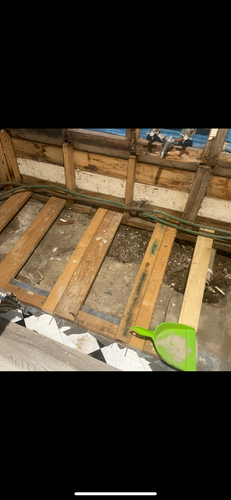
Hello - I have a 1.8 metre length by 850mm wide piece of 19mm Hardie secura flooring sheet to secure onto a bespoke timber frame with “joists” ranging between 150-350mm apart (see image). The timber is very securely fixed over the top of a concrete base, on one side dyna bolted into an existing tile/concrete raised floor and the other side screwed into the timber frame, with solid supports under the middle of each beam where there is between 30-60mm space between timber and the lower concrete floor.
The plan is to use the secura sheet as a flooring layer for a shower, which would then be screeded (plan is to make it a bonded screed) to get the required falls.
Unfortunately the frame isn’t perfectly level and the secura sheet at its full size rocks a bit up and down when I stand on it, most notably in two opposite corners at each end. Given I’ll be screeding leveled falls and waterproofing the top of screed, I’m not overly concerned about perfect subfloor levels but obviously I’d want to give the secura sheeting as level a base as I can, or work around it.
One option is shims or Masonite rods, or any other recommended levelling material on timber, fixed to the frame to level it out. But I’m not sure if that would be recommended for a flooring installation like this, with screeded shower to go on top. I.e would there be a levelling material that comes in versatile and varying thicknesses to be fixed onto timber and wedged between the timber and rest of shower base that would withstand the weight/compressive forces from screeded shower installed on top?
Another option is planing the timbers back using a straight edge to find the areas of concern and flattening. It would be a little difficult to work around the bolts but perhaps could chisel there if needed.
As a third option, I do believe if the board was cut into 3 or 4 smaller length sections and butted up against each other across the length of the frame, the levelling would be much better for each smaller length as the differences causing the levelling issues are minimised across smaller parts of the frame.
Is one option better than the other in this situation?
I think with first two options the process is fairly easy to conceptualise, perhaps more time consuming to execute well.
If I went with the third option. can I butt join those 3 or 4 sections of secura flooring together lengthwise, across a single timber frame of 1.8m length and if so, should I leave any small gap between each section of secura flooring and fill it with flexible sealant? I read James Hardie recommend 5mm butt joint gaps with an 10mm backing rod inserted into the gap. I could do this between each section but it does seem excessive for my situation as I’m not sure I’d want to have potential movement joints of that size beneath my screed and tiles and I wonder if I’d be better just leaving a small 2mm gap between each and sealing those smaller gaps purely for waterproofing purpose.
Also would I need to treat any lippage that may arise at the butt joints due to levelling differences and how would I do that if needed?
thanks for your help!


