Steps
Step 1
I drew up a rough plan 2100h x 500d x 832w and worked out what pieces I'd need, breaking it down into 2 sections - base cabinet with drawers, then sides and top section separate.
Using the cutlist optimizer again, I was able to maximise how many pieces I could get out of each sheet of Melamine.
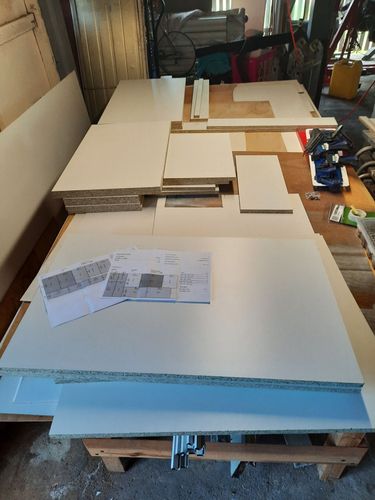
 One of my cut lists
Step 2
My first step was to assemble the base cabinet and drawers and add the iron on edging to dress the edges. For something different, I chose black to do the edges of the drawers and shelves. I would've done all the edges in black if it wasn't so expensive. Bunnings no longer sells it so I had to source the black one from Ebay.
 Base cabinet assembly, working solo, ratchet straps helped hold it together
 So much ironing!
 Adding drawer slides
 Fitting drawers
 Adding film to top to cover fixings.
I originally had the base the same size as the top then replaced it to create a ledge for the cabinet walls to sit on.
 Ironing on black edging for drawers
Step 3
With the base cabinet ready to go, I got the walls and top ready and 2 braces for the back. I forgot to take a photo of the braces being fitted, my first time using a pocket jig too! I didn't want any screws visible from outside the cabinet so screwed everything from inside.
 Holes drilled for adjustable shelving
 Sides screwed to base cabinet from inside with white cabinet screws
 Assembled and attached to the wall at the side and back
Step 4
I'm so glad I used the adjustable feet. The wall wasn't square to the floor so when I went to fit the drawer faces and doors, it was obvious I needed to adjust them. I removed the screws holding the back to the wall but left the side ones in, adjusted the feet until the unit was square (5mm), then re-screwed the back to the wall.
With everything put together, I finished off with kickboards to hide the legs.
 No special holes needed for these hinges and adjustable
 Drawer face clamps from Temu helped to line up faces before attaching them.
 Nice deep drawers
 Adjustable shelves
 Completed unit
Step 5
This corner of the laundry had a sliding back door which we removed (had hubby's help for that job) and converted to a hinged door for better security and a more useful corner. I finished off the wall area to be able to fit the cupboard.  Before with wonky small cupboard
 Space widened for door way
 Wall filled and painted, doorway not yet finished