Workshop
Ask a question

The Bunnings Workshop community can help with your home improvement projects.

How to construct a stud wall in a wet area?

Mark76
Just Starting Out

How to construct a stud wall in a wet area?

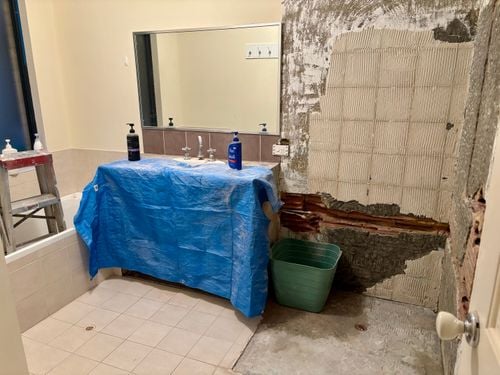
I’m doing a full bathroom renovation at the moment due to several
IMG_5541.jpeg

bad water leaks in an old house. I need to build 2 small walls as part of the work. I’m in WA so my house is brick, brick, brick everything. I was going to just do it out of fastwall bricks till a plumber suggested a stud wall would be way easier and quicker 👍🏻

My questions are, what type of timber H2 or H3 etc should I use in a wet area, what do I clad it with to then tile over and what about waterproofing, it is the same as I would do normally if it was brick and render? 
Any help would be appreciated, many thanks. 

JacobZ
Bunnings Team Member

Re: How to construct a stud wall in a wet area

Hi @Mark76,


Welcome to the Bunnings Workshop community @Mark76 . It's fantastic to have you join us, and many thanks for your questions about constructing a stud wall in your bathroom.


Typically, bathroom walls are framed with the same H2 timber that the rest of the house is. This is because in direct wet areas, the framing will be protected from moisture through the application of a waterproofing membrane.


In saying this, H3 timber can be used, but if water did find its way into the framing, due to the lack of ventilation, it wouldn't stand up all that much better than H2 would. Weighing up the cost of one against the other, considering this, would be my approach to selection.


Whichever framing you choose to use, I would suggest the underside of the bottom plate is covered with plascourse to prevent moisture wicking up through the concrete slab into the timber.


Once the wall is constructed, you would use Villaboard FC Lining, which is a moisture-resistant fibre cement sheeting that is standard in bathroom applications with tiled walls. Have a read through the Villaboard Lining Installation Guide and Wet Area Construction Application Guide; they will give you all the information you need. If you require any clarification on the installation process, please don't hesitate to ask. I am more than happy to help.


Waterproofing would be much the same as it would be with brick. You'll want to have a read through the National Construction Code Part 10.2 Wet area waterproofing. If there is anything you are not sure about, please let me know so I can assist further.


If you have any other questions, don't hesitate to ask.


Jacob


Why join the Bunnings Workshop community?

Workshop is a friendly place to learn, get ideas and find inspiration for your home improvement projects