The Bunnings Workshop community can help with your home improvement projects.
Hi guys,
I need to convert this corner shower 870mm into a walk-in shower. Could you please advise how to do so?
The bathroom has dimensions L2495 x W1795, bathtub L1620 x W725 and vanity 600mm.
Is it possible to leave the tiles? Or do I have to demolish the tiles, rewaterproof and re-tile? I am trying to make it the most economical way possible.
I'll replace the vanity with a slim wall hung vanity L600mm x D385 x W330.
Do you think an 800mm or 900mm frameless glass panel is better? The 900mm frameless glass panel effectively avoids water splash, but a very chubby person may struggle to get through the vanity and the shower screen.
Thanks
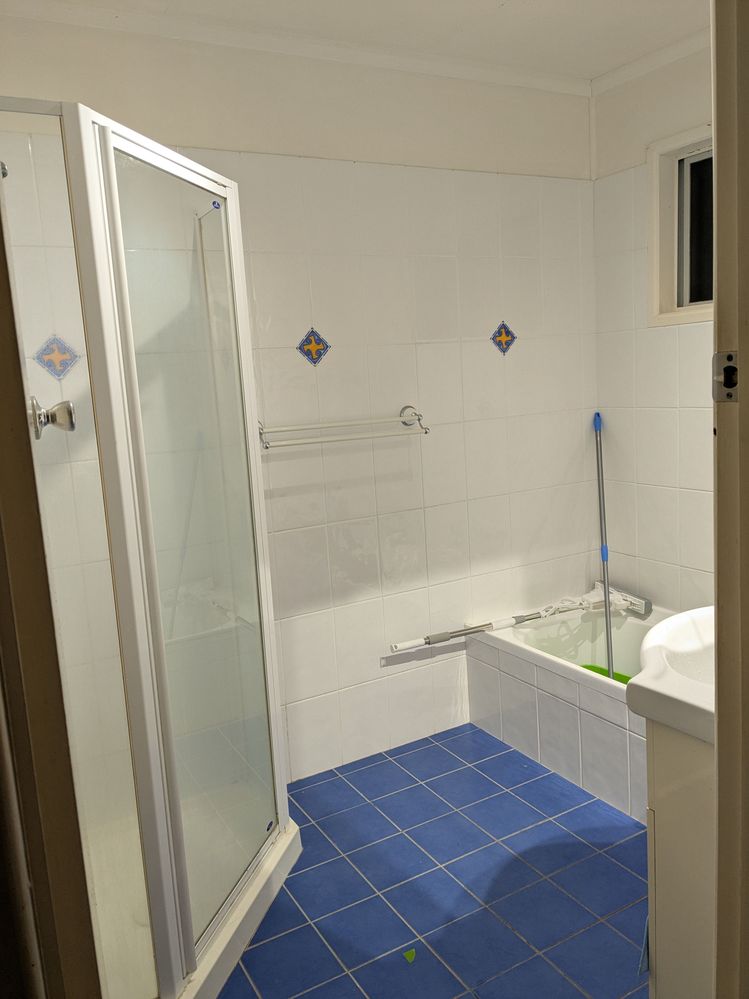
Hello @Beginner20
My apologies for the late reply. Your analysis in regards to the bathroom renovation is correct. The tiles will need to be removed and waterproofing reapplied by a qualified contractor. It's important that there should be enough of a gap between the vanity and the glass and if that means using the 800mm panel then that's what you'll have to go with. I see nothing wrong with using a 600-wall hanging vanity, it should fit nicely in the space provided. My best advice is to use a chalk marker to indicate how far the glass panel will be and the footprint of the vanity. You'll get a clear idea of just how much space you'll have between the vanity and the shower panel.
If you have any other questions we can help with, please let us know.
Eric
Hi @EricL
I washed the bathroom floor with water yesterday and the water seeped through the timber floorboard on the first floor down to the ground floor
Looks like the builder didnt waterproof the bathroom when they built it ![]()
Fortunately, the asbestos was removed from the ground floor ceilings and walls so i can fix the water leak issues before installing the plasterboard on the ceilings.
1. What are the best ways of preventing the water leaks to the ceilings on the ground floor in the future?
I am thinking of ripping out all the tiles and waterproofing the bathroom floor.
2. Is it worth installing a vapour barrier on the ground floor ceilings as a second layer of waterproofing? or
3. Is waterproofing the bathroom sufficient to fix the issues?
Thanks
Hello @Beginner20
I'm sorry to hear that the bathroom floor is leaking. Generally speaking, I don't advise putting any waterproofing on the ceiling as it often serves as an indicator if any leaks may be occurring in your ceiling. Adding a waterproofing membrane could cause more harm as you will not know about the leak until it has become too late and the damage has become quite extensive. By seeing the damage immediately to your ceiling board, you'll know straight away that something is going on.
Because water has penetrated down to your ground floor ceiling, odds are that there is a leak, but how extensive it is can only be determined by removing your tiles to see where the waterproofing has failed. Please keep in mind that this is an extensive repair as all the appliances in the bathroom will need to be removed along with all the tiles in the bathroom. Waterproofing is applied as a single homogenous layer and must be installed by a trained and registered agent as it will need to be sighted and signed off.
Once the new waterproofing has been applied to the bathroom it should fix the leaks occurring below.
Let me call on our experienced members @Dave-1 and @Nailbag for their recommendations.
If you need further assistance, please let us know.
Eric
Good Afternoon @Beginner20
😕 That is a pain with the water seeping downstairs. As @EricL has said it indicates a leak. There isnt much point in repairing the ceiling tho until your leak is sorted.
-The tiles will have to come up whichever way so I would start off the reno by getting soem quotes for redoing your bathroom.
-You will need to make sure its waterproofed properly and a certificate of waterproofing is issued (you cant just waterproof it yourself) for insurance purposes.
-Leveling the bathroom before the tiles, tiling and how far up teh wall you want plus types of tiles will all have associated costs. I would suggest a plain style of tiles, possibly white as they age decor wise less then say current tile types.
-When going through your design think of light fittings/powerpoints and where they are. There is a limit on how close they can be to a water source.
You have some leeway, your existing base is waterproof so its not urgent that you rip your bathroom apart. Possibly you could go for another stand alone shower base and walls. I am not sure if that is possible or wise. (If you have tiles under yoru existing shower then "hands go shrug" I would certinaly have a talk to a builder/bathroom center to ask what is possible as it will be more accurate as to the larger base replacing the corner base) Note that it still leaves the issue of water penetrating the tiles when youw ash the floor.
A hard call 😕 but some quotes, drawings and ideas will help step you through the process.
Dave
Hi @Beginner20
I would agree with all the comments already made by both @EricL and @Dave-1
The first thing to establish the extent of the water damage. If you can get under the floor then thats the idea place to start. The fact your renovating is a great opportunity to repair/replace the highly likely rotted joists and possibly bearers, but unlikely there. If you can get under the floor, you will have access when the tiles and shower is removed and the floor taken up. The back walls behind the shower to the extent of the proposed new shower also removed.
Once the rotted timbers are replaced, the floor will need to drop at least 20mm where the new shower is to go to cater for the walk in. Buy your new tap and shower rose as these will have back of wall fittings for the plumber to install before the walls go back on.
Also speak to your tiler, who I highly recommend you get as walk in floors unless your a real good tilers and can make deadly accurate cuts, will be a huge challenge. at this point they can give you any further information.
I also recommend getting a tiler who is also a certified waterproofer. This way it's guaranteed to be done correctly and the same guy is tiling accordingly. You will need to talk to him also about the type of drain you want, which the plumber will need to know as well.
From someone who has done several bathroom rebuilds, it's vital to get a full or even part reno done correctly or it could come back to bite you.
Nailbag
Thanks @Nailbag @EricL @Dave-1
I am getting some quotes for waterproofing and tiling.
Surprisingly, all the joints and bearers are fine - no wood rot! ![]()
Now, there is another issue ![]()
The timber floorboard was installed directly on the joints and bearers without any protection layer and the water can seep through the gaps into the ceiling downstairs.
1. Are there ways to waterproof the timber floorboard and its gaps? I have 2-3mm gaps
2. Can I install the plasterboards on the ceilings downstairs now and fix up the bathroom/toilet water leaks later as I am trying to get one bathroom completed before renovating another one so I'll have at least a functional shower and a toilet?
Thanks
Hi @Beginner20,
The standard method of waterproofing over timber floorboards is to lay James Hardie Ceramic Tile Underlay over the timber floorboards and then waterproof over it before tiling.
I probably wouldn't put plasterboard on the ceiling before any leaks are dealt with, as if water leaks and sits on the plasterboard, it can be damaged and would be completely wasted material. You are far better off leaving it open until you are confident there are no leaks.
Let me know if you have any further questions.
Jacob
Hi @Beginner20
I agree with the advice by @JacobZ in getting all the water ingress issues sorted before starting anything else.
Having said that, you could get the plumber to temp install a toilet even with all the internal walls open. It's a quick job. For the shower, you could consider a portable camping one, even a 2nd hand one. They are not too expensive and maybe a good temp solution. My sister's family of 4 set mine up for about 3 weeks during her major renovations.
Nailbag
Thank you @JacobZ and @Nailbag
This 50-year old house didnt have any water leak issues (i.e: no wood rot, leaked ceilings nor moulds downstairs) until I moved in and washed the toilet and bathroom floors with water - I like a very clean floor!
I guess I'll have to mop the floors ONLY from now on lol
As long as I dont pour the water on the bathroom and toilet floors, it'll be OK for now.
The toilet upstairs has just got installed a few days ago by a plumber which leads to all these new discoveries.
The toilet walls have asbestos. Do I need to remove all the asbestos walls before pulling out the floor tiles and waterproofing the walls etc?
Workshop is a friendly place to learn, get ideas and find inspiration for your home improvement projects
We would love to help with your project.
Join the Bunnings Workshop community today to ask questions and get advice.