The Bunnings Workshop community can help with your home improvement projects.
Hi,
I have a potential slow shower leak manifesting as bubbling paint in the ceiling below our bathroom shower.
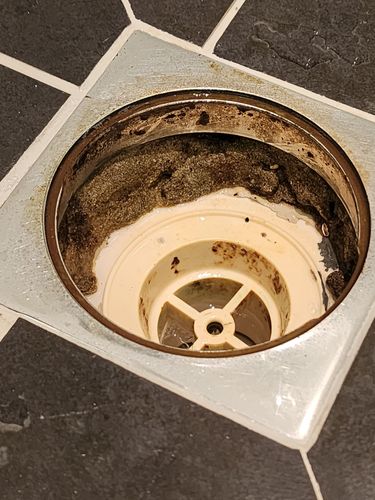
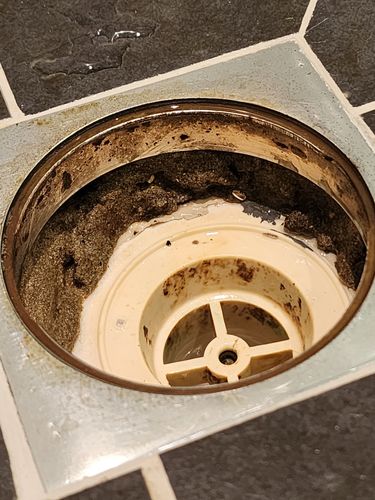
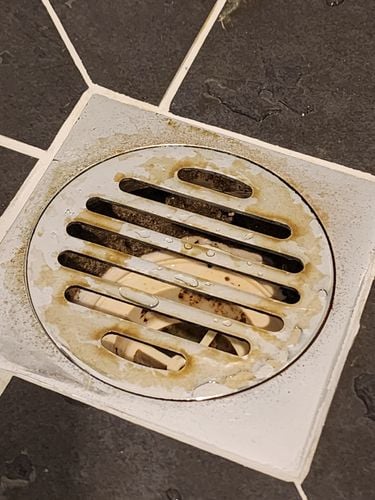
Today, a shower leak repair service inspected and said the builder who did our bathroom has not installed the shower drain properly. The white drain should be up to the level of the tiles without the cement screed visible. He thinks that water may be tracking through the cement potentially under any waterproofing. He found that the grouting and silicone all looked good so he doesn't think they are the cause. A plumber who was also present fixing other things agreed that the shower drain should not have been installed like this. He said short of redoing the entire shower I needed to find some way of making the water flow directly into the centre of the white drain without going onto the cement. He didn't have any ideas of funnel shaped pipes to achieve this.
I am scouting for possible fixes. One idea that came to my mind was to use an epoxy putty eg Selleys Knead It Aqua or PC products PC Marine Epoxy putty to mould all the way around from the lip of the metallic shower waste, just below the grate, almost like a funnel to just inside the raised ring of the white shower drain.
Could this be a fairly watertight solution between the waste and the underlying drain that stops water tracking into the cement? Can I assume the putty to be watertight when dry? While this is a potential cheap DIY fix, would any of this potentially make things worse?
Welcome any ideas.
Hello @Binkybill
Welcome to the Bunnings Workshop community. It's sensational to have you join us, and thanks for sharing your question about your shower leak.
Just a friendly reminder that any plumbing work must be carried out by a licensed plumber for safety and compliance.
The answer to your question on both products is yes, Selleys 50g Knead It Aqua Epoxy Putty and PC Products 57g PC Marine Epoxy Putty are waterproof. Will it seal the leak? Perhaps, I can't give you a 100 percent leak free guarantee. But since you are not yet ready for a full-blown renovation and repair, I can only propose testing the epoxy putty around the area. Since the product will dry hard and solid, I don't see it causing any harm to your current plumbing set up.
Let me call on our experienced members @Dave-1 and @Nailbag for their recommendations.
If you have any other questions we can help with, please let us know.
Eric
Hi @Binkybill
Interesting the plumber said you need to find a solution. I guess he doesn't want to do a repair he can't guarantee will work.
If you decide to go down the path of a DIY repair with an epoxy filler, I would provide another layer of protective coating with a waterproofer thats designed for constant water immersion. but then there is still no guarantee it's going to work. And the last thing you want is ongoing internal water ingress which has the potential for an even more invasive and expensive repair to the lower level.
To repair the lower level ceiling a section of the plasterboard needs to be removed and replaced. Having this section out will allow you to see the extent of the internal damage and actual source. I would leave this open for some time after you have done your DIY fix to the shower drain as it will give you the only visual way of knowing if you were successful.
Nailbag
Hi @Binkybill,
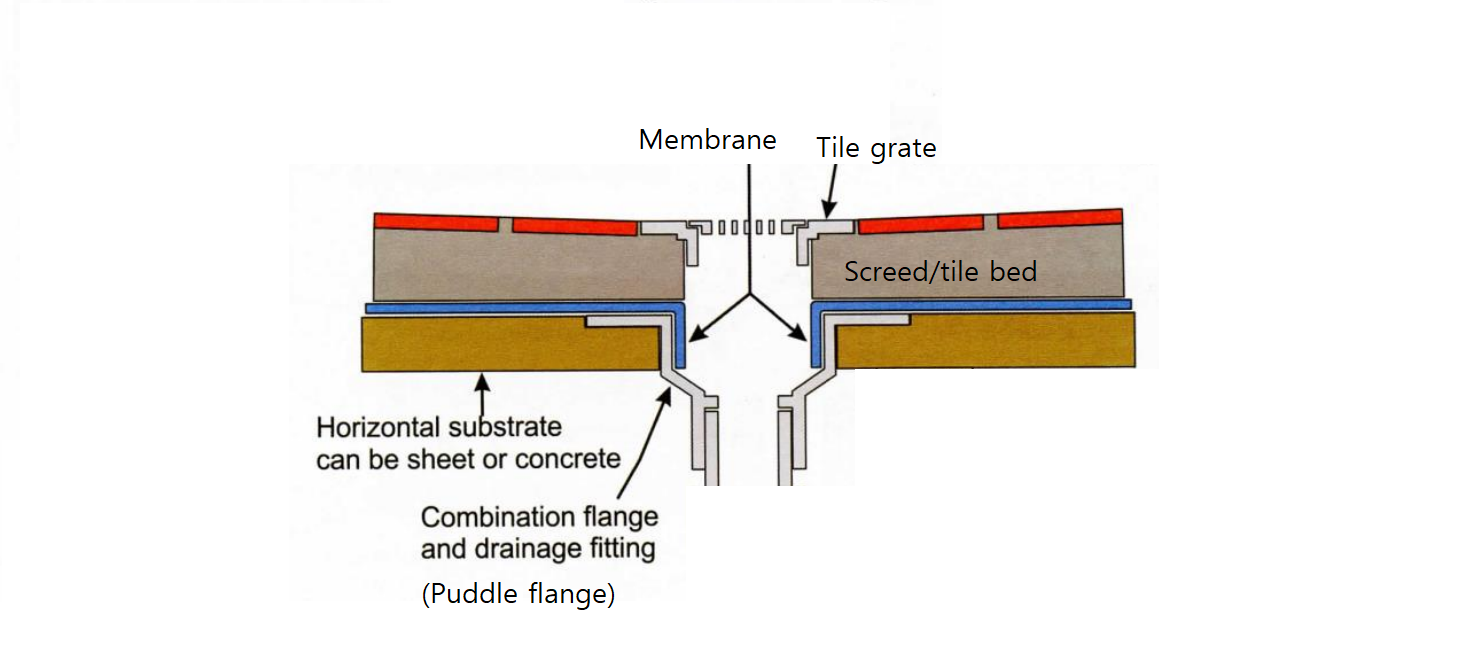
I'd get a second opinion from a waterproofer. I don't believe that is correct, but I'd be happy to be wrong. The puddle flange goes on the bottom, where it is with the waterproofing membrane, and then the screed/tile bed. The screed is a wet layer as moisture passes through the grout, down through the screed, hits the waterproofing membrane, travels along it and into the puddle flange. If the puddle flange (white drain) was at the same level as the tile, then the water draining down through the grout into the screed would not be able to enter it.
I'm sure there are drains these days that are designed to sit flush with the tiles and then have a secondary port lower down to capture water that hits the membrane, but in your case, I think it is installed correctly as per the diagram below. Further to this, you cannot seal between the tile grate and the puddle flange, as this would prevent the water collected on top of the membrane from entering it. You'd stop the membrane from doing its job, which is to collect and funnel the water to the puddle flange.
This doesn't mean there's no leak, the membrane could be compromised, but it's not at the point where you see exposed mortar/screed/tile bed. Water should be able to go in and out of there without causing issues.
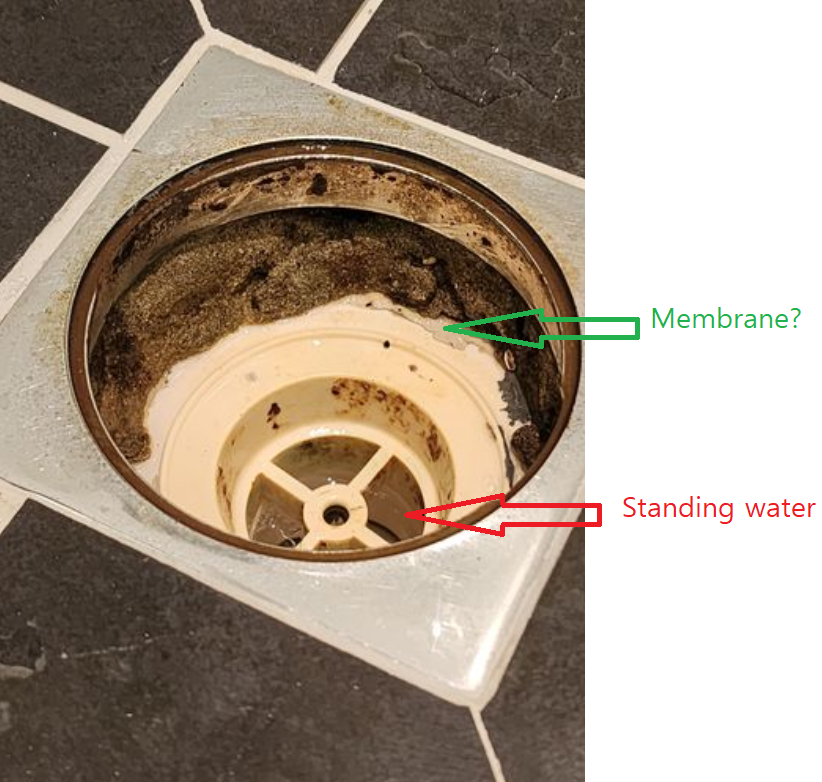
What I do note is you have standing water in the puddle flange. Was the leak detectorist running a test at the time of the image? You shouldn't be able to see water sitting there like that. It should be lower down out of sight in the trap. If water is standing that high up, it could be finding its way out of the pipe joint, below the puddle flange and into the ceiling below.
Please let me know if you have any questions.
Mitchell

Good Morning @Binkybill
With @MitchellMc diagram, thats how I thought the bathrooms waterproofing was laid out. As I was going through the thread and taking on board the decriptions I had that scrunched brow look. I was thinking If there is paint bubbling , how long has it been bubbling for in the room below. How much water seems to be leaking? @Nailbag 's suggestion of removing the plaster for a period to verify where tghe leak is makes sense.
I generally suspect waterproofing has failed in some kind of way. If you block off the screed as you are thinking that may cause even more of a build up and focus of teh water through whatever other hole in the waterproofing there is. I would probarlly remove teh plaster where the leak is below as a first step and then monitor to note where the water is coming from as a second step.
Dave
Thanks for your helpful diagram. The waterproofing membrane could be below the screed and perhaps in this case what I proposed might not help. I can't see the waterproofing membrane though and all the people who have come to look at it so far all say it has not been installed correctly. The water leak very minor, only noticeable that the ceiling surface has started to bubble a bit and is uneven. Some advice so far that we need to lift all the tiles, re-waterproof and fix the puddle flange. That would be very difficult as we don't have replacement tiles and some of them are non-standard in size.
Hi @Binkybill,
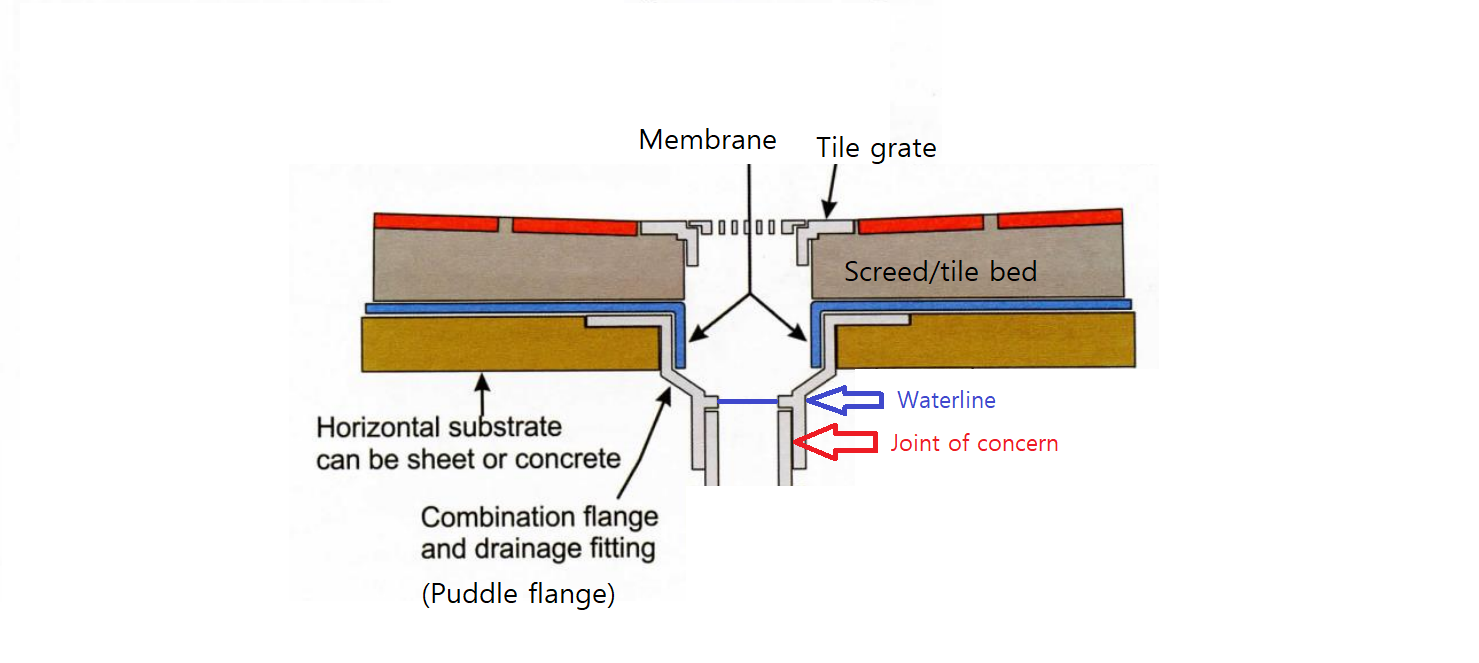
I've marked in the image below what could be the membrane and also what appears to be standing water in the vertical pipe. Do you have any idea why the pipe is full to the top? I'll also include a blue line on the cross-section diagram to show you where that water line is. If the joint is submerged, water can enter the ceiling.
My priority would be determining why the water is standing there in that pipe.
Mitchell


Hi MitchellMc,
Thank you for your informative posts and diagrams.
I have an update. The leak is definitely coming from the drain. I bit the bullet and made a hole in the ceiling below the bathroom to investigate.
Firstly, how the drain pipe from the shower goes is that firstly there is almost a 1m stretch of almost horizontal pipe, then a 90 degree turn and then a fall of about 15cm over 1.5m to a central floor waste. Our drain easily becomes blocked after a while so often so that we routinely have a plunger nearby. I would guess that there is general debris and soap scum particularly along the horizontal component that makes it drain very slowly. However I can see that water does flow and enter the vetical pipe of the central floor waste. I could get a pipe cleaner to try to clean this out. Importantly we have stopped using that shower and whilst the water continues to sit in that drain, it hasn't continued to leak.
Here is a video of when I turn on the shower. https://youtube.com/shorts/qohEGgCoWg8?si=-iQnvobz6jjZElDi
I suspect the waterproofing is not working at the drain. It is leaking around the drain into the ceiling space below. Seems to be both in front of the camera and on the other side.
I have consulted a few shower sealing businesses before I did this. Two did indeed suspect the drain though none bothered to investigate like me. One has said they would need to remove all floor tiles and first row of wall tiles, remove tile screed, refit proper puddle flange and waterproof and retile, and epoxy regrout. The difficulty is we do not have sufficient spare tiles for this and would need to use similar tiles. The cost of just moving the shower screen is almost half the cost of a new one.
Which brings me back to my original thought. Is it worth trying as per my original post to putty up the sides of the drain completely around 360 degrees. In your diagram this would be from the tile grate to inside the flange near the raised lip in my original picture. I would only try this as a nothing to lose remedy before calling in the experts if it didn't work.
Hi @Binkybill,
I see no harm in using a product such as PC Products PC Marine Epoxy Putty to attempt to block the sides of the drain, as long as you are aware that it may not resolve the issue.
If you would like to try this, you'll want to fully cover the screed layer, as water can seep through it.
Give it a try and reinspect. The worst that can happen is that you have to call in the professionals for a more in-depth solution.
Jacob
Workshop is a friendly place to learn, get ideas and find inspiration for your home improvement projects
We would love to help with your project.
Join the Bunnings Workshop community today to ask questions and get advice.