The Bunnings Workshop community can help with your home improvement projects.
Hello friends,
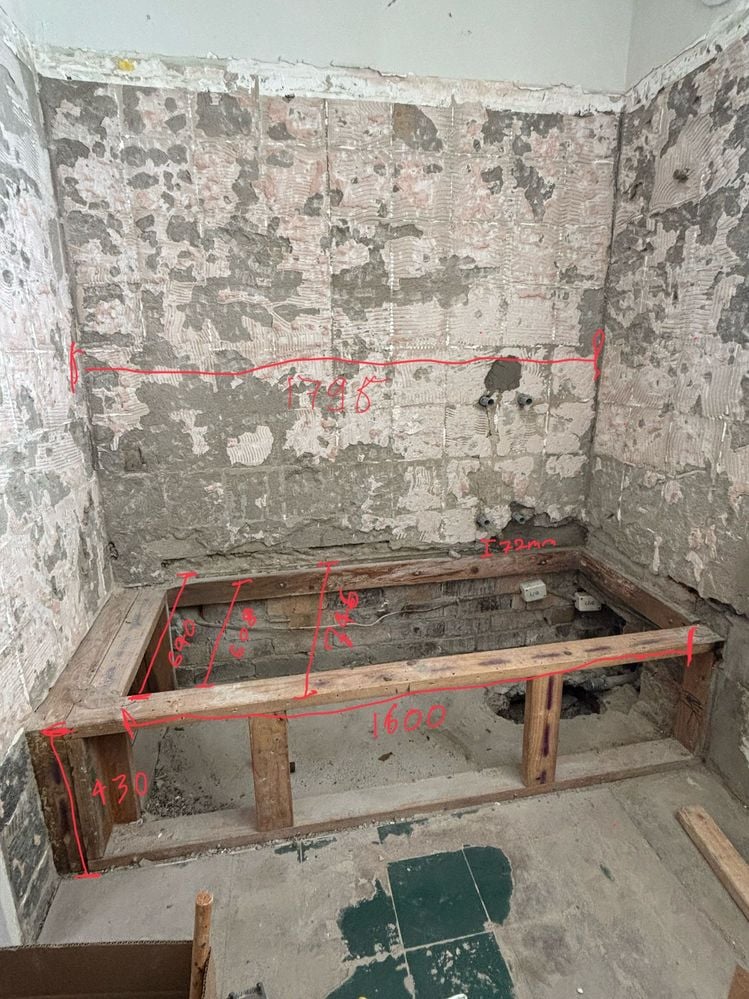
I successfully removed the concrete bed under the old bath , without damaging the slab, with the help of some workshop members' advice. I'm back for some help with trouble shooting how to install the new bath. The pics attached show the measurements of the existing bath frame which I was hoping to re-use. I have a bath chosen that fits but I am not sure how to get it into the frame. I can't drop it in because of the tap fittings. There is not enough space to angle it in from the far end. There is not enough room to angle the far lip of the bath under the tap points and then drop it in either. The conclusion I have come to is that I need to remove the whole front side of the frame, slide the new bath in onto a fresh cement base and then immediately position a new, pre-prepared frame on the front side before filling the bath (in this case weighting it down with buckets of water). The bath I want to put in is 1700mm long x 700mm wide at the top. The tub part is 570mm wide Thoughts? Advice? Things I haven't thought about?
Anyone worried about waterproofing I will install waterproof angles around the three sides prior to installing the bath, and pre-install an angle on the pre-prepared outward facing replacement frame.
Thanks friends ![]()
.
Hello,
Still progressing my bath tub install. I have removed the frame front in the way you suggested and have everything pre-drilled ready for a a quick install once the tub is in. I have also levelled the walls and ensured the frame and bath will allow for render and tile. I am now attaching villaboard on the top of the frame front and the left side where the render and tile won’t overlap the bath flange. I will attach to the front of the frame once installed. I have a few question about attaching the villaboard.
1. I know that for a timber frame I can use galvanised fibre cement nails - is there any problem if I use galvanised fibre cement screws? I already have some of these and don’t want to buy nails if the screws will do the job.
2. I know I need to silicon the screw heads to not compromise the waterproofing. Do I need to cover the screw heads with anything else so that when the waterproofing membrane is applied it won’t be compromised by the screw heads/nail heads? I have read I can use joint compound..? Will that work?
3. When joining the villaboard at a right angle (front of bath frame (vertical) and top of bath frame (horizontal) should the two sheets of villaboard meet flush? I.e one doesn’t overlap the other?
Cheers
Hello @crisis
As much as I would like to say yes to the use of galvanized fibre cement screws, I can only suggest what the manufacturer has recommended and that it is to use fibre cement nails. Their big flat heads provide superior holding power. I'm not aware of any extra compound you should use on the nail heads and therefore recommend not using any unless specifically instructed by the installation manual. The Villaboard panels must not meet flush but be left with a 2mm to 3mm gap.
Let me call on our experienced members @Nailbag and @AlanM52 for their recommendations.
Here is a link to the Villaboard installation manual: Villaboard Lining Installation Guide
Here are some handy step-by-step guides:
If you have any other questions we can help with, please let us know.
Eric
Hi @crisis
1. It's recommended you use cement sheet nails as this will sit flush without the need to countersink the heads which will compromise each fastening point. Otherwise there is a specific gal screw for cement sheet that drives in flush.
2. No need to apply any silicone over each nail head. The waterproofing process of tapes, and compounds will do this.
3. I have always (possibly right or wrongly) stopped the two intersecting sheets to their inside corner edge so not overlapping but also not leaving a specific gap there than the edge not being perfectly straight. Basically the same as when hanging plasterboard to external corners. But @EricL has mentioned they shouldn't and a gap of 2-3mm should remain. I couldn't find that information in the document he linked. But if @EricL can direct us to that section then thats definitely how it should be done It. Metal external edging covers the corners before waterproofing
Nailbag
Yes thats correct @crisis
Hello friends @Nailbag @EricL @@and whoever else may be reading this. An
update and another question on my bath install. I have successfully added cement sheeting to the top of the frame and happy to say everything is level. I put the bath in as a dry run to check everything and the bath is not resting flush on the frame. It is resting at the ends but not in the middle and it seems the edge of the tub bows upward I.e it is the tub not the frame. I removed the bath and put a level on the underside of the flanges and sure enough it isn’t level.
Any idea if this is normal or a fault with manufacturing and I need to change the tub?
Hi @crisis
Different manufactures and price-points will determine this type of error, but it's likely this is within tolerance. Just remember there will be a silicone sealant to go around once in its final position resting on the tiles. Give the manufacturer a call and get their opinion to make the call. Worse case just put a thin packer underneath.
Nailbag
Thanks @Nailbag I did wonder about tolerance i will give the manufacturer a call . Is it not an issue that the tubs weight isn’t fully supported by the frame? I was worried about tub movement and impact on tiling.
Workshop is a friendly place to learn, get ideas and find inspiration for your home improvement projects
We would love to help with your project.
Join the Bunnings Workshop community today to ask questions and get advice.