Workshop
Ask a question

The Bunnings Workshop community can help with your home improvement projects.

How to level shower subfloor for Secura sheet flooring?

sheldo
Cultivating a Following

How to level shower subfloor for Secura sheet flooring?

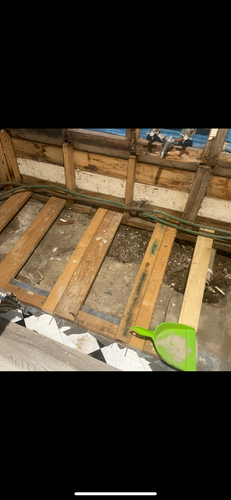
IMG_5238.png

Hello - I have a 1.8 metre length by 850mm wide piece of 19mm Hardie secura flooring sheet to secure onto a bespoke timber frame with “joists” ranging between 150-350mm apart (see image). The timber is very securely fixed over the top of a concrete base, on one side dyna bolted into an existing tile/concrete raised floor and the other side screwed into the timber frame, with solid supports under the middle of each beam where there is between 30-60mm space between timber and the lower concrete floor. 

The plan is to use the secura sheet as a flooring layer for a shower, which would then be screeded (plan is to make it a bonded screed) to get the required falls.


Unfortunately the frame isn’t perfectly level and the secura sheet at its full size rocks a bit up and down when I stand on it, most notably in two opposite corners at each end. Given I’ll be screeding leveled falls and waterproofing the top of screed, I’m not overly concerned about perfect subfloor levels but obviously I’d want to give the secura sheeting as level a base as I can, or work around it.

One option is shims or Masonite rods, or any other recommended levelling material on timber, fixed to the frame to level it out. But I’m not sure if that would be recommended for a flooring installation like this, with screeded shower to go on top.  I.e would there be a levelling material that comes in versatile and varying thicknesses to be fixed onto timber and wedged between the timber and rest of shower base that would withstand the weight/compressive forces from screeded shower installed on top?


Another option is planing the timbers back using a straight edge to find the areas of concern and flattening. It would be a little difficult to work around the bolts but perhaps could chisel there if needed.


As a third option, I do believe if the board was cut into 3 or 4 smaller length sections and butted up against each other across the length of the frame, the levelling would be much better for each smaller length as the differences causing the levelling issues are minimised across smaller parts of the frame.


Is one option better than the other in this situation?

I think with first two options the process is fairly easy to conceptualise, perhaps more time consuming to execute well.


If I went with the third option. can I butt join those 3 or 4 sections of secura flooring together lengthwise, across a single timber frame of 1.8m length and if so, should I leave any small gap between each section of secura flooring and fill it with flexible sealant? I read James Hardie recommend 5mm butt joint gaps with an 10mm backing rod inserted into the gap. I could do this between each section but it does seem excessive for my situation as I’m not sure I’d want to have potential movement joints of that size beneath my screed and tiles and I wonder if I’d be better just leaving a small 2mm gap between each and sealing those smaller gaps purely for waterproofing purpose.


Also would I need to treat any lippage that may arise at the butt joints due to levelling differences and how would I do that if needed?


thanks for your help!

JacobZ
Bunnings Team Member

Re: How to level shower subfloor for Secura sheet flooring?

Hi @sheldo,


Thank you for your question about installing Scyon Secura flooring in your shower.


With any wet area like this, minimising the number of joins is in your best interests as they are a weakness that water may find its way through. For this reason, I would eliminate the third option as you are adding unnecessary joins that could cause issues in the event of a membrane failure.


The timber frame looks like it will work, but if there is any bounce in the middle of the joists, I would suggest adding some window packers underneath them to support and reduce any potential bounce.


I would then suggest you follow the instructions in How To Level a Subfloor to identify and plane back the high spots. If you need to temporarily remove the fixings to do so, then this would be advisable to remove the risk of damage to the planer.


You should then identify the low spots and use 3mm Hardboard Masonite Packers or a series of window packers to raise the level.


This will be more time-consuming, but it is your best option long term.


It's also worth mentioning that, as waterproofing and plumbing are licensed industries, with strict requirements around their practices, you will require the assistance of a suitably licensed plumber and waterproofer later on, so it is worth communicating with them early on to ensure everyone is on the same page and the installation is up to code. They will be able to attend the site to advise you on any nuanced things that are not immediately evident through photos alone.


Allow me to tag @Dave-1 and @Nailbag for their thoughts.


Let me know if you have any further questions or concerns.


Jacob


Dave-1
Community Megastar

Re: How to level shower subfloor for Secura sheet flooring?

Good Afternoon @sheldo 

Looking at your photo and the description and seeing the timber that you have used across the floor I am thinking of pulling up the smaller ones and replacing them with different height ones. I was going to suggest to bolt new ones at the right level height to the existing ones but the boards look around 40mm thick?


I would mark a level line that you are happy with, pull up the high point timbers and also the low ones, replace with hardwood beams. It might sound like a lot more work but trying to compensate for the uneveness will probarlly cause more headaches.


Dave

sheldo
Cultivating a Following

Re: How to level shower subfloor for Secura sheet flooring?

Thanks both @JacobZ and @Dave-1 for those useful suggestions. I’m going to use a bit of a hybrid approach of both. I picked up some window packers and will pull up the pieces attached to the bottom plate of house frame and pack with window packers to required height before reattaching. There’s a stepped section in the bottom plate which causes a couple cross laid timbers to sit higher, so I’ll lift those also from the bottom plate too and install a false bottom plate right next to them that sits a little lower to fix the impacted cross pieces on. On the floor side there’s just one small section I’ll need to lift and pack and reattach and then leaves minimal places where I’ll need to use some window/masonite packing fixed directly on top of the timber. I have some of these deck supports to install in the middle of the cross section timber pieces to support them and prevent bounce (a deck support on each side of the timber pieces).

Why join the Bunnings Workshop community?

Workshop is a friendly place to learn, get ideas and find inspiration for your home improvement projects