This is a complete overhaul of our early 90’s colonial style laundry into a Mediterranean Farmhouse style, using Kaboodle cabinetry (Alpine - Macaron) and European Oak bench top. We used reclaimed European roof tiles to create a ‘worn’ look on the floors, introduced VJ and shiplap panels to bring the farmhouse style in, and replaced our standard sink with a fireclay butlers sink. For a functional feature, we installed a European Oak shelf with a hanging rack (a piece of Tasmanian Oak dowel from Bunnings!). The brass tones of the hardware amplify the aged ‘feel’ of the space - making it a lovely spot for the dreaded task of washing!
Materials
From Bunnings
Kaboodle Cabinetry - Alpine profile in ‘Macaron’
Kaboodle European Oak Benchtop
VJ door and brass hinges
All timber studs, plasterboard, screws, no more gaps, VJ and shiplap panels
Timber protect by British Paints in Satin
Dulux Matt low sheen, semi gloss and one step prep paint and brushes (Lexicon Quarter and Italian Clay)
1200mm Tasmanian Oak Dowel (22mm)
Other suppliers
European Oak floating shelf
Tan leather hanging straps with brass hook
Aged brass brackets
White Newport wall tiles
Reclaimed European roof tiles (floor)
Fireclay Butlers sink 900mm
Brass Taps and Mixer
Tools
Battery drill
Hammer drill
Grinder
circular saw
drop saw
nail gun
pinch bar
jackhammer
paintbrushes
pliers
screwdrivers
side-cutters
paintbrushes and trays
hammer
nails
caulking gun
Steps
Step 1
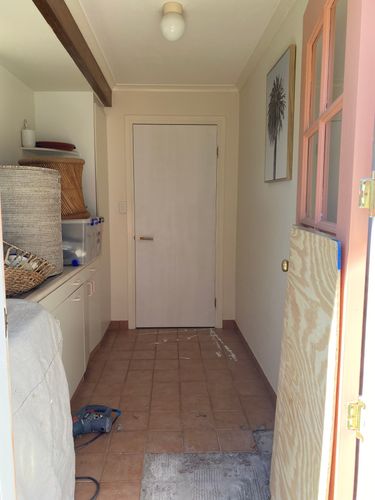
The first step was to design the space we wanted, taking into account what we needed to do in it, the budget we had available, and how we wanted it to look as part of the style of our overall renovation.
Step 2
The next step involved demolishing the existing set up so we could start with a blank slate. We removed the original cabinets, benchtop and sink and sold them on FB marketplace. We jackhammered up all the tiles and glue (not a fun job) and removed all the old plasterboard including the old blue glue on the studs. There’s a few trips to the tip at this stage!
Step 3
Building any new frames with studs in the walls, plumbing rough in for the washing machine and sink taps and adding the VJ and ship lap profiles was the next step.
Step 4
Cabinetry time! We put together the Kaboodle cabinets and installed them, making sure the end and mid panels were fixed up off the floor to allow for the tiles to be laid. At this stage, we also cut and fixed the benchtop - dropping the butlers sink into place.
Step 5
Tiling started! We started with the herringbone pattern on the floor and then moved to the standard pattern on the walls. Waterproofing was done as part of step 2/3 once the demolition was complete.
Step 6
Once the tiling was complete, we got the plumber back for the final fit off. This involved installing the taps and mixer and setting up the washing machine in place.
Step 7
Painting starts! We began with the shiplap wall (low sheen), skirting boards (semi gloss) and door (semi gloss). Then we moved to the VJ feature over the bulkhead (low sheen), architraves (semi gloss), cornices (ceiling white), ceiling (ceiling white) and walls (low sheen).
Painters tape is a must through this entire process and we used the 10mm ‘Little Ripper’ micro fibre rollers for all our painting.
Step 8
Lastly, we applied timber stain to the benchtop, caulked with silicone, installed the floating shelf and drying rack, updated the electrical switch plates and received our new dryer to add to the mix.
Step 9
Time to style!
As we have a Mediterranean Farmhouse vibe going, we kept it simple with a few Teracotta coloured hand towels and pots, an old Grecian urn filled with olive leaves, and wooden hangers with linen shirts to complete the look.
Step 10
We filmed a reel outlining the process from demo to DONE on our Instagram account @noosacoastandcountry
Time to do some washing!
Kendall and Adam x