The Bunnings Workshop community can help with your home improvement projects.
Hi there,
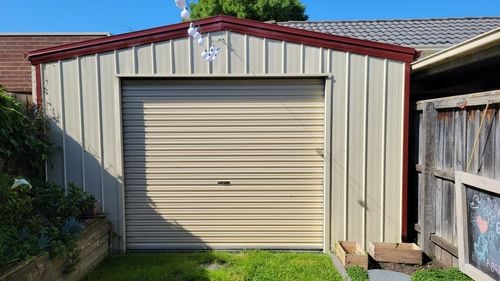
I have a ~4.4 x 2.2m garden shed on a concrete base that I want to convert to a home office. Essentially, I want to do something very similar to this sewing studio project but with ply walls and ceiling.
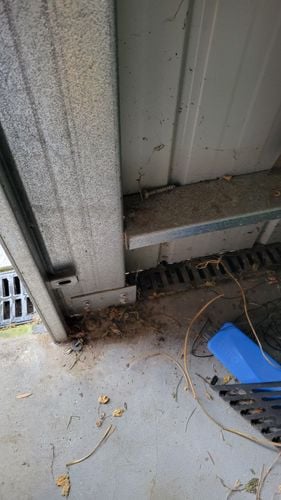
I've been trawling the boards for a while now and I think I've read just about all of the discussions here on this subject! But there is one thing about my shed that I don't know how to address - it is sitting on top of a channel drain.
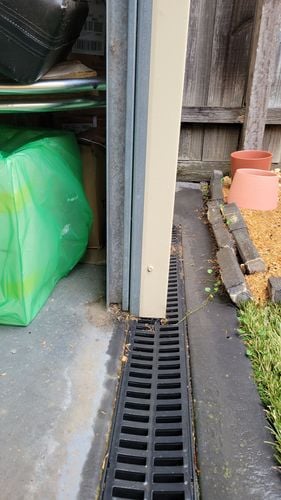
How do I treat this when framing, insulating and lining the wall? The concrete floor gets slightly damp as you can see in the first photo, do you suggest having a raised floor like a low-level deck? Is it simply a bad idea to build over it in the first place?
Thank you 😊
Hello @homework
Welcome to the Bunnings Workshop community. It's sensational to have you join us and thanks for sharing your question about your garden shed.
Yes, you are correct it is a bad idea to build over this channel drain as it will contaminate the flooring and wall fittings with heavy moisture whenever it rains. But it appears that the concrete front holding it place is not that formidable. I propose breaking apart the concrete and moving the channel away from its current location so that the front can be redone and levelled. I suggest engaging the services of a handy person to break apart the concrete. Once the drain is out of the way and has been repositioned, nothing should hold you back from starting your shed to office project.
Let me call on our experienced members @Dave-1 and @Nailbag for their recommendations.
If you have any other questions we can help with, please let us know.
Eric
Hi @homework
Looking at the sewing room project, they haven't provided any details on how they address a couple of weatherproofing areas. In particular the entrance and where the shed walls meet the slab.
Starting with the entrance and addressing your question, I would leave the drain in place and seal over the internal portion of the grate left and right of the opening with flashing and Sikaflex F11C. Unlike the sample project, I would incorporate a flashed door sill as part of flashing the in-fill frame work other side Installing an automatic weather-strip at the bottom of the new door will help prevent rain and wind entering. If you look at the doors on the sewing room, they have no sill which means any rain on it will enter under the door.
They don't mention it, but you can see they at least have sealed along the bottom of the shed walls where it meets the slab, which you will need to do as well. Once fully cured you can check for any spots you have missed with a hose around the outside of the shed as best you can considering its position against the fence.
Once satisfied your right to go internally.
Nailbag
Good Morning @homework
Love conversions of sheds
A tin shed comes with extra things to keep in mind, I do like @Nailbag's approach to how to get it prepped before continuing on lineing ect.
For my idea on the issue of the drain - (Kind of follows @EricL 's)
Depending if you are getting water on the sides and rear entering your shed?
I would remove the currnt drain, Fill it with concrete and then reinstall one further towards the photographer, even a new 500mm slab with the low point of the slab having the drain in it. As @Nailbag has mentioned, do the sealing and then use a hose to check.
I would love to see the photos as you go through or a project put together as sheds are always interesting ![]()
Dave
Workshop is a friendly place to learn, get ideas and find inspiration for your home improvement projects
We would love to help with your project.
Join the Bunnings Workshop community today to ask questions and get advice.