Workshop
Ask a question

The Bunnings Workshop community can help with your home improvement projects.

How to build a skillion roof timber shed?

DanUnited
Just Starting Out

How to build a skillion roof timber shed?

Hi everyone,


I've been lurking on here for a while getting ideas for building my shed. Decided to DIY due to the costs of the timber kit sheds.


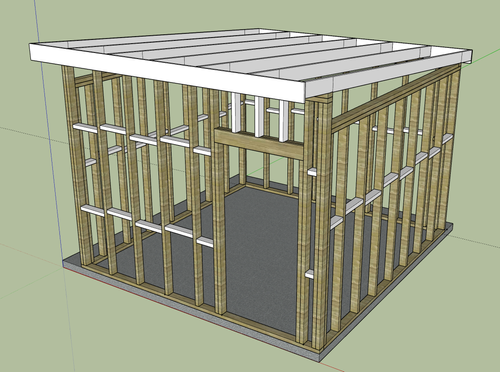
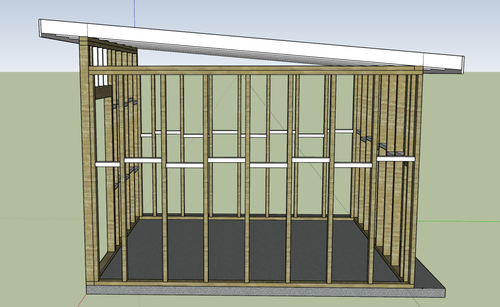
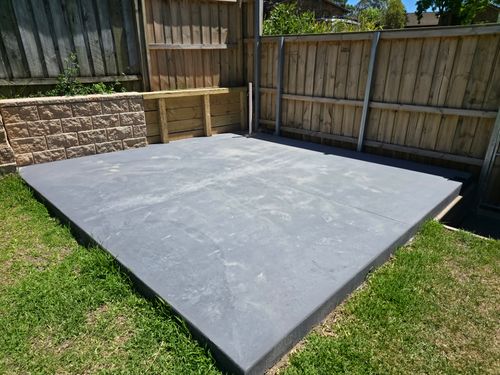
I have an already poured concrete slab up against the boundary of my house and close off fence, the shed I'm looking to build is 3600mm x 3450mm (frame size). Height is 2700mm or so high side and 2400mm low side. With roof on it'll be just at 3m above ground at the high side. I realised that the slab I got poured is bigger than the floor space of the shed I can build as the slab was also to clean up the corner near my retaining wall. I've got a few questions that I hope I can get answered.


Waterproofing:

I've read this lots of posts like this: https://www.workshop.bunnings.com.au/t5/Garage-and-Shed/How-to-waterproof-shed/td-p/196408 

as well as how to waterproof a shed floor. Do I follow the same principle here with Sikaflex 11FC and an unequal angle? How would I incorporate dampcourse under the bottom plates? I'm using H3 90x45 pine studs throughout the build.


I also have expansion cuts in the concrete which I didn't realise would create a water channel to get into the shed floor. Would I run extra Sikaflex down into that groove to try and prevent anything coming through?


Flooring:

I'm looking to lay laminate flooring inside as I have a heap of it left over from my house build. What would be an appropriate underlay that would protect the shed and floor from water damage?


Door frame:

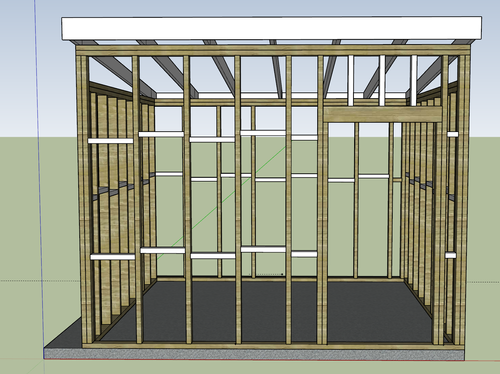
Would I keep the bottom plate as shown in my sketchup or would I cut this out and fix a door jamb timbers to the concrete itself? And I'm looking to put a 920mm wide external door in, for a standard stud wall opening, am I looking at 2080mm x 955mm?


Guttering and Roofing:

I'm looking to put in Colorbond roof sheets (one of the more fancy profiles, not standard corrugated). Does guttering attach directly to my fascia boards at the low end of my roof?


Cladding:

Looking to use some sort of hardieboard cladding just to keep costs down. I assume timber cladding boards would be super expensive. Something with a bit of texture would be nice. Any recommendations?


General:

Does my overall stud wall design look sound? I think I'm supposed to have noggins between my last rafter and the top plate of the side walls?


This is my first time tackling a job of this size. I've built stud frames for a theatre room platform but nothing at this height.

I'm not going to use this shed for anything other than a storage shed. We want to keep it vermin proof as much as possible, what steps would I need to take to do this?


Thanks for your help, I've learnt a lot just reading through responses on this forum already! I've attached pics of the slab and the design below.

Dan
20251204_112955.jpgimage.pngimage.pngimage.png


MitchellMc
Bunnings Team Member

Re: Building a Skillion Roof Timber Shed

Welcome to the Bunnings Workshop community @DanUnited. It's a pleasure to have you join us, and many thanks for your question on building a shed.


You have clearly put a lot of thought into this build already and it is great to see you taking on a project of this size. Before getting into the specifics, one really important thing to clarify is whether your shed requires building permission. Your local council will be able to advise you on this. If it does need approval, you will likely need engineered plans. That alone would answer many of your questions because the design, connections, bracing, waterproofing details and structural requirements would be properly specified for you. Even if approval is not required, getting a builder or carpenter to look over your plans is still a wise step.


One of the big picture issues here is that although this is a shed for storage, some of your expectations, particularly around waterproofing the floor and using laminate flooring, lean into the territory of a habitable room. Sheds are not typically designed to be waterproofed the same way as internal rooms. When you build any structure on a slab, ideally the walls sit flush with the edge of the concrete so that water running down the cladding drips off the outside, not onto a flat slab surface that extends further out. Because your slab is larger than the footprint of the shed, any water that lands on it will always be trying to find its way underneath the walls. You can certainly limit water ingress by sealing the junction between the bottom plate and the concrete with Sikaflex and unequal angle, but you cannot expect this joint to behave like a fully waterproof floor detail in a house. If you run with this approach, I would make sure that your cladding comes down far enough to help direct water away, and you can apply Sikaflex along the exterior edge to reduce the chance of water finding a path underneath.


Your expansion cuts will also allow water to channel across the slab surface, so yes, you will need to Sikaflex those cuts to bring them flush with the surrounding concrete so they do not become a path for water. Even with all of this, the slab itself may still wick moisture up from the ground unless it was poured over builder’s plastic. That is why laminate flooring is not recommended by any of the manufacturers in this type of setting. Laminate is designed for internal, fully protected, dry environments. There is no underlay that will reliably protect laminate from moisture rising up through a slab or from sideways ingress under walls. If you truly want a finished internal floor, you may need to apply a waterproofing membrane to the whole slab as a continuous base before any floor covering goes down. Alternatives like vinyl plank or sheet vinyl are sometimes more forgiving in outbuildings, but even then manufacturers tend to insist on dry, fully sealed environments.


With the door frame, you can leave the bottom plate where it is, but a door typically needs to rebate into a door jamb. Without that rebated bottom jamb, and with the door simply sitting across the plate, you may find that water gets in beneath the door. You can run with your current layout, but I would at least add a bottom door seal to help keep moisture out. Many people prefer to remove the bottom plate in the door opening and fix a jamb directly to the slab, but you need to think through how you will seal that junction as well.


Your guttering will indeed attach to your fascia boards, but it is best practice to screw through the fascia into the structural ends of rafters or outlookers. That gives you a strong, long-term fixing. For cladding, timber boards can get expensive, so Hardie cladding is a very sensible choice. There are plenty of profiles with texture, and most are quite budget-friendly. It really comes down to which look appeals to you.


Structurally, your stud wall layout looks broadly sound. The main thing I would question is the triangular gap between the top of the frame and the underside of the skillion roof where the cladding would otherwise be unsupported. You would need to continue your framing up into that space to give the cladding something to fix to and to ensure the wall behaves properly as a braced unit. This is another area where having a carpenter look over the plan would be worthwhile because they will quickly spot the details that need tightening up.

To keep vermin out, the key is building with tight tolerances and making sure there are no gaps anywhere in the structure. Pay close attention to the junction between the bottom plate and the slab, the corners of the frame, the spaces between cladding sheets and the area beneath the door. Any small opening becomes an invitation for mice or insects, so sealing every potential entry point during construction is far more effective than trying to deal with vermin later.


Since this is your first project of this scale, some professional input is genuinely valuable even if you are doing the labour yourself. It will help make sure the structure performs well, stays dry as reasonably possible for a shed, and keeps vermin out. 


Let me tag one of our experienced members, @Nailbag, for their thoughts.


Please let me know if you have any questions.


Mitchell


See something interesting? Give it the thumbs up!

Why join the Bunnings Workshop community?

Workshop is a friendly place to learn, get ideas and find inspiration for your home improvement projects