The Bunnings Workshop community can help with your home improvement projects.
Hello,
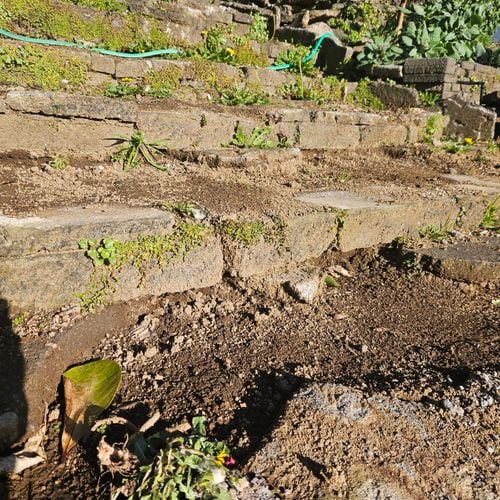
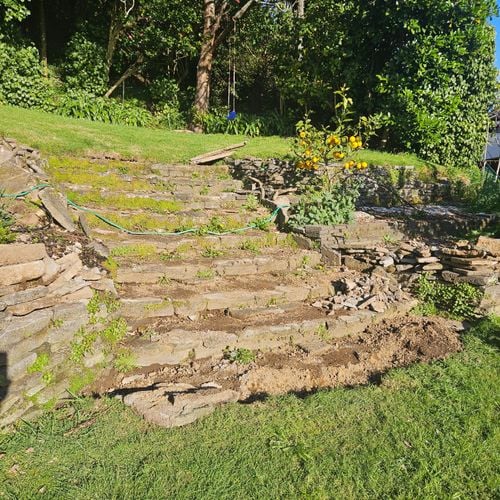
We are interested in a DIY overhaul of our old 'stone's (recycle concrete slab) garden stairs. They were becoming unsafe with loose or missing stones and were becoming a weeding issue. Our idea was to create grass steps using the existing stone risers (to save money).
For better or worse we got started on it by removing the concrete slabs from the tred surface and have now got a bit stuck on what to do next. We want to make sure we build a safe and sturdy stair case
2 issue we have noticed are:
- some of the tred stones were under the riser stones and so removing them has left them less supported
- we removed all the lower level stones that were flush with the lower lawn. I have since read these are often places there to combat soggy ground that can form at base of garden stairs. These were also supported with 2x layers of buried stone.
All in all we are worried we may have undermined the stability of the whole staircase case.
Thes stairs are roughly 3m wide by 1.5m high. Riginal rise 18cm and run 45cm.
See 2 photos below.
Pix below: example of what we have in mind.
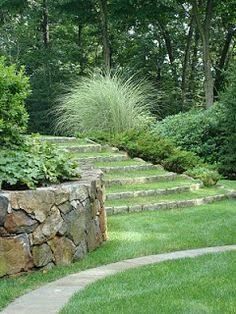
We are wondering if its ok to use existing stone risers and concrete one more layer in them followed by filling in tred with spoil and then grass seed.
Or should we start again... place gravel under each riser and then build on that.
And what should we do with the area at the bottom of the step? Was that probably supporting the whole thing? Do we need to re-do that too?
All advice and suggestions welcome.
Many thanks

Welcome to the Bunnings Workshop community @YKennedy. It's terrific to have you join us and many thanks for your question on building a staircase.
From what I can see, even with the concrete treads in place originally, it doesn’t look like the staircase had a lot of structural stability to begin with. The risers appear to have been loosely laid, with the treads simply on top, so removing the treads hasn’t really made the situation worse. If the stairs were unsafe before, you haven’t created a bigger problem—this is actually a good opportunity to make them solid and reliable.
For a sturdy and safe setup, you’ll need to bed the risers in mortar. Without the treads sitting on top, loose-fitted risers won’t be able to handle the pressure from the soil behind them. I’d recommend starting from the top and working down carefully, removing treads piece by piece so you don’t undermine the soil. Wet down each stone lightly before applying a good portion of mortar as a bed, then set the first riser stone on it. Apply mortar on top and in the joints, then place the next riser stone above it. Most of your risers look like they’re two courses high, so repeat the process for each course.
Once all the risers are mortared in place, you’ll have a much sturdier structure that can handle the soil and any foot traffic. If you want a cleaner, more polished finish instead of a purely rustic look, you can point the joints between the stones after everything is set. A tuck pointing trowel is helpful for this. This “glues” everything together visually and structurally, making your staircase safe and solid for your grass-step project.
For the bottom section, you might like to replace the previous stones or finish with some pre-fabricated pavers.
Please let me know if you have any questions.
Mitchell
Workshop is a friendly place to learn, get ideas and find inspiration for your home improvement projects
We would love to help with your project.
Join the Bunnings Workshop community today to ask questions and get advice.