The Bunnings Workshop community can help with your home improvement projects.
Hello all,
Hope everyone is well.
We are in the process of converting our garage into a living space for guests.
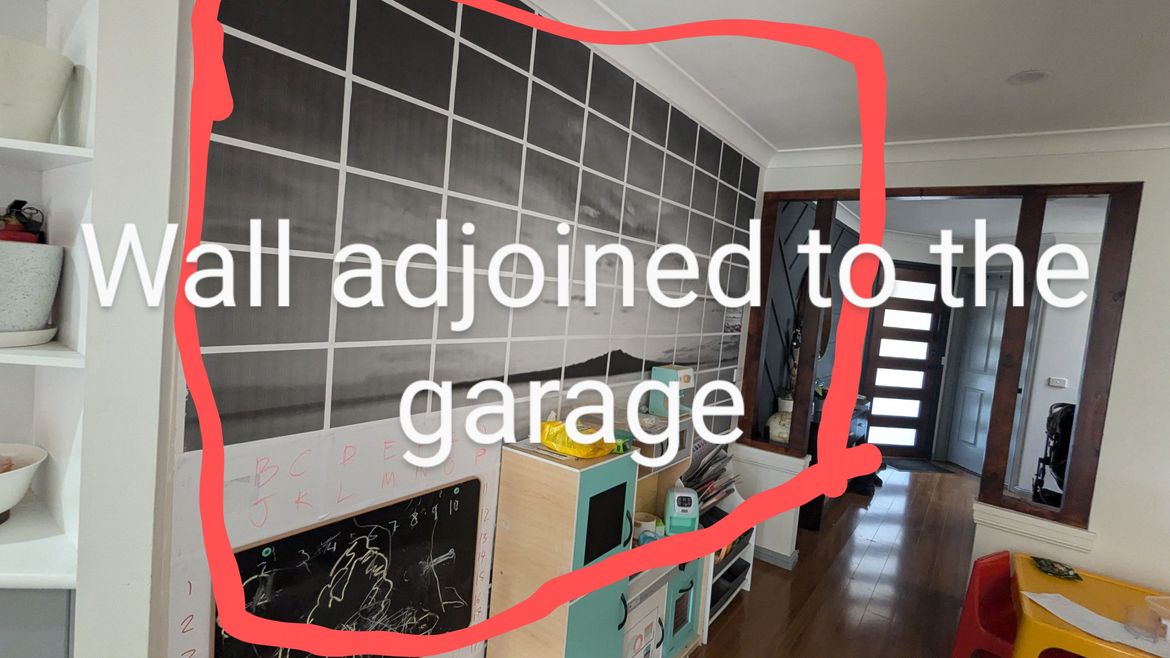
The garage is located deep inside the front of the house, and it adjoins wall from the front entry down towards our living space. So, there is a major soundproofing issue that needs to be addressed, including noise from the bathroom.
Here are the ideas we are considering:
1. Using Earthwool R2.5 90 x 580 x 1160mm 9.4m² HD Insulation SoundShield Wall Batt
2. Installing a mass-loaded vinyl noise barrier
3. Using double gyprock
4. Using pipe soundproofing wrap to reduce the noise from the pipes.
We have already purchased the soundshield R2.5, does the grade of the R make any differences?
Please see the picture for reference.
Front entry of the house and Garage placement
Front Entry of the house/garage
Entry hallway/our toddler play area
Inside wall from the garage
Wall inside the garage
Thank you all,
Hi @stelz,
If you were to use SoundShield Wall Batts, a mass-loaded vinyl noise barrier, double gyprock, and pipe soundproofing wrap, you'd be well on your way to creating a sound studio. Just the insulation and double Gyrock would see quite good results in obscuring noise transition. It really depends on how little noise you wish to prevent transferring.
The Earthwool insulation you’ve chosen is a good option for soundproofing due to its density and sound absorption properties. The R-value (R2.5 in this case) primarily measures thermal resistance, but higher-density insulation like the one you have also improves soundproofing. While the R2.5 grade is adequate, higher-density options can provide better soundproofing results. There is the 2.7, which is slightly thicker and would have a tad better insulation quality. However, it needs to fit within your studs depth. The 2.7 is 90mm thick, and if you are using 90mm studs, that is fine. If you're using 70mm studs, then compressing the bat down into that space is not optimal and can make it perform worse than a batt of thickness to suit the cavity.
Using double gyprock is certainly an option, but you might like to consider Gyprock CSR 3000 x 1200 x 13mm 3.60sqm Soundchek™ Plasterboard RE instead. It's specifically designed for situations where superior acoustic resistance is required and is twice the weight and density of standard plasterboard.
Lastly, wrapping pipes with soundproofing material can help reduce the noise from the bathroom, especially if you have water hammer issues or if water transfer through them is a disturbance.
Please let me know if you have any questions.
Mitchell
Hey @stelz @MitchellMc
@stelz what did you end up doing for this project? I was looking at mass loaded vinyl too. It's expensive!
@MitchellMc does Bunnings sell MLV? I couldn't see it in a search. Or what alternative would you suggest? I'm pulling off the sheets on a bedroom room from the old, enclosed sleep out and going to use Gyprock Sounchek 13mm too & insulation. Oh and I keep hearing about Green Glue for acoustic properties. Any thoughts? I am not so interested in "sound proofing" the bedroom, but "sound deadening" but the bedroom backs onto the living / dining room on one side and another living room on the other side. & is it that much more superior to the sound deadening, thermal coated foam you can get to reduce car noise? As usual, I would love your thoughts.
Thank you Victoria
Hi @victoriacalhoun,
I'm not aware of us stocking or being able to order MLV, so your best alternative would be using Gyprock Soundchek 13mm plasterboard in combination with acoustic insulation like Earthwool SoundShield. That pairing alone provides a solid level of sound deadening for internal walls, especially when you're not aiming for full soundproofing, but rather just reducing general noise transfer.
I don't have any information on Green Glue as it's not a product we carry.
As for the foam used in car sound deadening, yes, technically that can help in certain applications, but it's typically used to reduce vibration and airborne noise in metal cavities (like doors and panels), not really for walls in homes. It’s not a bad idea, but you’d get far better results sticking with materials specifically made for residential acoustic performance.
So, in short, Soundchek plasterboard + acoustic insulation is a tried-and-tested combo and should give you the quieter bedroom you're after.
Please let me know if you have any questions.
Mitchell
Workshop is a friendly place to learn, get ideas and find inspiration for your home improvement projects
We would love to help with your project.
Join the Bunnings Workshop community today to ask questions and get advice.