The Bunnings Workshop community can help with your home improvement projects.
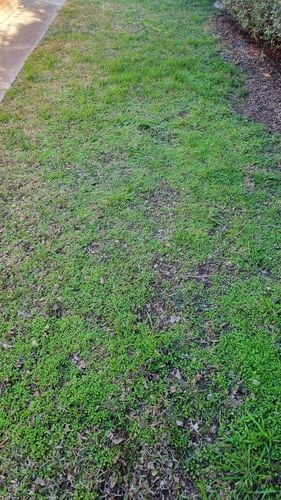
First year living with this lawn so I'd like to take care of it; region/location is near Canberra, which may or may not be important considering climate of high summer heat and winter frost.
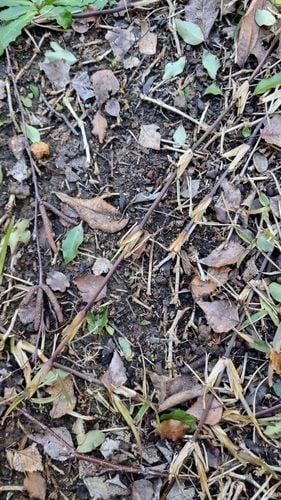
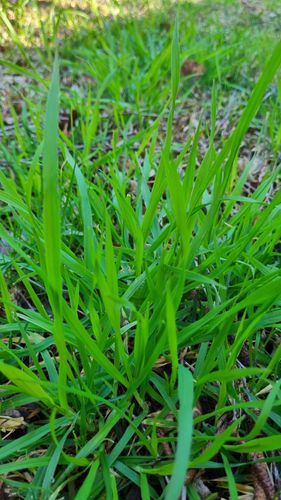
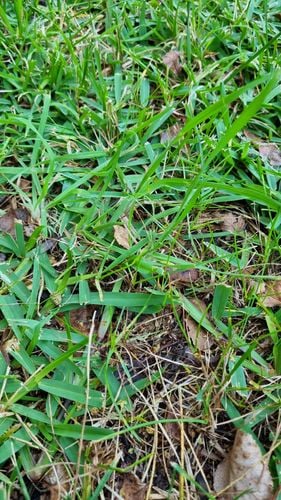
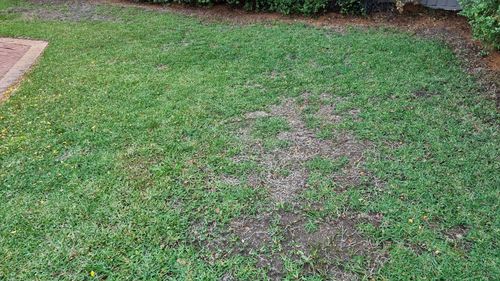
It appears as though there is a dead patch in the middle of the backyard which I'm guessing might only need some aeration and potentially seed. However I don't know if this is Couch or Buffalo and AI image identification seems to swap answers all the time.
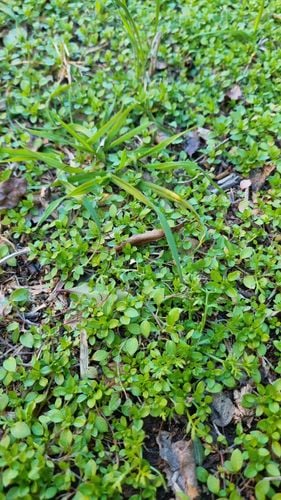
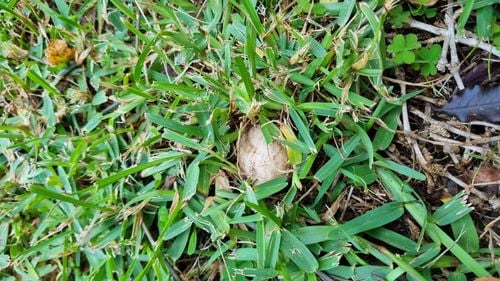
Over the last 2 weeks there has been a massive growth of what I think might be chickweed that wasn't there before.
So now the ask:
1. Can someone please help identify what variety of grass this lawn is?
2. Do I need to do more than aerate the dead patch (and entire lawn)?
3. How do I remove the invasive weed without killing the lawn?
4. Should I apply any fertiliser?
Lastly, if I need to aerate, poison, fertilise and mow, is there any particular order to this and any time gaps between activities?
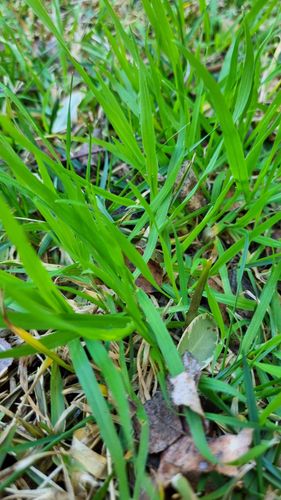
Solved! See most helpful response
Hello @chickensoup64
In Canberra’s climate, your lawn looks like Couch grass fine‑bladed, vigorous, and runner‑forming which aligns with common varieties in similar environments. To revive the dead patch, begin by aerating the entire lawn to relieve soil compaction and improve water and nutrient uptake. A great budget-friendly option is the Saxon Lawn Aerator Spiked Roller (hand‑roll tool), or if you want a more thorough coring, the Cyclone 3‑Prong Lawn Aerator is available and ideal for larger lawns.
Once aerated, you’ll want to overseed the bare area with Couch-compatible seed blends that promote quick, lush recovery. Good options include Munns Professional 1.1 kg Couch Lawn Seed Blend which is coated with a germination booster and slow‑release fertiliser, covering up to 100 m² for new lawns or Scotts Lawn Builder 1.4 kg Seed & Feed Couch Lawn Seed (special order), which mixes Couch and annual rye for fast greening and your new lawn will be nourished for up to three months.
To tackle the fast‑spreading chickweed without harming your Couch grass, use a selective broadleaf herbicide that targets weeds like chickweed while sparing grasses. An effective choice is Amgrow 250 ml Multiweed All Purpose Lawn Weeder, which controls chickweed and many other broadleaf weeds and is safe for Couch lawns. Apply this in spring when chickweed is actively growing, following label instructions carefully.
For fertilising, a slow‑release lawn food helps your lawn thicken and outcompete weeds. Scotts Lawn Builder 8 kg All Lawn Types Lawn Food feeds for up to three months, is safe for Couch, and promotes deeper green growth with boosted iron.
Suggested product sequence and timing:
First, mow the lawn to a manageable height. Then, aerate using the Saxon Roller or Cyclone Aerator. Immediately overseed the bare patch using one of the Couch seed options, and apply the slow‑release fertiliser (Scotts Lawn Builder). Keep the area well-watered to help seed germinate.
Once the seedlings are established (or if you chose not to seed immediately), apply the selective herbicide (Amgrow Multiweed) to curb chickweed. Avoid applying herbicide too close to seeding allow at least two weeks before or after seeding, or follow the herbicide instructions for safe intervals.
If you need further assistance, please let us know.
Eric
Thanks @EricL for the detailed info. I'll grab all that gear I'm missing and see how it goes over the next few weeks
Hey @EricL thought I'd post an update. It's taking a bit longer than expected but the growth has come through in the dead/compacted patch!
The rest of the lawn is looking so-so as I feel it all needs more aerating but time will tell. I've just done the first mow and will hit it with the weedkiller in a couple of days. Additionally, all around the edge of the lawn under the pittosporums I've recently taken a pick axe and turned up the soil to now add fertilizer and more seed; will probably grab some topdressing too since a lot of the soil was bone dry and I had to soak it. Let me know if you think I should do anything more to this.
A follow up question for the lawn in general, something completely unexpected when I was turning the soil, I hit a sprinkler about 2-3 inches deep. I didn't have time to dig around it further but I feel this is what the cut hose might lead to next to the lawn. Pictures below.
For a lawn sprinkler system, would you happen to know what the usual layout or distances between sprinklers would be? I am trying to figure out if it might still work, if there are more, or if it was removed but this one was missed. The sprinkler head was completely buried so I can't spot any others either but if there is a typical installation pattern then I might be able to roughly "guess" where another might be and dig around.
Hello @chickensoup64
It's good to hear that you've got some initial growth, that is always a positive sign. Using top dressing is always a good idea specially if the soil appears to be a bit bare.
In regards to the sprinkler system, I propose attaching your garden hose to the black irrigation pipe and running water through it at high pressure. You might be surprised to see that some of the sprinkler heads might still be in working condition. I propose tracing the edge of your garden at 1.5meter intervals and looking to see if there are any other heads buried in the garden. Hopefully the warmer weather will encourage more growth from your lawn.
If you need further assistance, please let us know.
Eric
@EricL I did manage to connect the sprinklers but only 1 bubbled under the dirt and couldn't pop up. I found the black hose in a garden bed with what I can only describe as an "exhaust" which let's me hear the water flowing, but no idea what's happening. Guessing the only option is to dog everything up. Doubtful I'll do that.
The lawn itself on the other hand was fantastic early December but now has dead patches all over. Feels like almost exactly like where it all started from. Would this suggest I've got some pretty dead spots of horrible soil?
My intuition is saying wait until around March, then turnover all these patches, mix with cow manure, wetting agent, fertilise, water, and seed again. Gonna be a huge effort.
Also seems like the grass previously was buffalo and now I've got a mix with the couch seeds, although that blend appears to be the only stuff dying off.
December:
January:
Hi @chickensoup64,
It's entirely up to you, but if you wait for a good rain storm to come through and give the ground a good soak, the soil will be soft and you can follow along the poly tubing with a post hole shovel, just driving it into the soil and opening it up, not actually removing any soil, then pull the tubing up and stomping the soil back in place, with very minimal damage to the grass which will heal over in a matter of days. I've seen videos of greenskeepers and lawn professionals doing it, and it is not as arduous a process as you might think. This is, of course, if you can really be bothered, which is entirely up to you.
I think what you are seeing is because most seed mixes contain ryegrass, which they refer to as a nurse crop. Ryegrass is added to lawn seed mixes because it germinates very quickly and provides rapid green cover. This fast growth helps shade the soil surface, keeping it cooler and more evenly moist, which protects smaller and more difficult to establish couch seeds during germination. It also reduces evaporation and stabilises the soil, so the seed is less likely to dry out, wash away, or fail in the early stages. In this role, ryegrass acts as a temporary nurse grass rather than a permanent lawn component.
As temperatures rise, ryegrass begins to fail because it is a cool-season grass that does not tolerate sustained summer heat. What initially looked like strong lawn growth now collapses as the ryegrass reaches the end of its useful life. When the couch has not fully established underneath, this die off appears as dead or thinning patches, which is consistent with what you are seeing.
I think the best thing you can do right now is rake out the dead grass from these bare patches so buffalo runners can contact the soil and spread into those areas. Some light aeration can also be helpful in conjunction with this. If gaps remain by March, you can patch with buffalo runners or small pieces of buffalo turf for the quickest recovery.
Over the next couple of months, the priority is to reduce stress and encourage the buffalo to spread sideways. Keep mowing on a higher setting suitable for buffalo and avoid cutting too low. Apply a buffalo-safe fertiliser once now and again in early autumn, and water deeply but not too often to support strong roots rather than soft growth.
Reevaluating the situation in March, when things have cooled down a bit, will definitely be a good idea. If these patches remain inconsistent, then we can look at steps when needed.
Let me know what you think and if you have further questions, please don't hesitate to ask.
Jacob
Workshop is a friendly place to learn, get ideas and find inspiration for your home improvement projects
We would love to help with your project.
Join the Bunnings Workshop community today to ask questions and get advice.