Workshop
Ask a question

The Bunnings Workshop community can help with your home improvement projects.

How to add drainage for artificial lawn?

MambourinNewbie
Finding My Feet

How to add drainage for artificial lawn?

Hello,


I am in the process of laying down artificial lawn in my backyard. 


Things I have done so far:

1. Cleaned the weed and levelled the soil base with a Hand Tamper.

2. Laid down weed sheet covering the area. 

3. Have spread 20mm Class 2 crushed rock. I have not compacted yet..


I am looking for inputs w.r.t water drainage when it comes to artificial lawns.


How can I best implement proper drainage. 


Points to call out:

1. The lot kind of has natural slope away from the house/slab

2. The house has perimeter concrete 1m from the slab all around the house. (Hence, the concrete has already got the required slope away from the slab )

3. When I put the crushed rock, I tried to maintain the natural slope of away from the slab towards the fence (More of a visual interpretation of the slope, haven't used strings/laser level et cetera). I have put the crushed rock till the top level of perimeter concrete with the understanding that after compaction, top of crushed rock base sits 10-15mm down from top of perimeter concrete.

4. I am planning to have raised garden bed near the fence along the length of the land where artificial lawn is to be put (except of ~2m where I am planning to have sit out area)


There are a couple of stormwater drain openings in the backyard. 

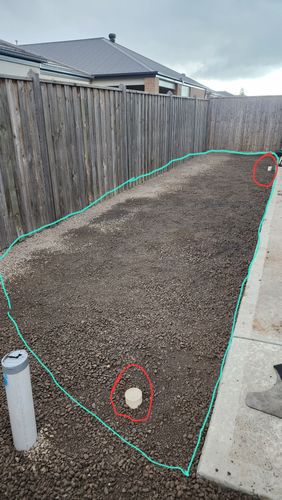
Attached is the picture of the backyard (13.5m Long and 2.6m Breadth). Area to be covered with artificial lawn is highlighted with green and the two stormwater drain openings circled in red)


Please advise:

1. How to best slope the base so that the water drains into the those stormwater drain openings.

2. Any other option to increase the drainage 


I am doing this myself so please also advise if the options/responses can be done DIY.


Appreciate any input.


Thanks 
 

1000471153.jpg

MitchellMc
Bunnings Team Member

Re: Drainage in DIY Artificial Lawn at Backyard

Hi @MambourinNewbie,


The most efficient way to improve drainage under an artificial lawn would have been to lay ag-pipe (perforated drainage pipe) directly over the soil before spreading your crushed rock. The agline collects any water that seeps through the base layers and channels it away to your stormwater system. Unfortunately, since the gravel has already been laid, it’s a bit tricky to retrofit that without digging back down.


As it stands, any water landing on your artificial turf will pass through the turf backing and the crushed rock, eventually reaching the soil layer. From there, the water will follow whatever natural slope exists in the soil. 


There’s no practical way now to “redirect” subsurface water from above the gravel base into those stormwater drains. However, you could have a plumber convert the existing stormwater openings into pit drains with surface grates. These would collect water running across the surface, though keep in mind that most water will still drain through the turf and rock rather than across the top, so the benefit may be limited.


If you’re open to a bit more work, you could consider digging narrow trenches (about 150mm deep and wide) through the gravel layer, right back down to the soil, and installing ag-pipe wrapped in geotextile sock. You’d then cover them back over with crushed rock and have a plumber connect them to the stormwater pipes. That would help collect subsurface water more effectively and direct it toward the stormwater points, providing a proper long-term solution that’s still D.I.Y. achievable. 


Here's a helpful guide: How to install garden drainage.


Please let me know if you have any questions.


Mitchell


See something interesting? Give it the thumbs up!

Re: Drainage in DIY Artificial Lawn at Backyard

Thanks for your message Mitchell, appreciate it. 

If I were to go with the option of French drain, can you please advise if the attached picture with blue lines properly depict how the drain should be placed. 


Also, please advise on the following:


1. If I am not wrong, I can dig up, place a base layer of wahsed gravel on the trench, place the socked, slotted AG Pipe, connect them to unslotted pipes to run across to the stormwater drains. 

Only connecting them to the stormwater drains needs to be done by a licensed plumber right? Please advise.


2. I have 2.5m Sewerage easement in my backyard, hope the ~150mm trench won't be a problem w.r.t the easement. Please advise. 


3. The width of the backyard is 13.5 m. Do I connect the AG pipe to two stormwater drains (as shown in my picture) or connecting to one would be sufficient, please advise.


4. Some websites/videos say not to backfill the trench with the excavated soil. Do I then just use washed gravel and the crushed rock and dust to backfill and compact with a plate compactor. Please advise.


5. Would the AG Pipe withstand compaction with a 73kg plate compactor? Please advise.


6. Hope I can also place raised garden beds which would run across the fence and sit on top of the AG pipe. Please advise.


7. I currently have weed mat under the crushed rock, after I placed the AG pipes and backfill, can I put non-woven weed mat over the area where the French drain runs? Please advise. 


Thanks in advance.

20251012_182835.jpg

Re: Drainage in DIY Artificial Lawn at Backyard

I would just dig down through the gravel to the soil layer, about 150mm deep @MambourinNewbie, and place the socked agline in that trench. You can then backfill with crushed rock above it and hand-tamp the area. You can also use a plate compactor, but I wouldn’t go overboard, specifically over those sections. Just use the motorised compactor to set the gravel in place. The easiest option with the best ability to capture water from that area would be to run a circular system. Instead of having one straight length along the back fence with two lines connecting to the stormwater pipe, which misses the front portion of the lawn, I’d recommend running a large loop around the back fence, down both sides, and then across the front near the concrete. This creates an elliptical or square-shaped layout that captures water from a much larger surface area. Connecting to two stormwater outlets would allow the system to dissipate water quicker, but it is not a necessity.


I wouldn’t backfill the trench with excavated soil, as that can clog the system and reduce the agline’s ability to collect water. The goal is for water to move freely through the gravel, reach the soil, and then flow into the ag pipe at the low points of the trench. Adding raised garden beds won’t be an issue, and they can sit on top of the ag pipe, but it’s more effective if the pipe isn’t directly underneath them. You could instead run that section of the pipe just in front of where the garden beds will sit. Once the trenches are filled, you can certainly put the weed mat back over the areas where you’ve worked.


Mitchell


See something interesting? Give it the thumbs up!

Re: Drainage in DIY Artificial Lawn at Backyard

Hello,

I am still in the process of digging the trench.

Can you please advise on the following?


1. With the help of a plumber, can I connect the AG Pipe to the two stormwater openings (as seen in the picture) with appropriate PVC connectors?


2. How best can I achieve slope towards the stormwater outlet? Can the base layer of 20mm drainage gravel help create the slope ?


Thanks in advance.

1000485227.jpg

1000485228.jpg

Re: Drainage in DIY Artificial Lawn at Backyard

Hi @MambourinNewbie,


Yes, you can connect your AG pipe to the stormwater openings with the help of a plumber using the appropriate PVC fittings, as long as the connections are watertight and comply with local plumbing requirements. To achieve the correct slope, you generally shape the soil first, digging the trench so that it naturally falls toward the stormwater outlets. You can then use your 20 mm drainage gravel to refine and maintain that slope. Place most of the gravel beneath the pipe so the water can flow freely into it, and make sure the pipe sits slightly lower at the outlet end to encourage proper drainage. This will help ensure that water runs efficiently toward the stormwater points. 


Mitchell


See something interesting? Give it the thumbs up!

Why join the Bunnings Workshop community?

Workshop is a friendly place to learn, get ideas and find inspiration for your home improvement projects