The Bunnings Workshop community can help with your home improvement projects.
Please help me out with saving my lawns.
I have just purchased a property in the West Australian Wheatbelt and its riddled with weeds.
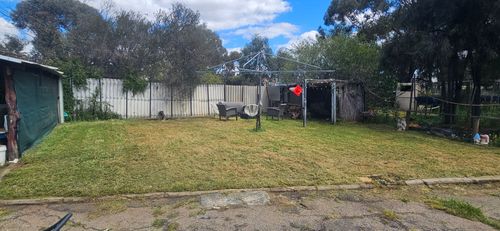
I have no idea what they are called but my back lawn is riddled with yellow daisy like flower weeds.
I believe it is salvageable with alot of dedication and work, but have no idea where to start 😳🫣
There is retic in each corner but unfortunately we can't use them at the moment due to a massive leak in one of the connections, so for now its hand watering or a hose sprinkler.
I also need to do the front lawn, but I don't think that's salvageable. It has a few bare patches, is full of bindi, those yellow daisy weeds and by what we can tell 1/3-1/4 of the lawn has some sort of succulent ground cover growing mixed in through the grass and it's full of ditches and uneven.
So, I'm pretty sure that will need to be completely killed off, ripped up and started from scratch...but how do I do all that?
Back Lawn
Front Lawn
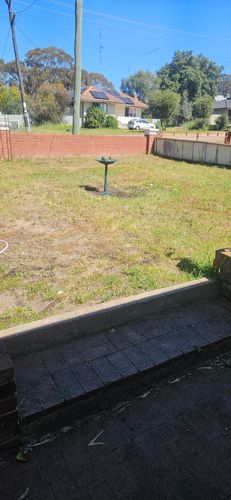
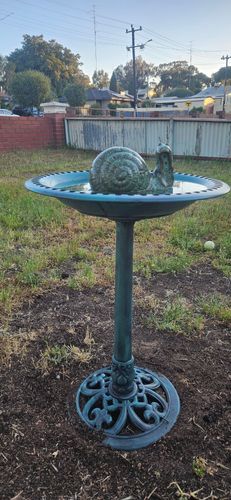
Example of bare, uneven/ditch patch in front lawn. Bird bath was put there today, so is not the cause of said dead patch 😊 Have a feeling previous occupants may have had a bonfire on the lawn 😳
HELP PLEASE!!!
Welcome to the Bunnings Workshop community @Elder85. It's fabulous to have you join us, and many thanks for your question about restoring a lawn.
It definitely sounds like your back lawn can be saved, so don’t lose hope. Those yellow daisy-like weeds are most likely capeweed or potentially dandelion, which are very common in WA. The good news is you can control it without killing off your grass. Start by applying a selective herbicide such as Buffalo Pro Lawn Weeder, which will take out capeweed, bindi, clover and other common weeds while leaving your lawn intact. After about two weeks, give the lawn a feed with a quality lawn fertiliser to help the grass recover and fill in the gaps where the weeds have died off. If the ground feels hard or the grass looks spongy, aerating with a garden fork and dethatching with a rake will really help improve soil health and allow water and nutrients to get to the roots. Since your reticulation isn’t working at the moment, make sure to hand water or use a sprinkler a couple of times a week, giving the lawn a deep soak rather than frequent light watering. With a bit of consistency, the back lawn should bounce back nicely.
As for the front lawn, you’re probably right that it will be easier to start fresh. If there are large dips, bare patches, and unwanted plants mixed through the grass, the best approach is to kill everything off with a non-selective herbicide and allow time for it to take full effect. Once the old lawn and weeds are gone, aerate the soil across the whole area and focus on filling the dips with sand or a topdressing mix. Spreading a light layer over the rest of the lawn area will also help improve soil quality and create a more even surface. After you’ve re-established a level base, you can decide whether to re-turf with instant rolls for a quick result, or grow a new lawn from seed if you prefer a more budget-friendly option.
Here are some helpful guides: How to lay turf and How to grow grass from lawn seed.
Please let me know if you have any questions.
Mitchell
Thankyou so much for this advice. I mowed the back lawn yesterday and tried to give it a good rake to dethatching but I think it needs more then a rack used, what would you recommend?
With both lawns, when do you think the best time would be to start? The days are starting ti get hot out here in the wheatbelt already.
Hello @Elder85
If using a rake is too difficult, I suggest looking at investing in a Ryobi One+ 18V Brushless Cordless Scarifier OSF1835BL or the Ozito PXC 36V 2 x 18V 350mm Brushless Scarifier PXSCS-0182 depending on what battery system you have invested into.
The best time to start dethatching your lawn depends on the type of grass you have and your local climate, but the key principle is to dethatch when your lawn is actively growing so it can recover quickly.
For warm-season grasses like buffalo, couch (Bermuda), or kikuyu, the best time is late spring to early summer. By then, the grass is in its peak growing season and will bounce back quickly from the stress of dethatching.
It is best to avoid dethatching during extreme heat, drought, or dormancy because the grass will struggle to recover. You should also aim for a time when rain or irrigation can keep the soil slightly moist to support regrowth afterward.
If you need further assistance, please let us know.
Eric
After looking over the back lawn after mowing have come to the realisation it might be best to start from scratch with it as well. Discovered very uneven spots that were hidden by overgrown grass and a section with a line of bricks dug into the ground 😳
Just worried that we have missed our opportunity. Yes it's start of spring but the days are heating up out here in the wheatbelt and we only have the weekends to do any yard work due to our work hours during the week 😑
Hi @Elder85 preserve with your lawn, a good looking lawn does take time. I have a Ryobi scarifier and they work wonders for a lawn. I would also feed your lawn to get it active (weeds as well). Once the weeds grow they are easier to remove, also your lawn recovers better. Give the lawn a good haircut, water and wettasoil. I would aim to get your lawn growing, then fix your bare patching, with topsoil. 4 weeks later you will be surprised, just right for Christmas time. Good luck!
What do I feed and weed with? I look on the bunnings website and get so overwhelmed by all the options. I need the best for achieving lush grass on a tight budget. I have seen the ryobi scarifier and would love to add it to my ryobi family but I need to convince the partner that its different to our petrol ryobi mower 😆
Hi @Elder85,
Like @Grub80, I would suggest persevering. Your lawn is a bit patchy and needs some TLC, but it is nowhere near the point you should consider giving up and starting again.
Combined Weed n Feed products have two main types: ones that can be used on Buffalo-type grasses and ones that can't. If you are unsure what type of grass you have, then the safest bet is to use a Buffalo-safe product like this Yates BuffaloPro Weed 'N' Feed Hose On Weed Killer.
This will provide essential nutrients, nitrogen and iron, to help promote healthy, green growth of your lawn, while also controlling common broadleaf weeds, clover and bindii that pop up in your lawn. It works over the course of 4 weeks, so don't be disheartened if the weeds aren't eradicated immediately, as it needs to work its way into their system gradually.
If you wanted to fertilise and let the weeds grow, like Grub80 recommended, you can really use any lawn fertiliser as long as it is a standalone fertiliser, not one with included herbicides. For fast acting fertiliser, use a liquid lawn fertiliser like this Scotts Extreme Green Liquid Lawn Fertiliser, for longer lasting nutrients that will drip feed your lawn over a couple of months, use a slow-release pelletised fertiliser like this Scotts Extreme Green Slow Release Lawn Fertiliser.
Let me know if you have any further questions.
Jacob
Hi @Elder85 @agreed, there is so much choice nowadays. I have used a variety of products, the one that I go back to is Scott’s lawn builder fertiliser, I think the nitrogen level is good for this price point, but also feeds the soil. Recently visited the big green shed and brought David grays herbicide, has knocked down the clover in my lawn, and a good price, you will need to mix they spray, I use just a 5 litre sprayer to apply. Get the lawn growing, give it 10 days, then spray the weeds, mow, wettasoil, and water it all in with a seasol solution. Good luck
Workshop is a friendly place to learn, get ideas and find inspiration for your home improvement projects
We would love to help with your project.
Join the Bunnings Workshop community today to ask questions and get advice.