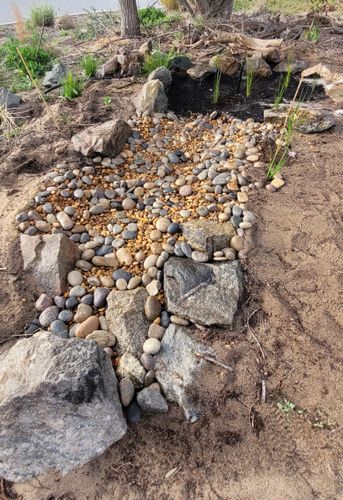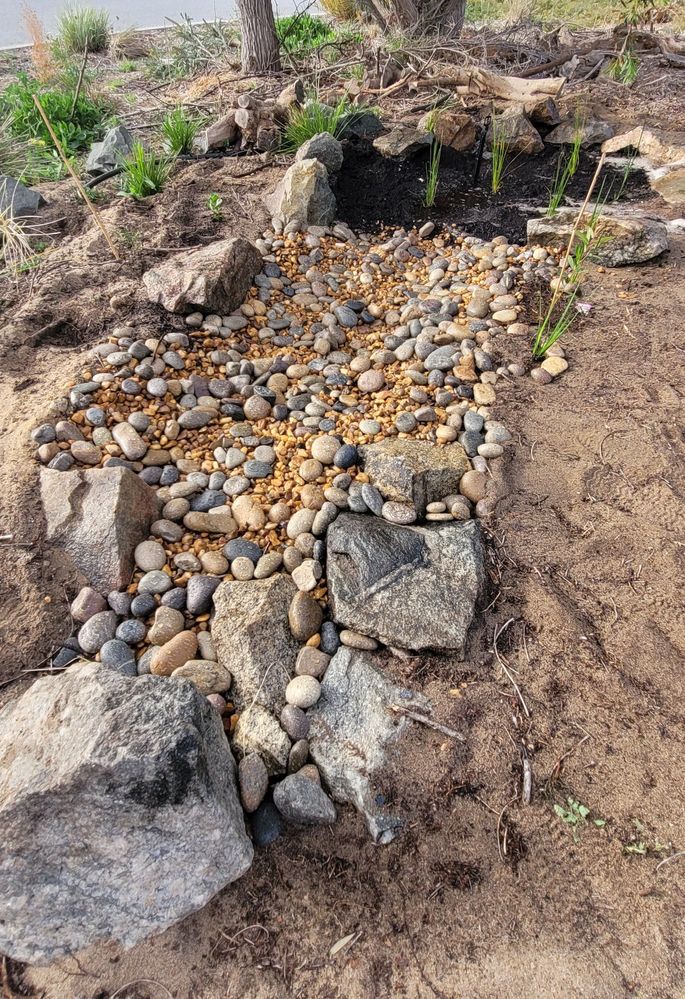
We bought our first house in Perth, and quickly learned that most of our gutter downpipes emptied water directly onto the soil, without any consideration of where that water would go. Draining rainwater directly next to a house is a big no-no, because it undermines the foundation, attracts termites, and erodes the soil. I’d already installed soak wells for other parts of the house, but one particular downpipe near the front of the house offered a unique opportunity.
RAINSCAPING! Stormwater management is a crucial aspect of home maintenance, but soak-wells aren’t your only option! Rainscaping is just landscaping without forgetting that it rains sometimes. Instead of “disposing” of the water from that downpipe, I wanted to exploit it as a garden feature.
Here were my objectives for the project:
- Erosion control: Our house is built on an elevated block with a retaining wall. That wall stops short of our front garden, so rainwater from that downpipe had caused significant erosion to the garden slope (and damaged our driveway!). I wanted to prevent it from getting worse by controlling where the water goes.
- Water retention: Here in Perth, we get bursts of major rain followed by prolonged dry periods. Perth soils are also notoriously sandy, so the water can sometimes disappear into the water table before my plants have had a chance to drink. Plant roots are the only thing holding our sloped garden together, so I want to give those plants more time to drink after it rains.
- Supporting local flora and fauna: It’s always good to see a bit of biodiversity, and it never hurts to create a unique habitat zone in your garden.
This project uses three rainscaping ideas.
- Rain Garden: Just like a normal garden, but it’s allowed to flood! Rain gardens are like surface soak-wells. Water goes in, then permeates into the surface underneath… but as I said before though, water drains into perth soil too quickly… which is where the next trick comes in.
- Rainfall buffer: (WARNING: Only use this trick if your soil drains TOO quickly!). After digging the hole, I realized that our raingarden would only retain water for a few seconds. Far too fast for our trees to get a drink. To slow down the drainage rate, I used a spread layer of bentonite clay; a thick layer would be enough to build a pond, but a thin layer is just enough to slow that water down.
- Dry Creek-bed: I had some left-over draincoil tubing from other work I’d done, but it wasn’t long enough to get to where I needed to go. A “swale” (drainage trench) is easy enough to dig, but why not make it attractive! For this project, we filled the swale with rocks and river pebbles to create a “dry creek bed”.
Steps
Step 1
Picking the site for this rainscaping project was easy, because the water had already eroded a path to it (and revealed my retic!).
 Retic exposed by erosion, perfect spot for raingarden!
 Retic exposed by erosion, perfect spot for raingarden!
Step 2
First, I dug a hole where I wanted the rain garden to be, while ensuring some of the soil got piled along the edges for support. I dug a shallow swale toward the downpipe, and continued to diging to make a trench up to the downpipe. After fitting my draincoil tube to the downpipe, I put a bit of gravel around the base to prevent erosion in the unlikely event of blow-back if the raingarden gets full.
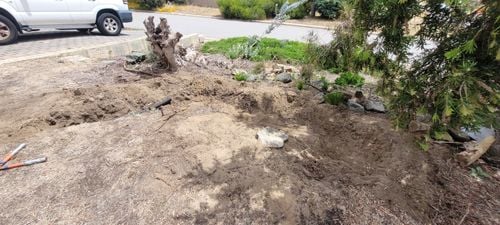
 digging
Step 3
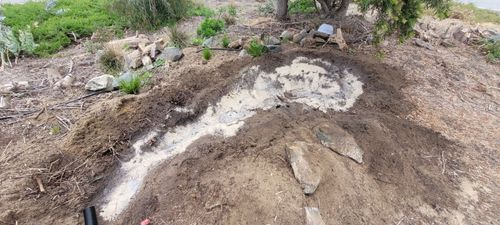
To slow down the final drainage rate, I sprinkled about 10kg of bentonite clay around the freshly dug hole. You can easily tell how quickly the final setup will drain just by using a hose. Water it down a little. Again, don't do this step if you live somewhere with poorly draining soils.
Step 4
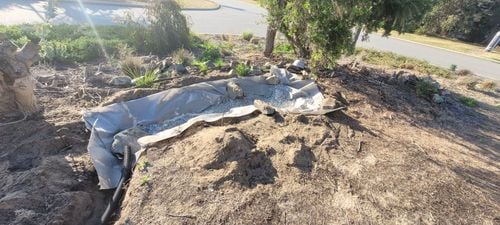
Once i was happy with the drainage rate, i lined it with geocloth.
Step 5
Now it was time to start filling everything in.
For the raingarden (on downhill end), I poured in some local soil for planting, and mixed in heaps of compost for water retention.
For the dry creek-bed (the uphill swale), I poured in heaps of blue metal gravel, which is great for drainage.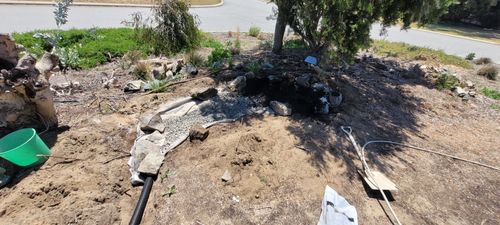
Step 6
All that was left was to make it look pretty! I added a bunch of decorative river gravel and pebbles to give it a more natural look (The larger rocks were locally sourced from our garden). Stuck a few damp & drought tolerant plants in the rain garden, and there you have it!
 Drains from this level within 1 hour.