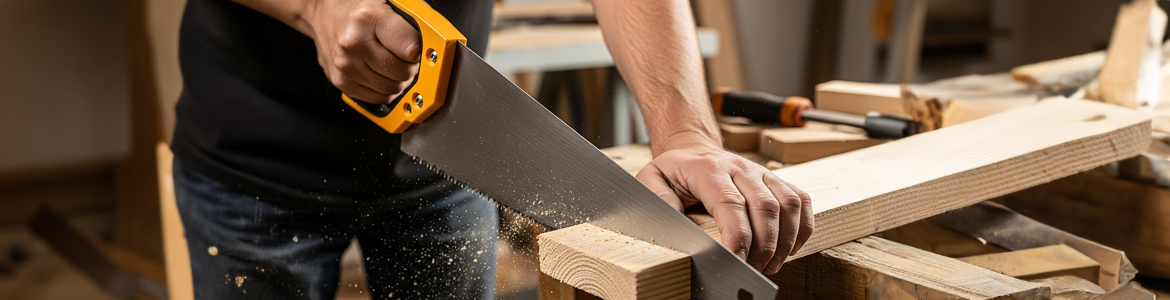
It’s important to use the right saw for the job. Each type of saw has been designed to handle different materials and deliver different finishes.
Choosing the right tool will save you time, make the work easier, and help you achieve a cleaner result.
Hand saw
 The classic hand saw has a broad blade with large teeth and a handle at one end. It’s usually about 45cm to 55cm long and comes in different tooth sizes, which affect how smooth or rough the cut will be.
A hand saw’s larger teeth cut quickly but leave a rougher edge. Because it doesn’t need a power source, it’s reliable and always ready to go.
A hand saw is perfect for cutting framing timber, plywood, decking boards or fence palings. It’s also great for general carpentry and D.I.Y. projects where speed and practicality are more important than fine detail.
Use a hand saw when you need to make long, straight cuts in large timber and don’t require high precision. Compared to a tenon saw, it’s faster and can cut deeper, but is less accurate. If you’re building a deck or framing a wall, a hand saw is your go-to. For fine woodworking or joinery, switch to a tenon saw.
Tenon saw
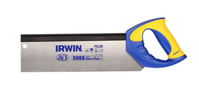
A tenon saw has a short, rigid blade with a reinforced back (the “spine”) that keeps it from flexing. It usually has much finer teeth than a standard hand saw.
A tenon saw’s stiff back and fine teeth allow for clean, straight cuts that are easy to control. While it won’t cut as deep as a hand saw, it’s much more precise.
A tenon saw is perfect for cutting accurate joints such as dovetails and tenons, trimming smaller pieces of timber, or whenever you need fine detail in woodworking. It’s a favourite for furniture making and cabinetry.
Choose a tenon saw over a hand saw when precision matters more than speed. Its rigid blade makes it ideal for joinery and detailed cuts. If you're crafting furniture or trimming timber for a tight fit, the tenon saw delivers cleaner results than a hand saw.
Coping saw
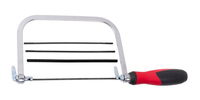
A coping saw has a narrow blade held in tension by a C-shaped frame. The blade can be removed and threaded through a hole in your workpiece to start cutting from the inside.
The thin blade of a coping saw allows for tight turns and intricate shapes, and you can rotate the blade in the frame to cut at different angles. It’s not fast, but it’s precise and flexible.
A coping saw is perfect for cutting curves in wood, shaping mouldings, or craft projects where detail is important. It is also useful for coping joints in skirting boards or trimming tricky pieces.
Choose a coping saw when you need to make curved or internal cuts in wood - something a tenon saw can’t do. It’s slower than a tenon saw, but far more versatile for detailed work. If you're shaping mouldings or cutting decorative patterns, this is the saw to reach for.
Hacksaw
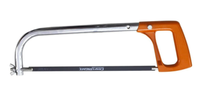
A hacksaw has a thin, replaceable blade stretched tightly inside a metal frame. Blades usually have very fine teeth and can be swapped out depending on whether you’re cutting metal, plastic, or softer materials.
The frame keeps a hacksaw’s blade rigid, and the fine teeth are excellent for sawing through hard materials without splintering. Blades are inexpensive and easy to change, making the hacksaw versatile.
A hacksaw is perfect for cutting steel or aluminium pipes, bolts, screws, brackets, and plastic conduit. It is an essential tool for plumbing, metalwork, and general repairs where a regular wood saw just won’t do.
Use a hacksaw when working with metal or plastic - materials that would damage or clog a wood saw. Compared to other saws, it’s sturdier and better for straight cuts in hard materials. If you need to cut through a pipe or bracket, a hacksaw is the right choice.
Jab saw
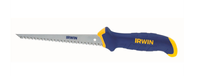
A jab saw (also called a keyhole saw) has a narrow blade that comes to a sharp point at the end. Some models have folding blades for safer storage.
The pointed tip means you can push a jab saw directly into plasterboard, soft wood or plastic to start a cut without pre-drilling. The long, narrow shape of a jab saw is perfect for cutting in confined spaces.
A jab saw is perfect for cutting holes in plasterboard for electrical outlets or vents, trimming plastic or softwood, and other situations where you need to start cutting in the middle of a sheet.
Use a jab saw when you need to start a cut from the middle of a surface - something a handsaw can’t do without drilling first. It’s ideal for renovation and electrical work where access is limited and precision is secondary.
Pruning saw
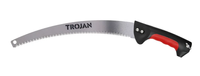
A pruning saw is built for outdoor use, with coarse teeth designed to cut quickly through fresh wood. Many are curved for better cutting angles, and some fold up for safe storage.
The teeth of a pruning saw are set wider apart to prevent clogging with green wood, and the curved blade allows you to cut branches more effectively with less effort.
A pruning saw is perfect for cutting small-to-medium tree branches, shaping shrubs, and keeping your garden neat. It is a must-have for anyone who maintains trees or hedges.
Use a pruning saw for regular garden maintenance. Compared to a bow saw, it’s lighter and easier to handle for smaller branches. If you're trimming shrubs or shaping trees, this is the better choice. For thicker logs or clearing brush, upgrade to a bow saw.
Bow saw
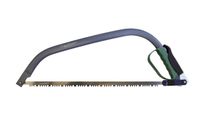
A bow saw has a long, narrow blade held in tension by a tubular metal frame shaped like a bow. The blade has coarse teeth designed to cut quickly through green or seasoned wood.
The strong frame of a bow saw keeps the blade tight, which makes it efficient for tackling larger branches and logs. Its design allows for powerful push-and-pull strokes, so you can get through thicker pieces of wood with less effort. Bow saw blades are usually replaceable, and you can choose between fine-tooth or coarse-tooth versions depending on the job.
A bow saw is perfect for cutting thicker garden branches, logs for firewood, or clearing shrubs and small trees. It is ideal for bigger gardening and outdoor jobs where a smaller pruning saw just won’t cut it.
Choose a bow saw when you need to cut through large branches or logs. It’s more powerful than a pruning saw and better suited for heavy-duty outdoor work. If you're clearing land or cutting firewood, this is the saw to use.
More helpful advice for choosing the right tool
The Bunnings Workshop community team has also shared many other useful guides for choosing the right tool, including:
The Bunnings Workshop community is also here to assist if you need a hand in choosing the right tool for your project. Don't hesitate to hit the Ask a question button and let us know your needs.