Steps
Step 1
Cut timber to size.
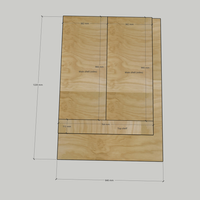
Cut the 2440 x 1220mm Plywood sheet at the 800mm mark, leaving you with one 1220 x 800mm panel and one 1220 x 840mm panel. This makes it much easier to manage the materials. Your local Bunnings store might cut the sheet for you for easier transportation home.
Once you’re ready to cut the individual pieces, measure and mark each line carefully using a spirit level to keep them straight.
Clamp a spirit level to the panel and use it as a guide for your circular saw. By running the base plate of the saw against the level, you’ll achieve consistently straight cuts, which are essential for this build. Set the blade depth so it just passes through the timber as this creates a cleaner cut with less splintering.
Here’s the cut list for the bookcase components:
- 1 × 900 mm × 800mm – Main shell (back)
- 2 × 900 mm × 382mm – Main shell (sides)
- 2 × 764 mm × 50mm – Bottom shelf support and front stop
- 2 × 764 mm × 382mm – Bottom shelf and bottom bookshelf
- 2 × 764 mm × 197mm – Face panels
- 1 × 764 mm × 234mm – Middle bookshelf
- 1 × 764 mm × 112mm – Top bookshelf.


Step 2
Sand the timber.
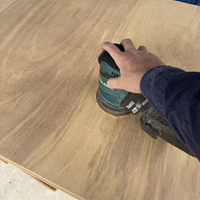
Before assembly, give all your panels a light sand with 80-grit sandpaper. Focus on smoothing the surfaces, but avoid rounding over the edges at this stage as that part will come later once the bookcase is assembled.
This initial sanding makes the timber easier to work with and saves you time later, especially in corners and joins that will be harder to reach once everything is screwed together.
Step 3
Assemble the main shell.
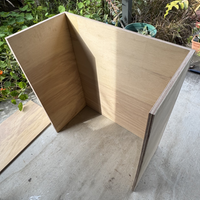
Mark a line 9mm in from the left and right edges of the back panel. On each line, make cross marks at 50mm, 300mm and 600mm from the bottom, then make a cross mark 50mm down from the top. Repeat the same measurements on the back edges of the two side panels.
Once marked, drill pilot holes in all three panels, countersinking the holes in the back panel so the screws will sit neatly below the surface. Screw the panels together carefully, making sure each screw head is recessed and ready to be covered with filler later. This will give you a solid, square frame to build on.


Step 4
Attach the bottom shelf and support.
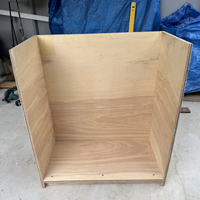
Drill pilot holes through the back and side panels of the main shell, as well as in the matching positions on the bottom shelf and its support piece. Once aligned, screw the bottom shelf and support securely to the main shell.
Screws are spaced evenly, with one 50mm in from each edge and one in the centre of the span. This pattern is repeated on all three sides.
Next, drill pilot holes down through the shelf into the support beneath it, then drive in the screws. This ensures the shelf is firmly fixed in place and strong enough to handle the weight of books and toys.


Step 5
Attach the shelves and face panel.
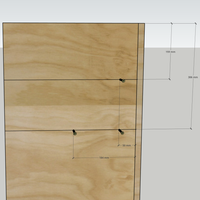
Start by drilling the pilot holes for the top bookshelf panel and then screwing it in place. Use three screws through the back panel and one screw through each side panel to secure it in place. The screws through the main shell (back) will be spaced in the same way as the previous step, with one screw 50mm in from each side and one in the middle.
Keep in mind that the shelf sits inside the main shell (sides) so the pilot holes through the main shell (back) will need to be 68mm in from the edge to line up with the pilot holes that are 50mm in from the end of the shelf.
Next, position the middle bookshelf. Drill and drive three screws, with the same spacing as the top bookshelf, through the back panel and two through the sides. The two screws through each main shell (side) should be 50mm in from the back and 50mm in from the front.
With the middle bookshelf in place, secure the upper face panel. Drive three screws up through the middle bookshelf into the face panel, then add another three screws through the face panel into the top bookshelf.


Step 6
Connect the bottom shelf, face panel and front stop.
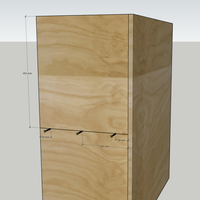
Position the bottom bookshelf and secure it with three screws through the back panel and three screws through the sides.
Now fix the lower face panel. Drive three screws up through the bottom bookshelf into the face panel, then three more through the face panel into the front edge of the middle bookshelf.
Finally, attach the front stop to the edge of the bottom bookshelf with three screws driven upward from below.


Step 7
Cut rounded front edges.
Using a piece of scrap cardboard, create a template that you can use to mark a radius cut at the top corners of the bookcase.
Start by measuring 100mm along the top edge of the cardboard, then 100mm down. Use your square to make sure the mark is in the correct spot.
Tie a piece of string around your pencil, then measure the tail of it and cut it to 100mm and pin it on the spot you have marked.
Keeping the string pulled tight, swing the pencil around the centre point, letting it trace an arc on the cardboard. The constant tension of the string ensures the pencil stays exactly 100mm from the centre, giving you an accurate radius for your template. You can then carefully cut along your curved mark to create your template.
Use this template to transfer the marks onto the main shell (sides) and carefully cut the rounded edges with a jigsaw. This will ensure each cut is symmetrical.


Step 8
Fill the screw holes.
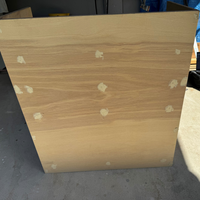
Once your bookcase is assembled, tidy up the appearance by concealing the screw heads. Using a putty knife or small filling blade, press Pine filler firmly into each screw hole, leaving it slightly proud of the surface. Smooth away any excess so sanding will be easier.
Let the filler dry for about 2 hours, or as directed on the product, then sand it back until the surface is flush and smooth. Run your hand across the area to check for raised spots. If you notice any gaps or dips after sanding, apply a second thin layer of filler, allow it to dry, and sand again. This will give you a clean, even surface that’s ready for oiling.


Step 9
Sand the joins and edges.
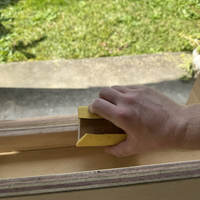
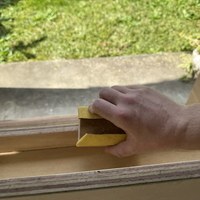
Once the structure is complete and the filler has dried, sand the entire bookcase using 80-grit sandpaper. Focus on rounding over sharp edges and removing any splinters or rough patches. For large, flat areas, a random orbital sander will make the job quicker and more even, while tight corners and edges are best finished by hand.
When the first sanding pass is complete, brush down the surfaces with a soft-bristle brush to clear away the sawdust. Then, go over everything again with 180-grit sandpaper to create a smooth, splinter-free finish. Run your hand across the panels as you work and if you feel any roughness, re-sand until the surface is even and ready for finishing. Brush down the surfaces again before moving on.


Step 10
Coat with oil.
With sanding complete, lay down a drop sheet, then apply the first coat of Danish oil evenly across all surfaces, using either a clean cloth or brush. Allow it to dry for 24 hours, then lightly sand back any raised grain with 180-grit sandpaper. Wipe away the dust and apply a second coat to bring out the timber’s natural colour and provide a durable, child-safe finish.