The Bunnings Workshop community can help with your home improvement projects.
Hi all,
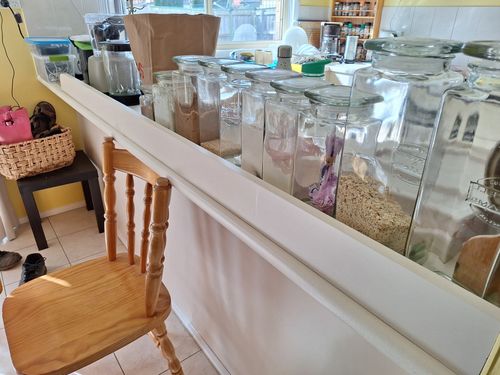
Some time ago I installed this barrier at the back of our kitchen bench to stop the canisters from being accidentally knocked off which cracked some tiles last time it happened. I glued it down with liquid nails onto the laminated bench top. Today my wife accidentally bumped it and it fell off. I have glued it down again with extra dobs of liquid nails compared to previously. I have not put a bead of liquid nails along the entire length as any leakage would be hard to clean up neatly.
My question is, will this be strong enough? I am reluctant to secure it with screws as that would entail damaging the benchtop, although in reality it is an integral part of our kitchen design.
TIA, Steve
Hi @SteveC,
Unfortunately, Liquid Nails alone would not be strong enough to resist a lateral force if it were applied to the barrier.
Using only Liquid Nails to attach the bumper rail wouldn't be strong enough because there's very little surface area for the glue to hold onto. When a sideways force is applied, the height of the rail acts like a lever arm, multiplying the force at the base where the glue is. This levering action creates a prying effect that tries to peel the rail away from the surface. Since the adhesive is only holding along a thin edge, it doesn’t have enough strength or support to resist that kind of pressure, and the rail can easily come loose.
My suggestion would be to remove the rail, then drill some holes in line with each other on the benchtop and rail to add some timber dowels.
Adding timber dowels helps strengthen the connection by providing mechanical support in addition to the adhesive. The dowels fit into holes drilled into both the bumper rail and the benchtop, creating a physical anchor that resists sideways movement and prying forces. This reduces the stress on the adhesive and helps distribute loads more evenly, making the overall joint much stronger and more durable. The great thing about using dowels is that they would make no visible changes to the look of the bumper.
Unfortunately, I'm not aware of a way to address this issue that would not include drilling into the benchtop.
Let me know what you think and if you have any further questions, please don't hesitate to ask.
Jacob
Thanks.
Do you have any suggestions as to how to accurately line up the dowels?
Hi @SteveC,
Start by tracing a pencil line along the outside edge of the barrier in the location that you'd like it to sit, then make a mark every 300mm or so along the length of the barrier. When the barrier is in place, you can transfer these marks onto the benchtop.
I'd then use a Combination Square to transfer the lines around the bottom of the barrier and make a cross line at half the width of the barrier.
You can then use the ruler to continue the marks on the benchtop past the line you traced at the start and place a cross line at the same distance from the outside of the barrier.
I would then use a nail punch with a fine point to create a small indent at the centre of the crosses. You can then use a 3mm drill bit to make a pilot hole, ensuring you hold your drill so the drill bit is as close to plumb as possible. You can then use a drill bit that is the same size as your dowels to widen out the pilot holes.
You can then dry fit your dowels to check for alignment before removing and reinstalling with some wood glue and a bead of Liquid Nails along the bottom of the barrier.
Keep a wet cloth nearby to wipe away any adhesive that squeezes out while it is still wet.
Let me know if you have any further questions.
Jacob
Workshop is a friendly place to learn, get ideas and find inspiration for your home improvement projects
We would love to help with your project.
Join the Bunnings Workshop community today to ask questions and get advice.