Steps
Step 1
Measure the room.
Decide which way you want to run the boards and then measure the length and width of the room.
Ensure that there the edge boards will not be too narrow (say less than 100mm). If so you will need to cut the boards. After clamping the board, we used a circular saw for all long cuts.
Step 2
Length of boards at each end
Ensure that the boards at each end of the first row will not be too short (say less than 200mm) and then cut the two ends. We used a set square and then a stanley knife to score the top of the board. Then rest it on a scrap piece of wood and press down firmly. We did all the short cuts this way and they cut cleanly every time.
Step 3
Measure the length accurately
To measure the length we put a 10mm spacer on one wall and then temporarily laid the boards in one single (unconnected) row, then used our tape measure to measure the gap between the end of the last board and the wall. Then subtract 10mm for the spacing and use this measurement to cut the last board.
Step 4
Lay the first row.
Working from top left corner of the room, connect each board, ensuring there is no gap between the ends. If the grey plastic edges are on the right side and the side closest to you then you have them in the right orientation.
Step 5
Lay the first board of the second row
This should be quite easy
Step 6
Lay the second board of the second row.
This is where we got frustrated and could not do it. Here is the trick we found useful
1. To connect the long edge you have to hold the board up 45 degrees and fold down. To connect the short edge you have to hold it up 45 degrees and fold down.
BUT - how can you do both at the same time?
2. We tried hammering it - we tried connecting a whole row end to end and then putting the whole row in at the same time, and it fell apart.
The trick we found is that once you have put in the long edge of the first board, you have to wiggle it out a bit so there is about a 1mm gap. Then you can put the two ends together. As you lower the second board, hold the first board in your left hand to keep the edges together, ease the second board to horizontal and then click the second board in on the long edge.
Step 7
Add the other boards in the row
Continue adding the other boards.
Once the boards are down it was impossible to close any gaps on the short edges, so make sure they stay closed. However, it is possible to later close the long edge gaps, so don't worry if there are small gaps there.
Step 8
Close the long edge gaps
Kneeling on the completed part of the floor, I lifted each board up slightly and pulled towards me to close the gap and sometimes hear a satisfying click. After one pass of doing that, I got a small offcut of board and used that as a tapping board. Holding the tapping board against the board I used a rubber mallet to tap the boards. This closes the gap even further and helps the boards to lay down flat. I tapped about 3 or 4 times at different points on each board.
Step 9
That's It
Continue doing the other rows in the same way. We found out this method by trial and error and so I hope you find some of the ideas useful.
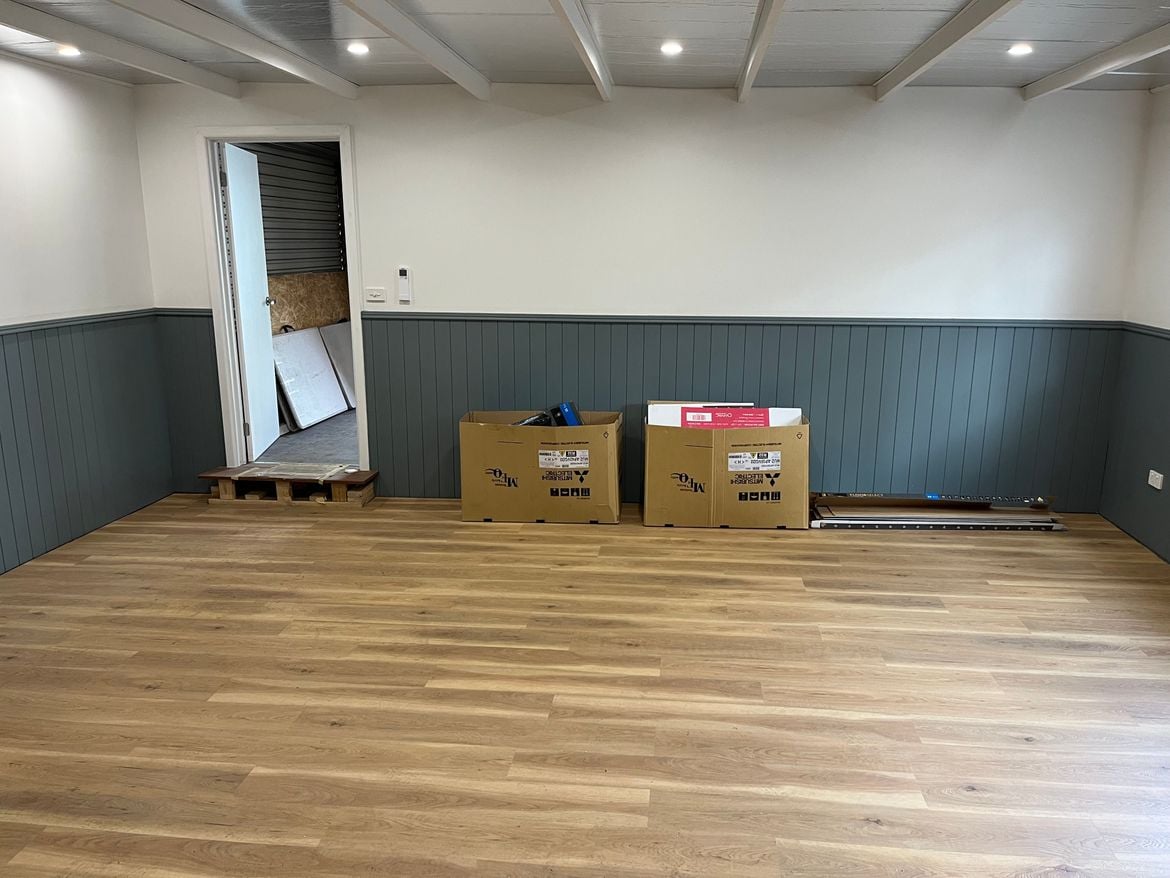
We just finished laying the board yesterday but so far we are really happy with how it looks and feels underfoot.
By the way, we chose not to use an underlay on our concrete floor but that is also an option for you to consider.