Workshop
Ask a question

The Bunnings Workshop community can help with your home improvement projects.

How to patch plaster on brick wall?

smped
Just Starting Out

How to patch plaster on brick wall?

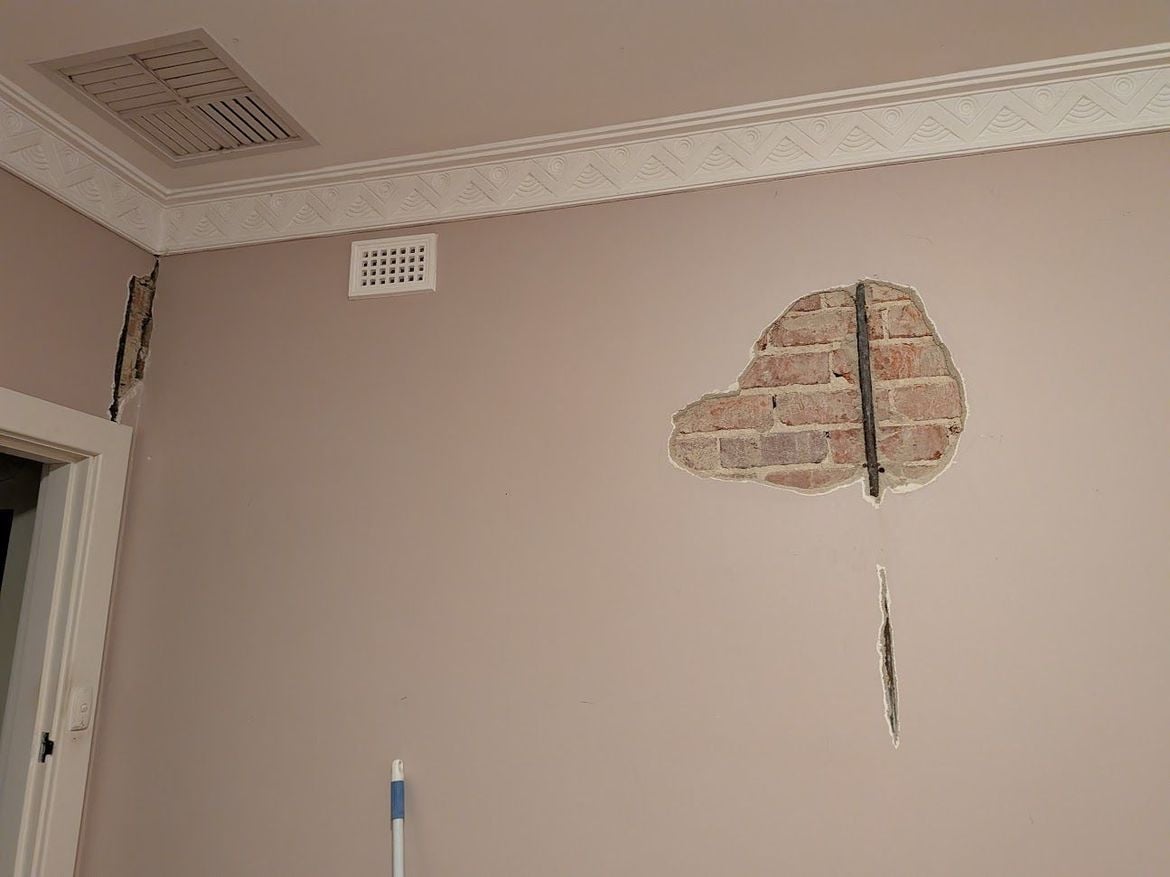
I'm preparing to repaint and have chipped off some plaster that was really loose, with both of the holes shown here covering the electrical wiring down to power-points & light switches. I think that was the cause of the plaster coming loose too. The large hole is about 60cm wide + 50cm high. I've previously used Poly Multipurpose Filler for smaller holes & that's worked well, but I think these areas are getting beyond that. Do you have any suggestions? Do I need a plaster base + top coat, or will a single-coat product suffice? The depth is about 10mm too.
 

PXL_20260110_135915605.jpg

MitchellMc
Bunnings Team Member

Re: Patching plaster on brick wall

Welcome to the Bunnings Workshop community @smped. It's marvellous to have you join us, and many thanks for your question about repairing a wall.

For holes that size on a brick wall, you’ll want something a bit more robust than your usual multipurpose filler. Since this is plaster over brick and not plasterboard, the key is making sure the new plaster bonds well and doesn’t just fall off. Start by misting the exposed brick with water so it’s damp. This stops the brick from sucking all the moisture out of your plaster too quickly. Then apply a hardwall plaster to fill the hole, roughly flush with the surrounding surface. Once that’s set, you can smooth it out with a finer skim coat, to get a really smooth finish. After that, sand it back so it’s flush, prime the patched areas, and you’ll be ready to repaint. This two-step approach, hard wall plaster for strength, then a fine skim for smoothness, works much better than trying a single-coat filler on a 10mm-deep, large area.


Here's a helpful step-by-step guide: How to hardwall plaster a brick wall.

Please let me know if you have any questions.

Mitchell
 

See something interesting? Give it the thumbs up!

Re: Patching plaster on brick wall

Sorry, but I'm really confused now. I bought the products you recommended. The Hardwall Plaster advises to mix with hydrated lime (which I didn't know I needed) at a ratio of 2:1, whilst the tutorial you linked advises to mix with both lime & sand at a ratio of 6(sand):1(lime):1(plaster), and your post hadn't mentioned either so it seems there are three options: 1) plaster + water, 2) plaster + lime + water & 3) plaster + sand + lime + water, and I don't know what to do


How do I mix the plaster for a hole this size? Is water alone fine or do I need lime? Do I need sand as well? What's the ratio of water to plaster? There's no guidance on the packet for a complete beginner.

JacobZ
Bunnings Team Member

Re: Patching plaster on brick wall

Hi @smped,


What the video shows is a cement-based render being applied to a wall, whereas Mitchell has recommended applying hardwall plaster, which is a gypsum-based product that is similar, but not the same as render. It is more to show the process of applying it than the materials used, as the application process is more or less identical.


You should still use the hardwall plaster, not cement render; just use the video as a reference for how it should be applied.


Mixing the hardwall plaster with lime increases its workability and flexibility, so it will be much easier to apply if you do so. It can be used without the lime, but it is more difficult to apply and more prone to cracking in the long term. So, I would suggest you pick up some hydrated lime and mix it with the hardwall plaster at the ratio mentioned on the packaging, then mix it all with water. 


Unfortunately, there isn't a specific ratio of how much water to use, but it isn't too hard to work out. The finished mix should be smooth, creamy, and hold on a trowel without slumping, while still being easy to spread. Think about the consistency of toothpaste. The mix shown in the video above will give you an idea of what you are aiming for. Start with some water at the bottom of your mixing vessel, then pour the dry mix in and start mixing, adding water as you go. If you think it has gotten too runny, you can always add some more of the dry mix to stiffen it up.


So, to summarise, use the hardwall plaster mixed with hydrated lime, mix them together, then mix the combination with water until it is similar to the consistency of toothpaste and use the video as an example of how it is applied. Once it is set, a topcoat plaster like the one Mitchell linked to can be applied to get the smoothest surface possible before sanding, priming and painting.


I hope this helps


Jacob


smped
Just Starting Out

Re: Patching plaster on brick wall

Thanks Jacob. Very much appreciated. The first batch was a bit runny and I ended up with quite a few hairline cracks as it dried. The next batch was much better as I figured it out & was both easy to work with and dried really nicely.

Why join the Bunnings Workshop community?

Workshop is a friendly place to learn, get ideas and find inspiration for your home improvement projects