Steps
Step 1
Preparation
The existing Merbau panels were easy enough to remove as was the plaster face which we happily discarded.
 Before
Ekodeck recommend that each panel be mechanically fastened to at least 3 rails / horizontal supports. They also say that the maximum support spacing should be 60cm.
I found this confusing. Ekodeck comes in 3.6m lengths, so 3 rails would mean they were 180cm apart. The panels are 219mm in width. Ultimately I wanted my rails 60cm apart and I mostly fixed each panel with 3 screws placed in the centre of each panel at the top, bottom, and one of the middle rails. This meant that the existing frame was insufficient.
 Exposed frame
Step 2
Framing
The underling frame was of poor quality, unevenly spaced, and not plumb vertical. I addressed these factors at this stage by fixing H3 treated timber onto the posts which also brought the surface of the castellated panels forward in line with the front of the sleepers underneath.
 New frame
The site was 4.6m long and (thankfully) 180cm tall. This meant that I could cut each 3.6m panel in half and not have expensive wastage. I placed rails at 60cm intervals so 4 rails in total using H3 treated pine 35mm deep. Remember to attach these using screws for treated pine as I'm told the standard external timber screws are affected by the chemicals in the pine and may degrade.
Getting it plumb vertical and horizontally straight took some time. Firstly the fence had a slight curve to the left end so I had to build this up. Secondly I had to cut into the vertical timber where the rails would sit, to variable depths until each vertical surface sat plumb vertical across the entire 180cm height.
 Framing up
 Note how the horizontal rails are recessed into the vertical timber
Step 3
Calculating how many panels you require
This was surprisingly tricky. According to the Ekodeck installation guide, each panel is 3.6m long, 219mm wide, and 26mm deep. For a 4.6m long fence divided by 21.9 I thought this was 21 x 180cm panels so 11x 3.6m panels. Wrong!!
 Overlapping panels
All of the panels overlap. Once you take this into account the actual measurement you need is closer to 19.5cm width for each panel. So for the 4.6 span I needed 460/19.5 =23.6 x 180cm panels or 12 x 3.6m panels, plus 1 more for around the corner. I therefore used in total 13 x 3.6m panels.
 1 panel
 4 panels
Step 4
Preparing the panels (cutting and sanding)
I was pretty worried about this step. The fence is 180cm tall so I needed to cut each 3.6m panel in half. I don't have a drop saw so I needed to make sure that the cut was straight otherwise the top of the fence would look terrible. I also didn't have any excess length to spare so I couldn't put up the panels and then cut them once they were all in place (which would be tricky anyway at that height) so I needed to cut them first. I also don't have a track saw, so I figured out a way of making a guide that my circular saw could follow which would ensure the cut was in the right place and perfectly straight.
First the panels are not exactly 3.6m long, they are a little bit over but not much.
 Length of panel
I measured where the circular saw blade guide would need to sit so that the blade was in the right place.
 Measuring up
 Measuring up
I then used some G clamps to carefully fix the timber at the correct place, and adjusted this to ensure it was perpendicular to the long edge of the panel. Tips here:
- Make sure someone helps you at this point
- Ensure the panel is lifted off the ground and the saw blade depth adjusted to you don't hit the ground as you cut
- Put something heavy against the side of the panel (in this case a full watering can) so it doesn't move away from you as you cut
- Have your assistant gently pull on the panel so it moves immediately out of the way as you cut each one. Otherwise it can drop down as you move onto the next panel (I cut 4 at a time for speed, and it was easier to make the cut level this way) and you don't want to run over the panel that you have just carefully cut with your saw blade
- Make sure that you wear appropriate safety equipment
 Set up
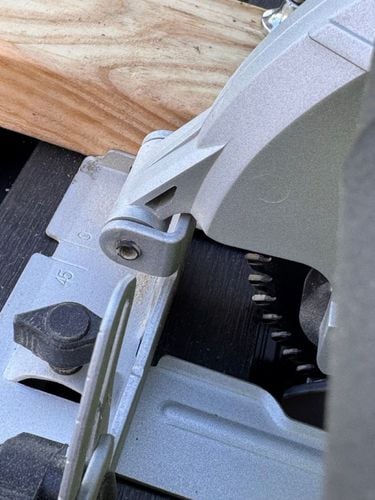
The cut ends are a bit rough.
 Rough ends
Happily you can treated the composite Ekodeck material just like wood so you just sand it with some 220g sandpaper and it smooths out easily. Don't worry about the overlapping edge as it is hidden anyway.
 After sanding
Step 5
Putting up the panels
I couldn't find any recommendation about what screws to use other than "exterior-grade 10g screws of adequate length". Clearly for my 'carbon' (charcoal) panels I didn't want a row of shiny metal screws. My solution was to use these black decking screws by Bremick from Bunnings which were perfect. I used 65mm long screws but 55mm would have been fine. Remember to pre drill the panels - I used a 4.5mm drill bit. The screws are self drilling so went into the underlying timber frame well. Be careful not to screw them in too hard with your cordless screwdriver as the head will go right through the castellated panel material if you're not a bit careful.
 Black screws
The panels come in other colours - Hazelwood (brown) and Blonde Oak (tan). I have no idea what you'd use then, though you could paint the screw tops I suppose.
The first panel I fixed thoroughly with I think 6 screws (2 per level at 3 levels) after making sure it was plumb vertical. Then I thought I'd be clever and just put each panel in place quickly with a screw, making sure they were overlapping properly and vertical, then put the rest of the screws in at the end.
 Placing the panels
This was certainly more efficient, but once all of the panels were up I of course realised that I couldn't see the underlying rails any more. I have to measure down from the top, and/or use a level to just go across from previous screws that I had already placed. Not ideal - suggest you fix each panel properly as you go.
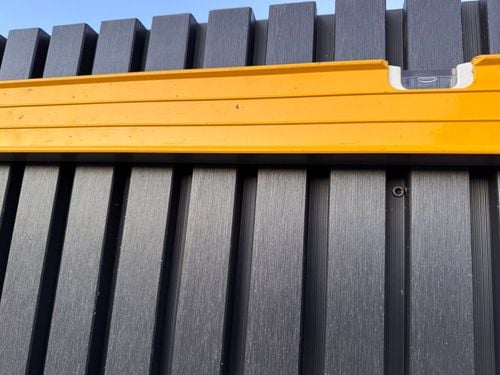
You will need to cut a panel vertically as the length of your fence won't exactly match the width of the panels. I decided to start at the corner as I didn't want a small panel piece there which would be difficult to fix. I ended up with ~½ a panel width at the right end of the fence. Remember it still has to overlap on the left edge so measure and cut carefully. In the end it was a snug but perfect fit.
 All panels up
Step 6
Appearance
Firstly the screws. The black screws worked really well, you can see them if you look closely but from further away you can't see them at all.
 Close up
 Further away
Despite my very careful measurements, the panels were not exactly the same length after cutting. To be honest you can't tell at all that here and there is a difference of a few mm either at the top or the bottom.
 Top edge
Step 7
Corner
The fence had an ugly corner with multiple posts which I was keen to cover and we had a left over piece which worked perfectly. I started at this corner so before putting up this panel I cut off the edge along the left side which is there for an adjacent panel to overlap.
 Corner edge
If you look really carefully, you can see that the circular saw blade caught the side of the visible panel.
I then placed another panel around the corner side. For this one I kept the right overlapping edge as it sat nicely against the front panel.
 Side panel
I think I should have left it at that as it looks really pretty good.
 Corner
However the Ekodeck installation guide talks about aluminium trim. Initially I thought I'd need this along the top but you definitely do not. But I'd bought a length so I thought I'd use this along the corner edge, covering where the saw blade had marked the panel. In retrospect I think this was a mistake.
 Aluminium corner
The problem as you can see is how do you fix this to the fence? A screw won't give much fixation into the castellated panel itself, you really want to be into the underlying timber frame. But it's tricky to reach the frame when the corner piece is so small (this is 25mm x 25mm).
 Fixation
I made it work and it looks good, but I just don't think it is necessary. Cut the corner panel carefully and it will look great without any trim.
 Finished
Step 8
Summary
We love the look of the panels, and many people have literally stopped in the street driving past to lean out the window and tell us how great it looks (and how relieved they are that the old Balinese face is gone!).
Measuring how many panels you need, and finding which screws to use to fix them, were the main problems to overcome. More information could be provided by Ekodeck to help. I love the corner hiding the old multiple posts, but you don't need the trim if you're careful.