The Bunnings Workshop community can help with your home improvement projects.
Hello community!
I am planning some drainage improvements in my yard of my new property and would love some ideas on how to do this trench drain better.. It is leaking at segment joints (every 1m) into my sub-deck area causing some moisture issues internally (slope of entire backyard + under deck is towards dwelling). I am also going to do a subsoil drain to handle the under the surface water, but tackling the overland flow first...
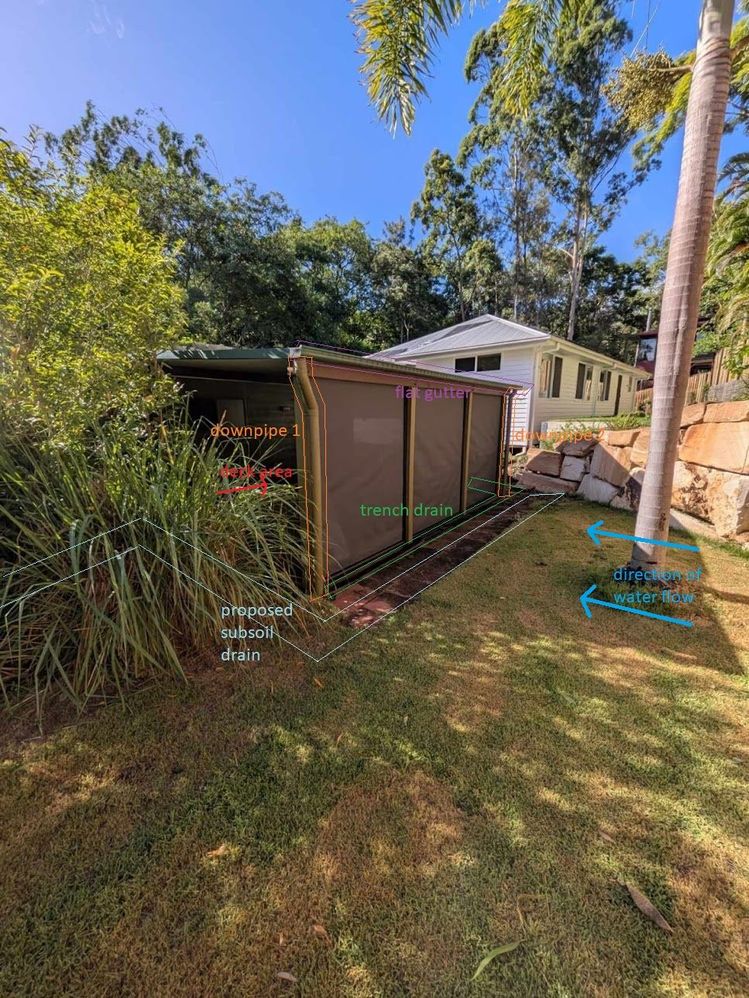
Close up
My observations of the issues with it so far:
* the drain is made up of 1m pieces of https://www.bunnings.com.au/everhard-1m-easydrain-polymer-grate-and-channel_p4770206, clicked together every 1m;
* drain drain is not installed in concrete, rather fastened to deck joists;
* the fall of many of the 1m segments was in the opposite direction of where it needs to be;
* there was a buildup of sediment in the drain and lots of water pooling during rain, likely due to incorrect fall + sediment buildup;
* the joins between the segments looked deformed (like a V shape), likely due to no concrete in installation;
* the grates over the top were too wide for the channel body, also likely due to no concrete in installation.
It seems that the trench drain is an effective (and required in order to catch overland flow from yard and multiple retaining walls) drain, but because of being right up against the deck, installing it with concrete is tricky, but I do need to replace it. I think without concrete it got bullied by the surrounding soil over time. I am also unsure how to make the correct fall (1:100) look visually ok - the deck length is 5.5m, and the height difference of the drain of 5.5cm from left to right will be easily visible.
Some ideas I had:
* try a similar installation approach but with a stainless steel grate, which might be less prone to buckling inwards, but I feel it may still get pushed up by the soil;
* remove some decking planks and do the concrete anyway;
* bring the drain away from deck by 50mm, to allow for the concrete to be on both sides of the trench (concrete would sit right up against deck, but then no soil behind it really)
Is there a way to make a trench drain work in this scenario? How do people with similar slopes finish their deck? Should I maybe divert the downpipes to a LPOD by running some PVC, delete the channel drain entirely and hope the subsoil drain (which will be 600mm deep by 300mm wide, top layer of decorative pebbles) catches everything and doesn't let anything slip under the deck?
TYIA
Denis
Hello @denisl
My apologies for the late reply. I believe that having a French drain will catch most of the overflow in your garden but installing an Everhard 3m EasyDRAIN Polymer Grate And Prejoined Channel serves as an excellent back up should the French drain get overwhelmed. In regards to the installation of the Everhard 3m EasyDRAIN, I propose using a concrete base to prevent it from moving. If it is not properly anchored the ground will move the drain.
In regards to maintaining the slope, I suggest using a spirit level and a builder's line for guidance.
Before you begin your project, I propose speaking to a plumber and getting their professional opinion in regards to your proposed layout. Please note that you will need their services should you decide to link your pipework to your stormwater outlet.
Let me call on our experienced members @Dave-1, @Nailbag and @AlanM52 for their recommendations.
If you need further assistance, please let us know.
Eric
Good Evening @denisl
Looking at your photos and description of the issue I am wondering if a grill drain is suitable or needed at all. @EricL does make a fair point that its good as a backup.
If you removed the pavers is there soil underneath them? If there is I would remove the grill drain, remove the pavers and dig a trench along the pavers path. To a depth of one of those pavers, fill the bottom of the trench with 8mm gravel to around 20mm height, then 100mm agi pipe, then fill the rest of the trenchg with the 8mm gravel. Do not let grass grow over the gravel, its there to capture the surface water and subsurface water. Slope your drain towards the low point you want and as @EricL has suggested contact a plumber if you need to run it into your stormwater piping.
I would actually make sure you have an air gap between the lawn/pavers/drain and deck. It will help prolong the life of the deck.
Dave
Hi @denisl,
Plenty of advice already and this garage aka workshop project may also be helpful.
The completed project.
This is a workshop (no vehicles) so there is no need to fill the whole trench, under the connection points is OK.
As we laid each section kept checking the fall.
This is how I turned the corner and married up with regular stormwater pipe.
This was prepped prior to laying the drain.
Came back later and made the connection.
The plywood is keeping the pebbles in place while everything sets.
Rather that testing with the garden preferred to wait for some real rain 🙂
Cheers
Good afternoon @EricL @Dave-1 @AlanM52 ,
My apologies also for late reply, it looks like the notification emails got eaten up by Junk filter ![]()
Thank you also for taking time to read the essay and make such detailed suggestions!!
I will reply to each point below:
@EricL : I would love to use the concrete base for the channel grate, but there is one side of it that cannot be concreted because there is no space for the concrete. Allow me to illustrate using a diagram of the side view:
So the new drain installation would look like this:
This would certainly be miles better than the existing setup, but will the lack of concrete on right side cause issues? Would soil just push the concrete along with the grate into the deck, displacing the metal plate?
I would love the idea of deleting the grate entirely, especially because this was suggested twice in this thread, I am just hesitant to have an airgap (as suggested by @Dave-1 ) because of the slope of the soil towards the building. Currently, rainwater escapes via those segment joints and slowly makes its way towards the wall. Around 2 hours of rain is enough to saturate the soil sitting up against the wall (which seeps inside the dwelling). I feel like deleting the grate might make this issue worse.
When I wrote about maintaining the fall, I meant more in terms of making it look visually ok, allow me to illustrate with view from front:
@AlanM52 's example was up against a workshop slab, so the finish is a lot nicer. I am not actually terribly fussed about the visual finish, as long as the function is there. Currently it looks good, but has bad fall, which has allowed for water / sediment pooling.
@Dave-1 there is indeed soil underneath the pavers. I am planning to do the subsoil drain exactly as you suggested
Just not sure about the airgap because of the soil slope (as above).
@AlanM52 thanks so much for sharing your project. It looks great and based on the garden hose test, it will work well! I like the pebbles over the pipe, looks very nice
Can I ask how long this has been in place? The reason I ask is one side has soil against it, and my fear currently with doing that is that soil will push on the drain laterally and squish it.
Regards,
Denis
Afternoon @denisl
Ive added some adjustments to your picture, think it fits in with what you are describing.
- The yellow shaded area is the drain area, it is all 8mm gravel around the agi pipe.
- The Purple square area is either a bricked retaining wall or a bessa block edge on compacted soil. You will need to line the dip with a rubber membrane I would think to stop water traversing through. So the rubber would follow the dip with teh drain then up to teh top of the bessa blocks, then backfilled with gravel.
- The black circle is teh agi pipe.
- There is an air gap between the bessa blck/brick wall of 10cm pref so air can circulate to keep things dry.
Dave
Hi @Dave-1 ,
Thanks so much for your reply!! I am not sure I fully understand what you are proposing, could you please clarify?
I get the subsoil/ french drain and the besser block / brick wall concepts, but I don't see how it's possible for them to be overlapping the grate drain. Perhaps my drawing lacks context / correctness. I will add a real life picture from the same angle as the drawing.
Also, what did you mean by "dip"? As in filling the gap between deck boards and grate drain to be filled with a rubber membrane? Will it fill a gap as large as 55mm?
Cheers,
Denis
Good Afternoon @denisl
No problems, will try to describe it differently ![]()
From your picture where we can see two pavers side by side, That is the area I propose to lift the pavers and dig a long trench along, following the pavers. The grate grain is to go as it wont be needed. In place of the grate drain is where I was suggesting to run the bessa block wall. To stop the soil/gravel drifting down hill and under your deck.
The "dip" I am refering to is the trench itself, the rubberbacked material is to line the trench and in particular line the side of the bessa block wall. This is where the agipipe will sit in, the dip in the middle of the trench type deal. The gravel covers the pipe and to ensure the gravel catches the water I would have the gravel around 30mm below the top of the bessablocks. This way the water can potentially pool on top of the gravel and then seep through to the pipe underneath and then down hill to where ever your outfall point will be. I would think you will have largish quantities of water so somewhere down slope and away from structures.
The water/including subsurface water will flow downhill to the trench with the gravel and the socked agi pipe in it. The rubber barrier across the bottom of the trench and up the side of the bessa block will focus the water towards the agi-pipe and that flows downhill, pretty much following the old grate drain you have.
You will need to have the drain go somewere away from where the existing grate finishes tho as the water potentially could still end up under the deck going by your photo.
Dave
Hi @Dave-1 ,
Thank you so much for explaining it, it makes perfect sense now. Actually a brilliant solution!
Can I ask what you mean by:
'have the drain go somewere away from where the existing grate finishes tho as the water potentially could still end up under the deck"
Do you mean to ensure the agi pipe discharges away from the deck area?
And based on the proposed design, do you still think 10cm airgap between masonry wall and deck? Wouldn't it let rainwater under the deck? I should add, the air does circulate down there, just not from the side of the grate, but sides perpendicular to it.
Cheers
Denis
Good morning @denisl
The drop off of your existing grate drain looks like it could potentially flow back under your deck (Bottom right of your photo from the side) So I am meaning to plumb it away from the house so it cant create any ongoing issues.
The only reason for an airgap I wa sthinking was for a "break away" so there was no chance the water could pool and tehn flwo under the deck, 50mm would also be fine. Air flow under the deck is differnt to airflow coming up along that rear edge, the airflow coming up at the rear will do far more drying wise then air from the end we see in the photo.
Dave
Workshop is a friendly place to learn, get ideas and find inspiration for your home improvement projects
We would love to help with your project.
Join the Bunnings Workshop community today to ask questions and get advice.