The Bunnings Workshop community can help with your home improvement projects.
Hi Team, Thank you for taking the time to read my question. I can't seem to find a cost effective, slip resistant and water proof option for my patio (39s
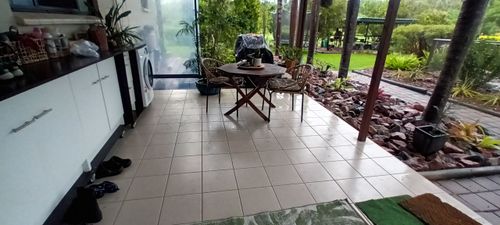
qm).
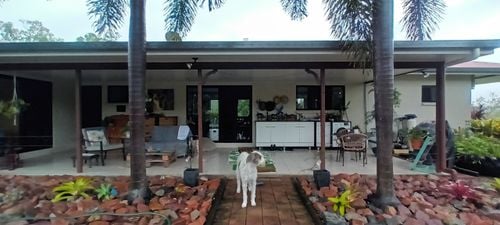
The patio really is used as front entrance to the home. With frogs, geckos, dogs, north qld weather and the pool just opposite it is disaster waiting to happen. The previous owner laid slippery indoor cream coloured tiles.... I been looking at decking tiles (expensive and with the gaps unsuitable as impossible to keep clean and smell free), tiles ($3500 for tradie alone) and now I am looking at the SPC vinyl plank options but can see there is doubt that it is suitable... I even looked at rubber tiles and pavers. Love to hear ideas or anyone who was successful in renocating/creating a cosy effective and safe patio area.
Apologies for the wet we just been through a cyclone and I tried to keep everyone including my wolfhound cross from slipping.
Solved! See most helpful response
Dear Mitchel and Eric, would you have a recommendation for decking tiles? When looking at some a lot of PP are coming up which of my understanding are very scratch sensitive. Thank you
Hi @YveB,
The options through us would be the Syneco 30x30x2cm Polypropylene 4 Slats Decking Tile Warm Grey- 9 Pack or the natural Acacia timber decking tiles.
It’s fair to say that, like most composite or plastic-based outdoor products, they can mark or scratch if they’re subjected to sharp or abrasive objects. Dragging heavy furniture, gritty pot plant bases, or debris like sand and gravel underfoot can leave visible scuffs over time.
That said, polypropylene is used because it performs very well outdoors. It’s UV stable, doesn’t rot, won’t absorb moisture, and handles temperature changes far better than many timber alternatives. For general foot traffic, outdoor dining settings, and everyday use, it holds up well and maintains its appearance when treated reasonably. Using furniture pads, lifting rather than dragging items, and keeping the surface swept free of grit will go a long way toward preserving the finish.
In your case, I would install a rugged outdoor mat at the entrance to help knock off debris from shoes.
Mitchell
Dear Mitchell, I bought one pack of the PP 9 tile in dark brown. Attached photo just to try. The acacia ones are untreated and would require too much maintenance the gentleness
Gentleman at my local bunnings advised. Unfortunately the PP is sounding very plastic like when stepping on it and feel the same way.
I did see these pavers however. Also photo attached. Unfortunately no one was available to assist. Would you be able to advise if these could be glued instead of filed in with sand and maybe a wooden border around it so they don't move? Also would they need to be primed. I can't find any info on the Web.
Thank you in advance
Hi @YveB,
If you were using the natural stone pavers over your tiles, you would need to start by giving the tiles a thorough clean to ensure their surface is free of contaminants. A pressure washer would be the best thing to use, but if you don't have one, a good cleaning with warm water, an outdoor cleaner and a scrubbing brush would suffice.
After cleaning, it would be a good idea to prime the tiles using this Crommelin 1L Tile On Tile Primer, which will help the mortar that you'll use to stick to the tiles.
You could then use How to Install Tuscan Path Natural Stone Pavers on a Concrete Base as a guide on installing your pavers. You would use a standard mortar mix as a bonding agent for your pavers.
Unfortunately, you would need to use some form of material between the pavers. This can be grout or a polymeric sand mix. These gap fillers are essential because they will stop the pavers from grinding against eachother if there is any movement, which can damage the tiles. It is much easier to replace some sand or grout than it is a whole tile that has cracked or broken.
You could certainly add a border around everything, but as it would be in direct contact with the ground, it would need to be treated accordingly. Otherwise, something like an aluminium angle, tile trim or a haunch made of mortar can be used to lock everything in place.
Let me know what you think and if you have further questions, please don't hesitate to ask.
Jacob
Workshop is a friendly place to learn, get ideas and find inspiration for your home improvement projects
We would love to help with your project.
Join the Bunnings Workshop community today to ask questions and get advice.