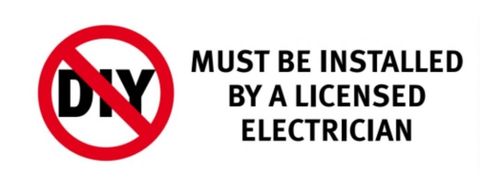
You may have seen these stickers around your local Bunnings electrical department and thought "oh they are just covering themselves". But it is so important not to carry out D.I.Y. electrical work as it has the potential to cause injury to yourself and harm others.
I am a qualified electrician of 20 years and have also held the position of a QTP (qualified technical person) - the person responsible for all rules and regulations of an electrical contractor licence of a business of multi million contracts. So I write this with an understanding of the importance of not only being qualified but always being current with the latest rules and regulations.
The following taken from the Electrical Safety Office QLD really gives good perspective on why you should never perform electrical work yourself.
You might think you can save a few dollars by having a go at electrical work yourself, but stop and ask yourself – is it worth risking your life or the life of someone you love?
Not only is it breaking the law, but you could also jeopardise your insurance!
Changing powerpoints or light switches might seem simple, but unless you are trained and qualified, there are lots of risks you just won’t know about. Never attempt to do your own electrical work – you could kill or injure yourself or your family, or start a fire. Always use a licensed electrician
What is electrical work?
Under section 18 of the Electrical Safety Act 2002 (the Act), electrical work includes "the manufacturing, constructing, installing, testing, maintaining, repairing, altering, removing, or replacing of electrical equipment".
This covers tasks like:
- installing a new power point
- replacing a light switch
- replacing a batten holder with a new light fitting
- repairing an electrical appliance like a heater
- altering the location of an existing power point
- replacing a light fitting with a ceiling fan
- constructing an extension lead
- replacing a plug on the end of an extension lead.
It’s not illegal to purchase electrical accessories or appliances that need to be hard-wired, but they must be connected by a licensed electrician.
Other work such as replacing a drive belt in a washing machine, cutting openings for air-conditioning units or fitting, but not connecting, an electric wall oven in a kitchen cabinet are not regarded as electrical work. However, electrical risks such as damage to, or contact with, wiring contained within wall cavities need to be considered and controlled, particularly when cutting holes or driving screws or nails into walls.
What can happen if I do my own electrical work?
In Queensland, electrical safety inspectors investigate and prosecute unlicensed work.
Aside from being illegal, people who perform unlicensed and DIY electrical work risk contact with electricity, which can have deadly consequences for them as well as for the users or anyone else who comes into contact with the electrical installation or equipment which may accidentally be left in an unsafe state. This danger may not be immediately apparent and often only becomes evident in a fault situation, or may even develop over time.
Major property damage from an electrical fire is also a risk and if it was the result of illegal electrical work, your insurer may refuse the claim.
What are the penalties?
DIY electrical work is regarded as unlicensed electrical work, which is illegal, and has penalties of up to $40,000 for individuals.
A breach that exposes an individual to a risk of death or serious injury or illness attracts a maximum penalty of $600,000 for an individual ($3,000,000 for a corporation) or five years imprisonment.