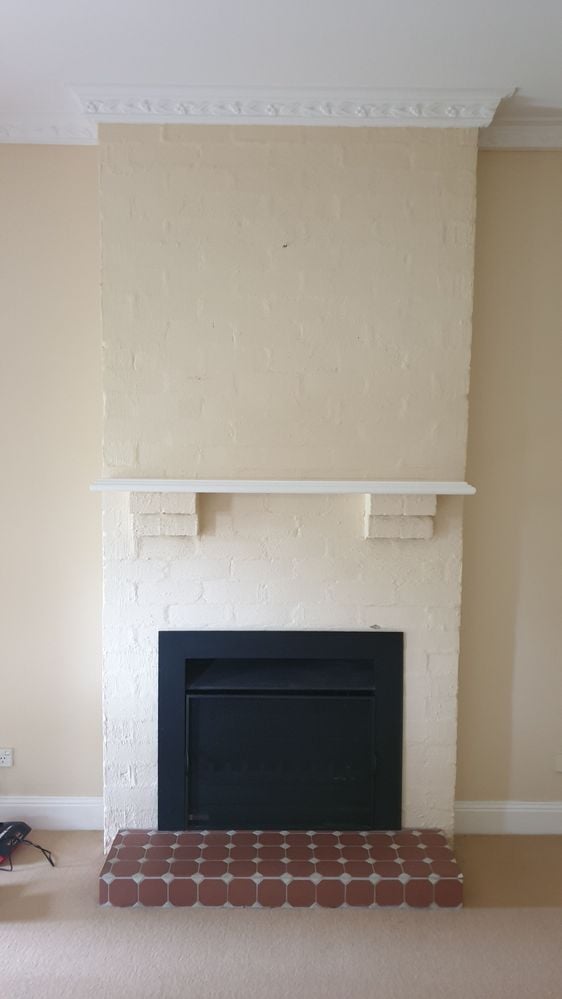
Hello,I'm looking to clad an open brick fireplace with stack stone. I was thinking of attaching cement sheets to the front and sides to give the stone a flat smooth surface to attach on to. Does this seem like a reasonable way to go about this?Cement sheet - https://www.bunnings.com.au/james-ha...62sqm_p0715374Adhesive between cement sheet and painted brick - https://www.selleys.com.au/products/...ls-rapid-cure/Screws for added support - https://www.bunnings.com.au/ramset-1...-pack_p2260701Thank you for reading and have a great day
Welcome to the Bunnings Workshop community @loggie. It's fantastic to have you join us and many thanks for your question.
What you have described sounds like a reasonable way to go about the build. The only alternative I can think of would be to remove all the paint from the bricks, as I wouldn't advise gluing stonework over the top of it. This will expose the bricks but wouldn't give you a perfectly flat surface to work with.
If you are going to use Tapcons, you should at least go up in size to Ramset 14G x 55mm Tapcon Countersunk Masonry Ankascrew. With your selected screw there will only be 17mm of thread in the brick, and I do not feel this will hold the weight sufficiently. Preferably I would advise you to use a Ramset 6 x 60mm DynaBolt Plus Flat Head Bolt every 500mm around the perimeter of the board. This might appear to be overkill, but once you have glued the stonework on, there is likely to be a significant amount of weight.
If the stack stone is natural, then they are susceptible to tile glues that are acidic and have long cure times. I've had some discussions with our various glue suppliers, and Sikaflex 11FC Plus Polyurethane Adhesive Sealant would be the best D.I.Y. product to use. I would advise to purchase the sausage 11FC and apply a liberal amount of the adhesive all over the back of the tiles and not just in dots or lines. You should find a QEP 6mm Square Notch Handyman Adhesive Trowel useful in getting a consistent coating.
Please let me know if you need further help or had questions.
Mitchell
Hi Mitchell,
Many thanks for the quick response.
Thank you for the link to countersunk dynabolts - I didn't realise there was a countersunk option, that's why I thought of using Tapcons. Dynabolts are definitely a better option thank you again. I was thinking of cement sheet over the brick because it allows for a quicker and less messy install compared to removing the brick paint.
The stack stone is natural quartz (picture attached); the company I bought them from suggested Mapei Kerabond Plus with Mapei Isolastic 50 as this is what their installers use even for large scale commercial projects. Does this sound like an ok alternative to Sika 11FC?
@loggie,
I would strongly recommend you follow the manufacturers' directions and what they suggest, I'm sure they know their product best. The only reason you would use Sika 11FC on slate, is to stop staining coming through the front of them from acidic glues. Quartz will not suffer the same issue as it is not particularly porous.
Thank you Mitchell. Will upload pictures of the completed project in a few weeks 🙂
I look forward to seeing the finished result @loggie.
Please let us know if you run into difficulties or need assistance. We're here to help.
Hello,
Quick update on the project - it came together quite well. I built a floating mantle and added some lights with a trim above to blend in with the existing crown moulding. Also lightly sanded the clay tile base and sealed with a gloss sealer. Apologies for the photo quality and shadows - the photo was taken late evening
Next step, painting and flooring 🙂
I took a few photos of the build process of each part; if anyone wants specifics feel free to ask.
Fantastic work @loggie! That has come up amazingly well.
I trust our members would really appreciate you adding the images of the build that you have. Undoubtedly, they would provide many with an indication of whether this is a project they could also complete.
Many thanks for updating us on your project. Well done.
thanks @MitchellMc the plan is now to paint the walls a warm white (haven't decided the colour just yet) and replace the carpet.
Here's a few build photos -
1. Started by removing the previous shelf and cutting the top layer of the brick corbels. The layer is used as a support for the floating mantel.
2. Cut and attached cladding using countersunk dynabolts (apologies didnt take a photo of this step).
3. Built the mantel using DAR pine. I routed a channel into the inside (bottom) of the mantel to accomodate the brick corbel before gluing, clamping and nailing from inside to avoid nail holes on the outside.
4. built the double returns on the mantle, routed an offset roman ogee trim layer on the underside and dry fit to check if it needed any adjustments.
5. Added support brackets for the first layer or stone just above the fireplace opening.
6. Continued with attaching the stone (approx 1m at a time) and built the light surround to match the thickness and length of the crown moulding.
Another angle of the finished fireplace:
Great job @loggie. And thank you so much for sharing plenty of photos and information for other members who might like to replicate your great work. We have featured this on our Project Gallery and are confident it will inspire other Bunnings Workshop members.
Jason
Hello @loggie,
That's beautiful work. Straight out of those design magazines! It just updates the look and feel of the whole area. Excellent touch on those lights. Amazing work all around!
Red
thanks for the kind words @redracer01 and @Jason
I made the light surround using pine moulding. 1 piece of this 92x11 straight edge and 3 pieces of this 42x11 with a colonial edge profile with mitered corners. I chose the colonial profile as it was similar to the 140 colonial baseboards the room has, which I plan on keeping after working on the flooring. The 11mm thickness also matched the lip of the existing crown moulding for a seamless transition.
If someone is looking for a more modern look, consider pencil round or tri quad.
Hi can I please find out whether its possible to install these stone panels on a less thick cement sheet? I have built-in shelves next to a brick fireplace (similar to the picture above) and was wanting to have a flush finish with the shelving if possible.
On the bunnings website I found a 9mm board - https://www.bunnings.com.au/james-hardie-villaboard-2400-x-1200-x-9mm-fc-lining-2-88sqm_p0710772 would something like this work if bolted down using the 60mm bolts mentioned above into the existing brick? thank you
Hi @daisie,
Welcome to the Bunnings Workshop community. We're so pleased to have you join us and look forward to reading about all your projects and plans for around the house and garden. We're sure you will get plenty of helpful information, advice and inspiration from our amazing community members.
The ever-helpful @MitchellMc will be more than happy to assist you with your question when he is back on the site on Friday. Thanks for your patience in the meantime. Let me also tag @loggie and @redracer01 who might like to share their thoughts.
Thanks,
Hi @Jason thanks for the tag and @daisie I'm happy that my project has inspired you to redo your fireplace as well.
There was a lot of conflicting information online about the use of villaboard for a stack stone substrate when I was researching online. I spoke to James Hardie to clarify and they directed me to their villaboard installation guide which suggests the product you linked to should be ok. To be on the safe side, if you do use 9mm boards, I suggest following instructions on page 10, 11 and 16 of the above link with bolts every 400mm and using support angles every metre or so. For the support angles, I used a few of these 20x600 pieces (can be cut with a grinder or tin snips) and bent with pliers.
There's also a clause on page 16, to not exceed 3m in height.
This document from Ardex was another one I referred to at the time. Page 2 talks about villaboard and the use of support angles.
Thanks you loggie for the detailed information and sharing your research in your fantastic project. Will have a read through the documents in detail.
It's great to see you've already received a helpful reply from @loggie. If you have further questions, please feel free to start your own discussion including images of the area and as much information as possible so we can provide a solution.
I'll be looking forward to following along with your project.
Thank you. Yes the information loggie provided was very helpful. And I'm glad the 9mm board looks like a suitable option.
My initial confusion about whether or not 9mm cement board would be sufficient was because of the following links I came across.
The instructions under the fibrous cement board section in the following link said minimum 16mm
https://www.norstone.com.au/installation-guide/
Whereas page 7 in this link specifically shows 9mm as a suitable substrate.
https://veneerstone.com.au/wp-content/uploads/2014/01/Installing-onto-stone-sheet.pdf
Sorry for not attaching a photo of what I was looking to do. Here's a sample.
Thanks for the clarification @daisie,
Please let us know if you need any further assistance. We're here to help.