The Bunnings Workshop community can help with your home improvement projects.
Help!
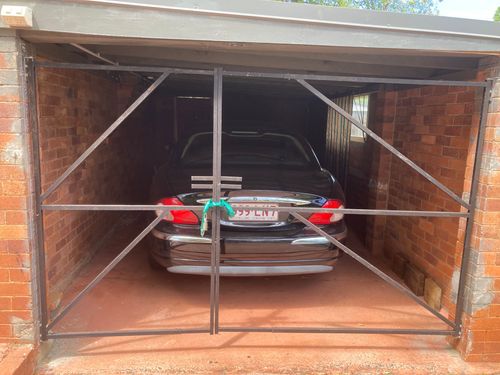
I bought a couple of garage door frames from Bunnings some time ago. I had erected them and clad them with 7mm marine ply. Unfortunately, it wasn't effective and after a while it started to buckle and eventually became so bad I had to pull it off and replace it.
The door frames are steel, I believe and made of about 20mm square tubing.
I received advice that wooden slats was the best option and I obtained 19 x 100 pine slats and after a sand to smooth, undercoated and top coated them with exterior paint.
I was advised to use galvanised 8g -18 x 32mm wing screws for fixing and to put 2 of each into top, middle and bottom rails and that the were self tapping and I shouldn't need to drill pilot holes, that they would just screw right in and I wouldn't need to drill pilot holes first.
Today I went to start the job.
* I clamped the first slat to a frame
* Tried using a cordless drill and bit to drive the first screw - it went through the wood but made no impression on the metal.
* I tried using a corded power drill but again without success.
* I then drilled a pilot hole slightly smaller than the screw diameter.
* I tried driving a new screw by using the pilot hole but again it was unsuccessful.
Obviously, I am doing something wrong or have the wrong screws or ?
Both of my drills are in good order and working fine on other jobs, they are not old and worn.
I used a new, for metal, 4mm bit for the pilot hole.
So, I'm not sure what is the problem?
Do I need different screws?
A better quality bit of a particular type?
Some form of lubricating oil for the screwing into the metal?
Can anyone advise me what I might need to do, please?
This is one of my least favourite jobs due to the difficulty level. A few months back I had to replace rotted wooden pickets on two large gates similar size to your frames with Merbau ones. Others may have a better method, but this is how I went about it.
Step 1. Check the steel frame is square and in most importantly is consistent in height. If it is, then the next step is easier.
Step 2. Lay the boards on a flat surface and run a pencil across the top, middle and bottom screws lines. The diagonals can be done once the timbers are up.
Step 3. Drill pilot holes the same size as the screw body
Step 4. Countersink the holes the depth of the screw heads
Step 5. Clamp the timber
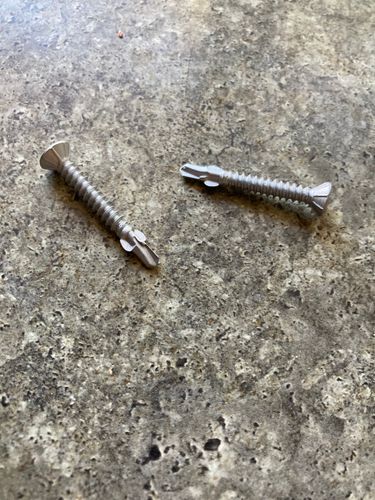
Step 6. Though those winged screws you have are meant for timber to metal, the wings can make a mess of the timber and rip the timber holes bigger than need be. The wings on some are supposed to break off when entering the metal. But if they don't they can bog the hole. Plus all too often a screw doesn't make it though, then there is a high chance it will jamb or snap. Most manufacturers even warn of this. So simple self drilling screws like the one picture below I find work best. I couldn't find them on the website but @MitchellMc might be able to assist.
And when driving the screws and one just doesn't seam to work, just swap it out for another. The chances are it has a burr on the cutting edge preventing self-drilling. Avoid stopping during driving process and maintain pressure on your drill-driver.
Nailbag
Nailbag, Thank you so much for your interest and taking the trouble to reply.
Your suggestions make sense to me, my only concern would be re-fitting the doors with the wood already connected because I am on my own and almost 80 with limited strength now. However, it did occur to me that perhaps I could follow all of your steps save actually fixing the slats, then hang the frames again and, because the holes will already be pre-drilled, perhaps it would not an easier job to put in the screws. I wonder what you think?
I had wondered about the 'wings', too, for in a pre-drill on a spare piece of wood, the screw did seem to make a mess of the hole in the timber.
Thanks again. I do very much appreciate your help.
Screw battens from the inner side of the steel frame.
Then just use wood screws to attach your slats to the battens.
Just a thought on a very hot day @nonsibicunctis.
Cheers.
Noyade, thanks for your suggestion. It is indeed very hot and was when I was attempting this yesterday - I was doubly hot by the time I gave up and decided to ask for advice - should have done so in the first place but (wrongly) thought I knew what I needed to do.
I'm giving it a couple of days to see what suggestions I get and then will decide and go back to it. Your idea seems reasonable but my reservation is the extra weight of the battens because the frame is only very light. When I bought it I tried to get details about what weight load it would carry but couldn't get any cooperation so took the risk - but not the most sensible thing to do and now, who knows?
Thanks anyway - I hope you, at least, can stay cool.
Hi @nonsibicunctis,
I can't locate a listing for a screw like @Nailbag mentioned, although I am pretty confident that we will have something similar and agree that they would be better. We have just changed over screw suppliers, so there may be some options missing from our website. If you head in store with Nailbag's photo as a reference, I am sure the team will be able to help you locate something similar.
With these screws, Nailbag's process is also what I'd recommend.
His method should be achievable with the gate frames in place; you'd just have to lock them in place or have someone hold them while you are driving your screws in, ensuring their hands are well clear of the screws themselves. Metal screws require you to apply a fair bit of pressure to your drill for them to punch through the metal, which could be a contributing factor as to why you have been struggling with the current screws. If you don't have an equal force pushing against the frame, then the screws are likely just pushing the frame away from you instead of biting and cutting through the metal.
With metal screws, you can put a small pilot hole through the metal, around 1-1.5mm in diameter, and then use the cutting head of the screw to finish off the job. This could certainly help, considering the issue is with the screw biting into the metal and then punching through.
I think the main thing is that the gate frame is really locked in place. If you don't have someone to hold them, then something good and heavy for the gate to push against would be a great help.
Fingers crossed your next attempt goes well, but we are always here to help if you need more support.
Jacob
Hi JacobZ,
Thank you for your contribution. I am sure that you are right about the pressure thing because it makes sense to me and, indeed, although I had some solid blocks behind the base of the frame, I didn't have anything further up. - I was holding the frame with my left hand whilst holding and drilling with the right. - Foolish and ought to have been obvious to me. - Perhaps I had an unconscious of sub-conscious awareness because after the debacle attempt, I had had in mind to take off the frames and put them on the garage floor whilst fixing the slats but I wasn't sure whether I'd be able to put them back on with the extra weight. I also have trouble bending so I'd also thought of putting them on saw horses (as in the picture) because I'd done that once before after a tradie backed into the doors and bent the frame, finishing off the earlier cladding for good. I managed to bend it back into shape by using some hard-wood off-cuts and clamps.
So, all of the information and advice I've been receiving is invaluable. It has given me new ideas with which to work as well as confirming some thoughts I'd had and alerting me to obvious mistakes. - Unfortunately, I have neither friends nor family but I think I will have to try and find someone to help or rig something to hold the frame firm - it's either that or take the frame off and manoeuvre it back on - I think I could probably achieve that on my own.
So, thank you and everyone else who has given me food for thought and advice. I really do appreciate everyone's willingness to help and this service that Bunnings offers - for those such as myself who has no skills and just makes it up as I go along, this service is invaluable.
Take care. Stay safe. Have a great year all.
@JacobZ reminded me that I missed a step, let's make it Step 5A: Which is to drill 3mm pilot holes in the steel even though I'm using self-drilling screws. It makes a huge difference in how easy the screws drive in. You will burn through a couple and I usually buy these ones. They aren't the cheapest, but by far the best I have used and you will get more than your money's worth in the amount of holes you will get out of each one in steel. Just ensure you don't apply to much pressure and keep the drill straight to avoid breakages.
Nailbag
Another great suggestion here @Noyade 👌
Workshop is a friendly place to learn, get ideas and find inspiration for your home improvement projects
We would love to help with your project.
Join the Bunnings Workshop community today to ask questions and get advice.