
The Bunnings Workshop community can help with your home improvement projects.
- Bunnings Workshop
- >
- Discussion
- >
- Outdoor
- >
- Drilling through steel/metal/colorbond
Drilling through steel/metal/colorbond
- Subscribe to RSS Feed
- Mark Topic as New
- Mark Topic as Read
- Float this Topic for Current User
- Bookmark
- Subscribe
- Mute
- Printer Friendly Page
Share


- Mark as New
- Bookmark
- Subscribe
- Mute
- Subscribe to RSS Feed
- Highlight
- Report Inappropriate Content
Drilling through steel/metal/colorbond
Had a go at putting together a colorbond fence over the weekend, while we got the job done, each hole I had to drill took a good few minutes each. I've watched just about every tutorial for drilling through steel and it just seems to go straight through alot easier than I was doing it, what am I doing wrong?? I'm just using a standard cordless drill (which from what I can gather is all I need) and a heavy duty cobalt bit. I'm pre drilling each hole, then using self drilling tek screws to fasten. Am I not using the correct tools?
It turned a relatively easy job into a full day mission because the drilling just took so long...

- Mark as New
- Bookmark
- Subscribe
- Mute
- Subscribe to RSS Feed
- Highlight
- Report Inappropriate Content
Re: Drilling through steel/metal/colorbond
"I'll take a photo this afternoon of my drill bit to see if you can identify any issues."
That would be interesting to see. Based on your experience, there has to be something wrong with the drill bit.
Did you try another 4mm drill bit?
- Mark as New
- Bookmark
- Subscribe
- Mute
- Subscribe to RSS Feed
- Highlight
- Report Inappropriate Content
Re: Drilling through steel/metal/colorbond
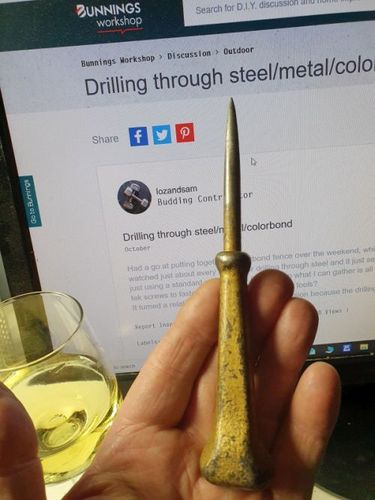
As Eric mentioned - a punch might be useful prior to drilling. But the 5 minute story is clearly excessive....
If there is wood behind the corrugated iron I tend to use this. The wine is just a bonus.

- Mark as New
- Bookmark
- Subscribe
- Mute
- Subscribe to RSS Feed
- Highlight
- Report Inappropriate Content
Re: Drilling through steel/metal/colorbond
For all sheet metal twist drills are a waist of space they catch and rip the sheet a very smart person designed step drills and bunnings has a range of cheap to not so cheap step drills They can be used for a wide range of tasks including drilling plastic.
https://www.bunnings.com.au/craftright-3-piece-step-drill-set_p0027584
- Mark as New
- Bookmark
- Subscribe
- Mute
- Subscribe to RSS Feed
- Highlight
- Report Inappropriate Content
Re: Drilling through steel/metal/colorbond
"For all sheet metal twist drills are a waist of space"
Gonna have to disagree mate. 
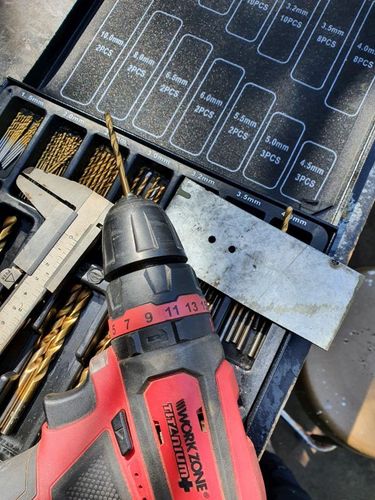
Experiment...
Cheap drill bits.
Cheap cordless (10.8V) Aldi drill - set to high speed.
1.5mm sheet metal.
Two 4mm holes drilled in 24 seconds.
Experience - priceless!
There has to something quite wrong with the opening poster's drill bit, as surmised by Mitchell on the previous page.
- Mark as New
- Bookmark
- Subscribe
- Mute
- Subscribe to RSS Feed
- Highlight
- Report Inappropriate Content
Re: Drilling through steel/metal/colorbond
Thats the beauty of this forum everyone has the opportunity to provide information and experience, a step drill 4mm set in cheap drill at heigh speed same thing no possibility of catching

- Mark as New
- Bookmark
- Subscribe
- Mute
- Subscribe to RSS Feed
- Highlight
- Report Inappropriate Content
Re: Drilling through steel/metal/colorbond
Hi Lozandsam,
I feel your pain and frustration with drilling into colorbond sheets/post, BUT I did some out of the box thinking and came up with a winning recipe.
For the issue with the sheet: I laid them down on the ground, put a piece of timber under the area where the hole would be, got a decent-sized nail, and with the hammer, I wacked the nail just once, sharp and solid, and bingo a hole was created.
For the colorbond fencing post, I used hex head roofing screws and just drove them into the post. The screw did the job, when I removed it there remained a whole.
It worth trying, and costs next to nothing. (sorry Bunnings)


- Mark as New
- Bookmark
- Subscribe
- Mute
- Subscribe to RSS Feed
- Highlight
- Report Inappropriate Content
Re: Drilling through steel/metal/colorbond
Hello @Cloverleaf
Welcome to the Bunnings Workshop community. It's sensational to have you join us.
Thank you for sharing your knowledge and experience in regards to creating a hole in Colorbond sheeting.
Were keen to hear more about all your projects and plans around the home and garden. Please feel free to reach out whenever you need assistance or would like to share a project with the community.
Eric

- Mark as New
- Bookmark
- Subscribe
- Mute
- Subscribe to RSS Feed
- Highlight
- Report Inappropriate Content
Re: Drilling through steel/metal/colorbond
Hi
without going into the technical aspect of drill bits there are several things that need to be taken into account the drill speed the material to be drilled so
1. the smaller the drill the faster it has to go ie a 4mm drill need to spin faster than 12mm bit reason the point of the bit will chip ( subject to material being drilled .Hence the larger the bit the slower is must go. There are a number of charts available on the net that details this.(boils down to actual point speed ie the point spins slower than the outer diameter cutting edge )
Points - the drill bit you buy is set at an angle of 118deg for drill a range of materials for harder metals l an angle of 135deg these are fundamental rules which can be fount on charts found on the net
There are a range of angles for all materials that can be found on charts on the net
The other aspect of the drill bit is how wide is the cutting point with sheet metal a relived point is better to drill with.
i suggest that if you have an interest look up drill bit angels for all materials and timber suffers the same issues
it must be kept in mind the drill bit you buy is sharpened for drilling a range of materials hence 118deg including cobalt drill bits
I am sure there are number of engineers reading this would agree
Best of luck for further drilling

- « Previous
-
- 1
- 2
- Next »
Why join the Bunnings Workshop community?
Workshop is a friendly place to learn, get ideas and find inspiration for your home improvement projects
You might also like


We would love to help with your project.
Join the Bunnings Workshop community today to ask questions and get advice.