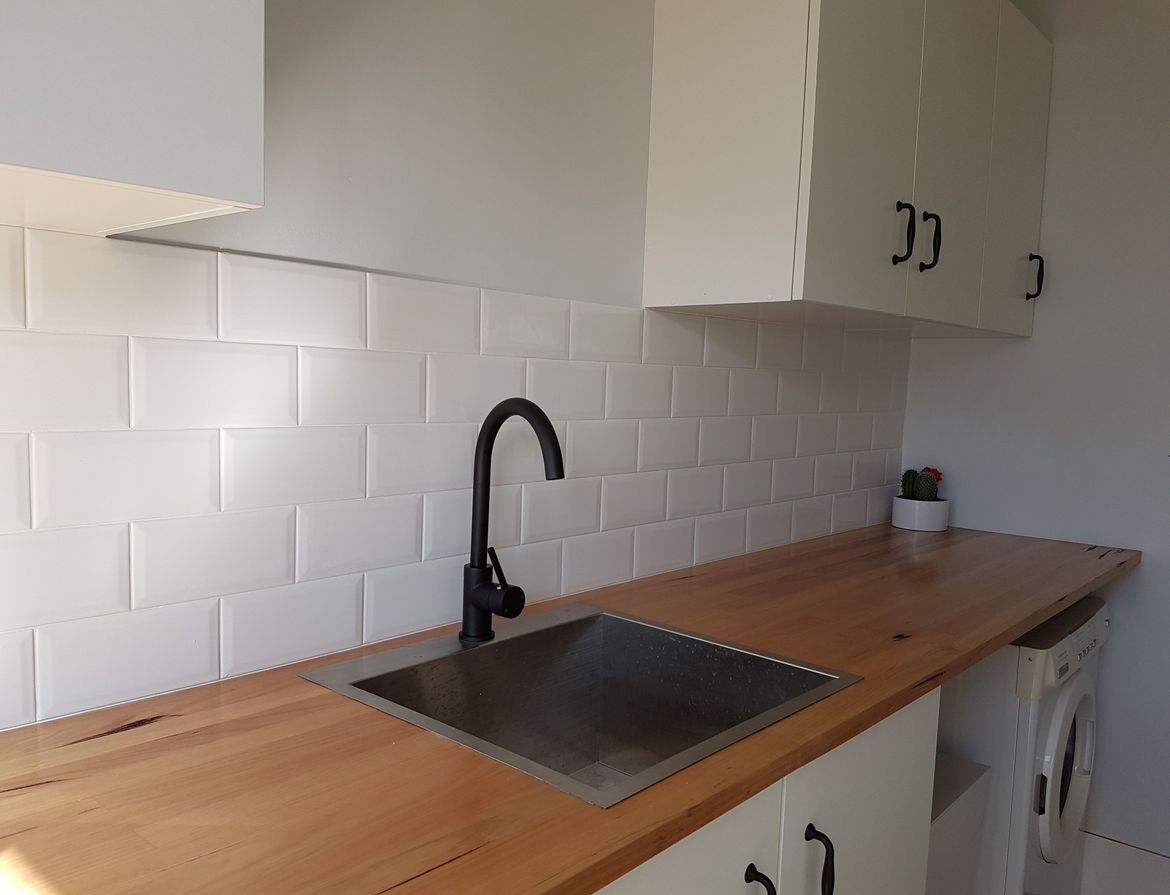
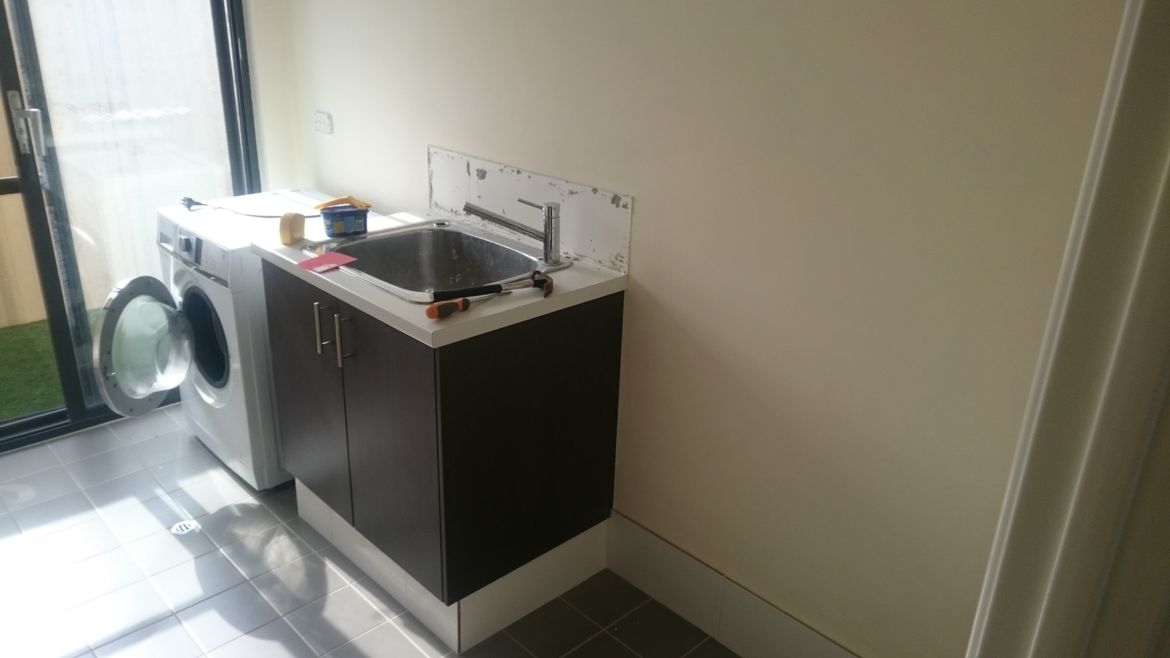
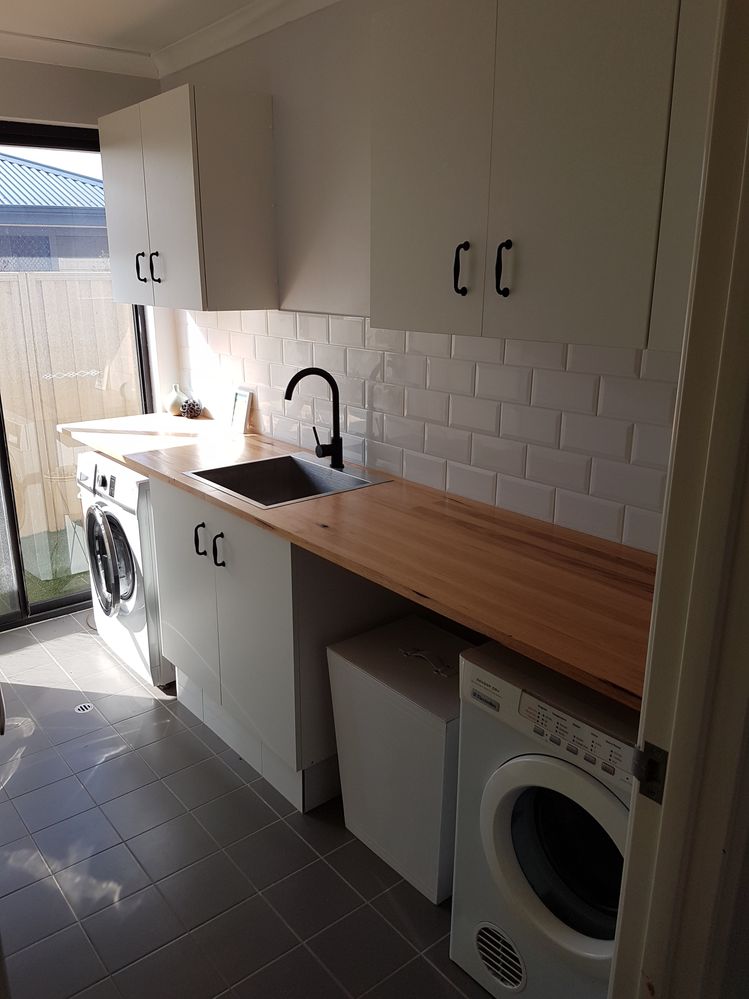
Updating your laundry with new fittings and extra storage can make the space more functional and attractive. This dramatic renovation included removal of the old laundry tub, a new splashback, lovely large timber benchtop using Tasmanian Oak project panels and overhead cabinets.
The project
To kick things off I obviously started with a design courtesy of Leah (Mrs ProjectPete) and regardless of how simple or difficult it was, it had to be done – time to rip out boring old stuff.
Once it was all out, I got started on repainting the walls and repositioning the powerpoints so it would be hidden under the new benchtop and wouldn't interfere with the new wall-to-wall splashback.
We marked out the position of overhead cabinetry we planned to install so we didn't have to waste time and money painting unnecessary areas of the wall that would be covered anyway.
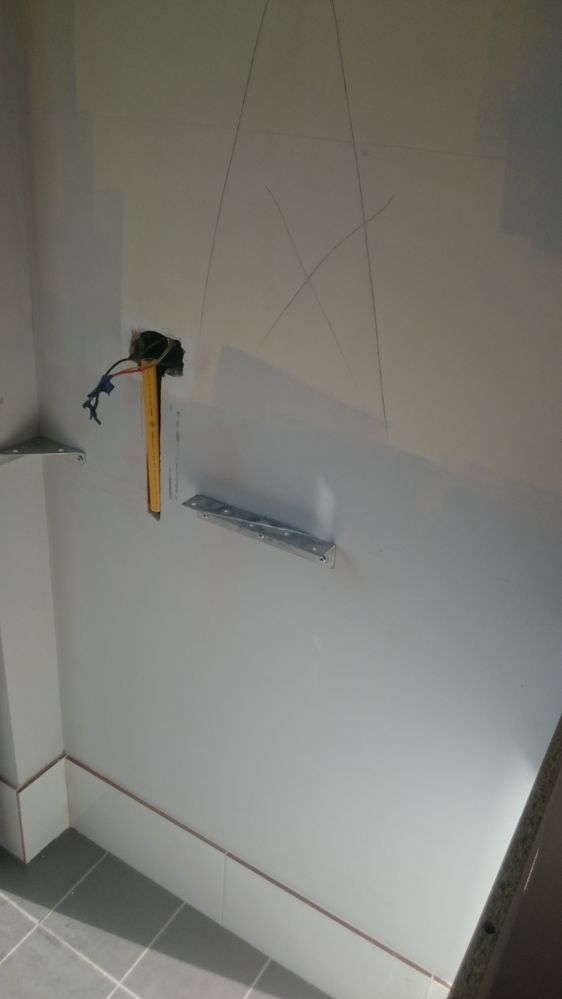
Installing the power points was a simple case of marking out where the benchtop would be, channelling the wall to the new position and filling the channel. I first installed the back and sides of the centre cabinet to get a level for the benchtop position, and then channelled the wall with an angle grinder. It gets super dusty, so cover up surrounding areas and vacuum straight away. To make repositioning the cables easier and the refilling smoother, you can use PVC or flexible gas piping. Refilling the bulk of the channel with cement, I finished it with a smooth Spakfilla, sanding it back to finish flush and smooth with the wall.
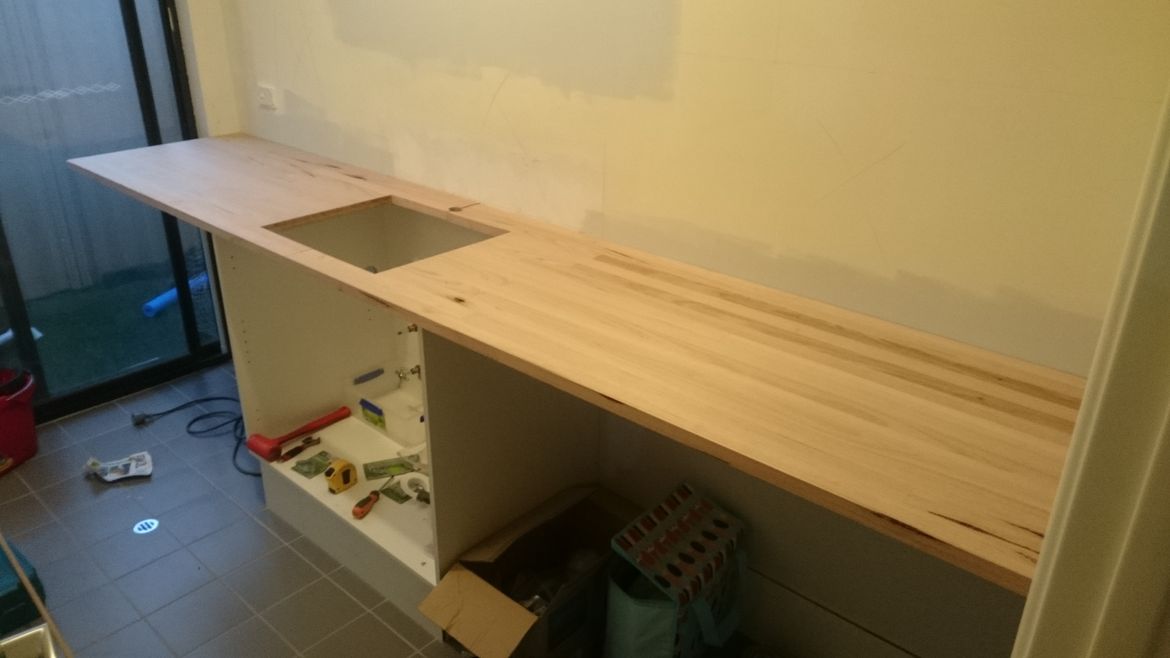
While measuring out the new benchtop, I also measured out the cutouts for the new sink. I then sanded and stained the benchtop, sanding after the first and second coats. I applied three coats of a Feast Watson product to finish and protect my timber benchtop, and it's still in great condition five years on from the initial install. Ensure every square inch of the wood is stained and sealed, including where you make cuts. This is to prevent the wood warping, especially in a moisture-rich room such as a laundry.
With the benchtop ready for install, it was slotted in and fixed to the brackets.
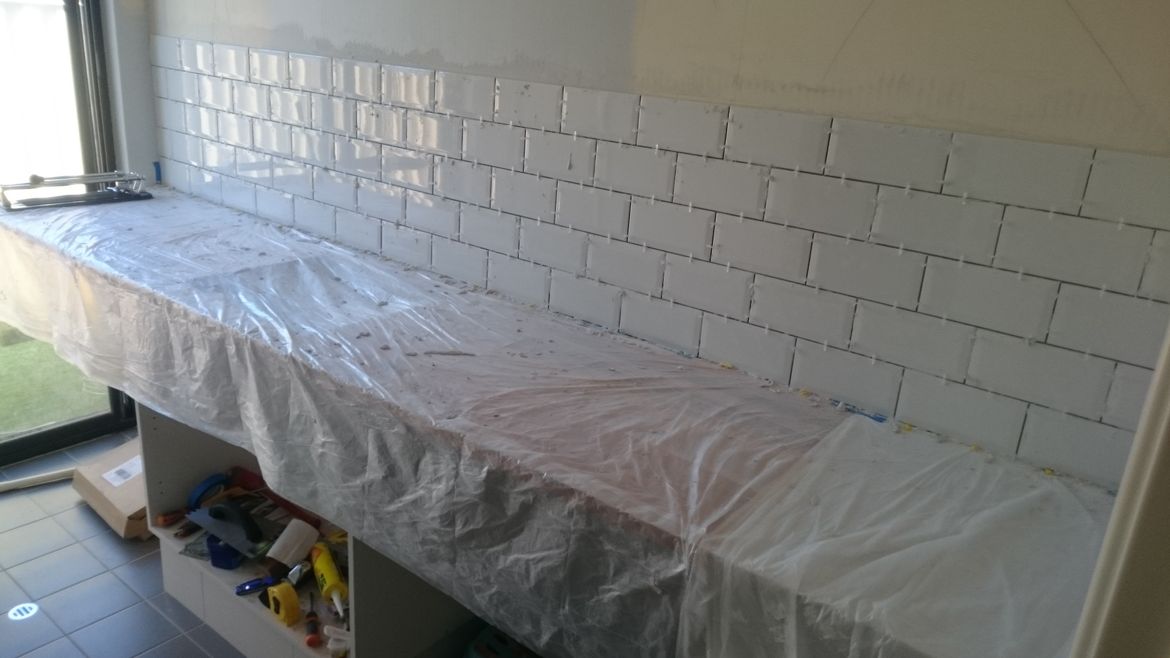
This video on Workshop from Bunnings was all I needed to install my first splashback. With the subway tile splashback completed, it was then time to install the overhead cabinets and the doors on the bottom centre cabinet, and then get the sink and plumbing finished.
The last thing to do was to fill the join, and then give the benchtop a final sand and coat. I hid the join in the two benchtops as best I could by putting it right in the middle of the benchtop so the sink would cover most of the join. Given the small amount of space to make the join, and to achieve the strength I needed, I used 12.5mm dowel joins. Given the benchtop is in a moisture-affected room with a lot of condensation, it's a good idea to leave a gap for expansion – 5mm is sufficient. Your wall tiling will cover the gap.
The timber used in this build was a couple of Tasmanian Oak project panels from Bunnings. I cut the lengths with my new Bosch Circular Saw. The benchtop is a Victorian Ash laminated project panel – readily available from Bunnings and great value. First pass with a sander is key, get it done with some power. Then it’s just a light hand sand between coats. The sink cutout was a straight forward job with my Ryobi jigsaw.
If I were to design this laundry from scratch, I'd have the washer and dryer side by side for ease of use, but for this renovation it came down to simplicity and cost given the plumbing and sink was already in the middle from the original build. There was no issue with the sliding door when renovating our laundry as I ended the benchtop on the outside of the 'frame' (brick wall) instead of cutting the wood to fit into the sliding door recess.
The bottom line – have a vision, plan for it, be ready to adapt and just go for it. There were some ‘firsts’ for me in this project and I’m super stoked with how well it all turned out.
Before and after
Tips for installing a tiled splashback
- Protect the benchtop – the fourth and final coat is done once the splashback is up and the overhead cabinets installed.
- Instead of smearing grout all over the tiles, pushing into the gaps and then cleaning, focus your application of grout to the gaps, push and smooth them – a lot less clean up.
- Get that first row right. As long as it’s straight and level, the rest will flow nicely.
- For small subway tiles like mine, use an angle grinder and a steady hand to cut to size. Don’t bother with a tile cutter.
Workshop member MikeTNZ added that being able to cut tile using an angle grinder to a line made with a fine pen is a great D.I.Y. skill and is far better than using a tile cutter. "Beginners should start with a 4" (100mm) grinder and a 2mm thick cut-off disc – these are easy enough to control with one hand."
For a step-by-step guide, visit How to tile a splashback.
Popular laundry renovation projects
Completed in just a day for a wallet-friendly budget of $500, Workshop member Jess transformed a basic laundry with a standard trough and no storage by installing a new sink, cupboards, tiles and benchtop.
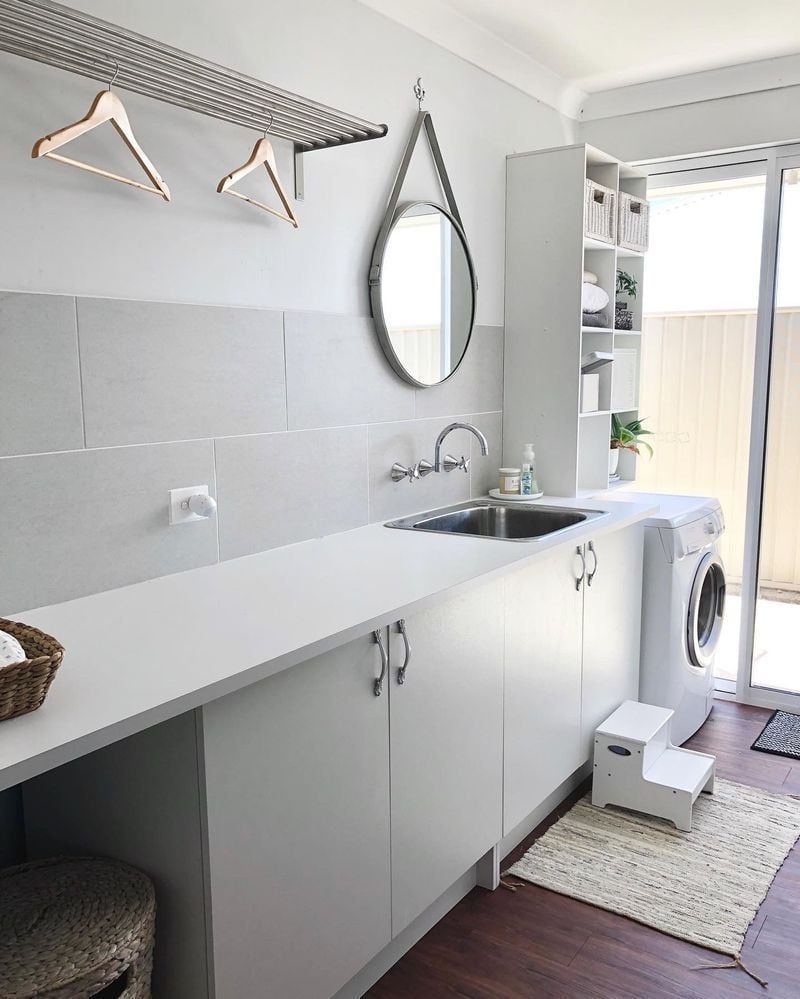
Starting out with a basic trough in a European style laundry, Workshop member Rufaro transformed this space with overhead cupboards, a marble benchtop and new sink.

Bunnings Workshop member abhayks replaced the flooring, tiles, benchtop, sink and cupboards in a D.I.Y. laundry renovation that saved them more than $6,000.
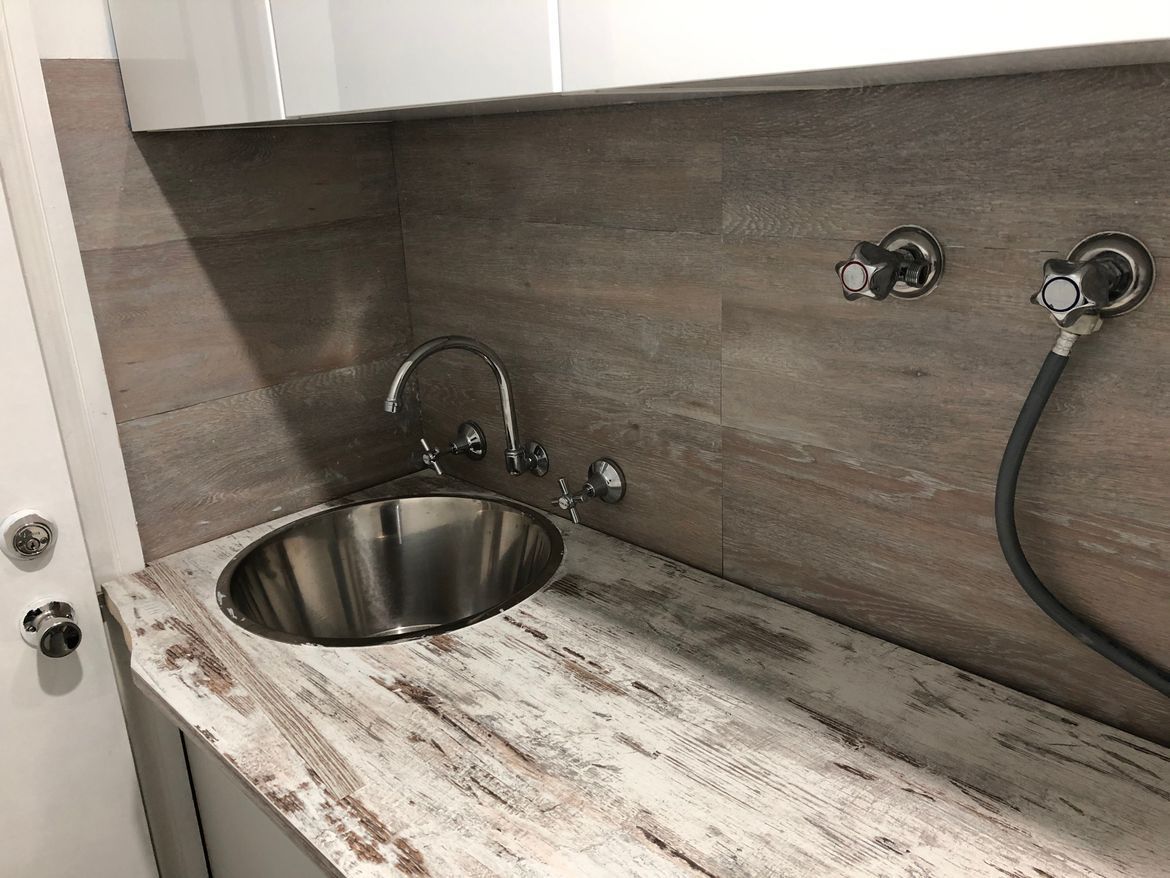
Get more ideas for your laundry makeover from our Top 10 most popular laundry renovation projects.