Hi folks,
Not sure if this is the right forum for this post, apologies if not, but as the title states I'm looking for a reasonable priced but efficient drill with drill bits for starting out. Are there drill bit kits that have everything you would generally need or is it kind of collect as you go? The ones I am looking at are as follows:
https://www.bunnings.com.au/ozito-home-12v-cordless-drill-driver-kit_p0018378?referrer=RetailApp&utm_source=Bunnings&utm_medium=ProductFinder&utm_campaign=SeeReviewsOnline&pid=0018378
https://www.bunnings.com.au/craftright-99-piece-titanium-coated-drill-bit-set_p0019576?referrer=RetailApp&utm_source=Bunnings&utm_medium=ProductFinder&utm_campaign=SeeReviewsOnline&pid=0019576
Any advice would be greatly appreciated,
T.
Just found a helpful guide on different types of drills. I understand that the drill I would be looking at is a cordless driver drill, still a bit unsure on bits though.
Hi @TJP
The first question is what do you intend to use the drill for and how much useage do you expect to put it to? A driver drill for example wouldn't be much use for drilling into a brick wall but most battery operated hammer drills can have the hammer turned off and be used as a drill driver. As to the useage, if you are going to do occasional work with it, a 12V may be OK but if you expect to get more frequent use, an 18V or even higher may be worth considering. You also need to consider the battery storage with the drill as well for how long you can use it between charges.
Let us know what you want it for and we can better advise.
Hi @R4addZ
Just off the top of my head, my first jobs would be drilling through screws securing a toilet bowl, attaching a toilet roll holder to wall, through what I believe is brick, Dead lock on door, attaching new lock to shed and eventually putting up some shelving
G'day @TJP
Regards the drill choice, may I suggest you bump up your search criteria to 18V.
Purely based on recent ground-breaking experimental brick penetration studies, should you require it...
😁
https://www.workshop.bunnings.com.au/t5/Whole-of-House/How-to-drill-into-brick-with-Hammer-drill/m-p/294163#M27467
Hi @TJP,
While the Ozito 12V drill would be useful for very light drilling and driving purposes, it would not be suitable for drilling into brick.
Realistically, if you are drilling into brick, you should be looking at two different drills: a rotary hammer drill and a drill driver.
A rotary hammer drill is specifically designed to drill into masonry, and if you have a brick home, then it is certainly worth grabbing one. This Ozito 710W Hammer Drill would be a good, relatively inexpensive tool for that task.
Your drill driver is going to have broader uses, and it is worth investing in something on an 18V platform as they will have more power and the batteries will be compatible with more tools. This Ozito PXC 18V Cordless Drill Driver Kit or this Ryobi 18V ONE+ Drill Driver Starter Kit would be good for basic drilling and driving. Either of these drills would be fine to drill into a door and attach a lock to a shed.
In terms of bits, this Ryobi 40 Piece Specialty Metric Drill And Drive Set contains a good variety of bits, including some masonry bits and spade bits, which would be handy for the toilet roll holder and dead lock.
Let me know what you think and if you have further questions, please don't hesitate to ask.
Jacob
Forget 12V go for the:
Ozito PXC 18V Cordless Drill Driver Kit PXDDK-250C (0299323)
and if you get bitten by the DIY bug (no treatment for that) follow-up with the:
Ozito PXC 18V Impact Driver - Skin Only (6290472)
I have the brushless versions of the above but always use the:
Ozito 710W Hammer Drill (0299328) with 13mm chuck for masonry work.
The Craftright 99 Piece Titanium Coated Drill Bit Set (0019576) is good for general DIY.
Suitable for drilling soft metal, wood and plastic
However... if you were contemplating refurbishing a garden shed that requires drilling out lots of pop rivets don't use any bits from that set. You would need something like this:
Cheers
There is no need to buy 2 drills when you can get one that does both jobs.The one in the link below is an inexpensive drill that will meet both needs but is more of a home use item than a tradie grade one. I can't comment on quality as I have never used this make. The drill has a hammer feature that you can turn off and a clutch for when using as a driver and it's only $10 more than just a plain driver drill.
https://www.bunnings.com.au/ozito-pxc-18v-hammer-drill-skin-only_p0124076
You will also have to buy a battery to suit it.
If you are drilling out the screws for a toilet then I would recommend staying away from an impact driver as the vibration could crack the pan.
If you are drilling out the screws because the heads are stripped, it may be worth mentioning that you can buy special drill bits that spin the opposite way to normal and when drilling out screws you can often get lucky and they snag but then screw the screw out for you.
Hi, @R4addZ @AlanM52 @JacobZ @Noyade
Thank you for all your input it has been very helpful. Just one question, like @R4addZ mentioned getting a two in one function drill, why would I not opt for this over two individual drills? Is it a case of the two in one is average at two jobs where as a drill that specialises in one job is good at the one job rather than average?
Regards,
That's exactly right.
While a drill driver with a hammer function is able to drill into light masonry, they aren't great at it and people are often let down by this fact.
I own a Makita 18V Brushless Heavy Duty Hammer Driver Drill DHP486Z, which is a high-end, trade-facing drill driver with a hammer function. While it is capable of drilling into brick, this Ozito 710W Hammer Drill, which I also own, is far better at drilling into brick.
Your best bet would be to invest in a decent quality drill driver with a hammer function, preferably on an 18V battery platform, and then grab a rotary hammer drill later on if you need it.
Perfect, thank you for confirming @JacobZ.
Some things to consider-
A cordless drill is actually quite limited when it comes to performing one of its basic functions - driving common crosspoint wood screws into timber.
The most popular DIY timber is pine and wood screws longer than even 30mm will likely require a pilot hole.
Don't expect good results using a cordless drill in hammer mode to drive in wood screws.
Google AI returns this:
Yes, a hammer drill can be used to drive timber screws, but it's generally better to use a regular drill or an impact driver for this purpose. While hammer drills are designed for drilling into masonry with a hammering action, they can also be used for drilling and driving screws in wood. However, the hammering action is not ideal for driving screws, as it can damage the screw head or the wood, especially with smaller screws or softer wood.
And here is a Workshop post - Re: Unable to drive a screw into timber pole using Hammer Drill.
https://www.workshop.bunnings.com.au/t5/Outdoor/How-to-drive-a-screw-into-timber-pole-using-hammer-drill/td-p/279838
I suspect @EricL didn't respond because he was not actually tagged.
As I said if you get bitten by the DIY bug (instead of now) you can purchase the impact driver later on.
Hello @TJP
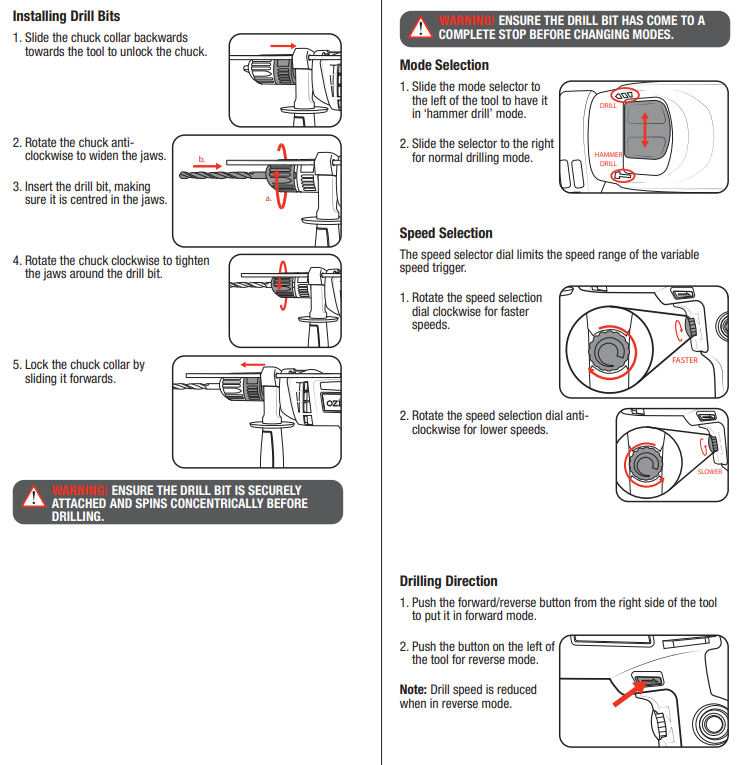
My apologies for the late reply. You've received excellent advice from our members in regards to a starter D.I.Y. drill. I just wanted to confirm what @AlanM52 has stated about hammer drills being used to drive timber screws. You can clearly see it on the Ozito 710W Hammer Drill. I've placed an image below to give you a better idea of its function. The corded drill has more power which you'll need when drilling into brick, masonry or steel.
Choosing your drill bit depends on what you are using it for. The multi drill bit set in a box or packet that is midrange is great for standard woodworking. For heavy duty work such as when you drill into hardwood or drilling into steel will require drill bits that have a higher quality. These are often sold individually and will often say cobalt, titanium coated or hardened tip. The Kango or Diablo sets are some of the most commonly used bits for harder materials.
If you need further assistance, please let us know.
Eric
@EricL @AlanM52
Thanks fellas' all this insight I've received into drills over the past 24 hours has been fantastic! It has cleared things up in regards of what to buy and what not to buy.
Yes, you can get better in each but does your use case justify the increase in expense?
I, as a tradesperson, swear by Bosch tools (I may be in a minority but in years gone by I actually sold power tools for a living). I have a seperate driver and hammer drill but it is a true hammer drill. The drills we are discussing here are not full blown hammer drills, they more produce a vibration rather than actually hammer the bit. Mine is more like this....
https://www.bunnings.com.au/bosch-18v-professional-rotary-hammer-drill-0611909000-skin-only_p8910280
(I can't find my model on the site) and uses SDS bits. These type of drills actually use an electro pneumatic action that drives an actual hammer piston back and forth and are so powerful you can't use a normal chuck as it could vibrate it to bits. With these types of drills you have the opposite problem in that trying to drill normal brick you have to be careful not to drill too quickly or risk damaging the brick and if drilling through a wall to the other side , I have to turn the hammer off about 20 - 25 mm before reaching the other side or it will blow a sizeable hole on the other side.
Any drill you buy for drilling masonry will benefit from a sharp drill bit and on occasion I have actually used just the driver with a masonry bit in it to drill smaller holes in brick (such as for a red plastic plug) with a new bit.
All this aside the drills we have discussed all claim to be suitable for drilling brick so it is up to you what you decide to buy.
Hello @TJP welcome to the Workshop Community 👋
There are a good range of drill DIY driver/impact driver kit offerings, I was given the Ozito PXC18V pack one Christmas (still going strong) to which I added other tools from that range, the XU1 starter pack is more budget focused whilst the Ryobi range have excellent battery backwards compatibility (had I not received Ozito I would have gone Ryobi for this reason alone), whatever you decide the hammer drill suggested is a worthy contender and will never require battery modules and/or charging.👍
I've had the most success with Sutton HSS titanium tipped drills which have performed the best and lasted the longest of all others I've tried to date and thus would recommend those.
Hi @R4addZ @DIYGnome ,
Much appreciated for you both going to such lengths to make this decision much more straight forward.
All the best,
Always a pleasure to be of assistance. Please let us know what you decide on and your experience with that decision as it may help others in your position in the future.
Last night in my Bunnings store - on clearance, were boxed UX1 drill and driver sets with two 1.5Ah batteries and charger = $18.50.
Apologies - I was mistaken.
$19.50
@TJP I was just wondering if you had a local "tool library" nearby? 🤔
You could try out a cordless/corded hammer drill and see which you preferred, I don't know how such places operate exactly but I imagine there is a nominal fee (or at least annual registration) involved 😉
@TJP If you're still looking for general use drill bits, I can highly recommend the 19 piece P&N drill bit set..
They will drill through wood and metal and everything in between..
That brand of drill bit has been around for many decades which is an indication of there reliability..
Hi @R4addZ @DIYGnome @Noyade
After a lot of pondering I decided to go with the http://I%20found this product at Bunnings Warehouse you may like: Ryobi 18V ONE+ Hammer Drill RPD18 - Tool Only https://bunnings.com.au/applinks_p0488985?source=product_share&utm_source=bunnings&utm_medium=retail-app&utm_campaign=product_share&utm_content=pdp_deeplink.
After a painful mistake of finding out that my Ryobi 36v pole pruner was infact an 18v battery I just bought the skin for the Ryobi. If I had known this sooner, I would have shared this information, and made the decision simpler.
As for the drills performance, it's been fantastic, any errors I've encountered have been user errors as this is my first drill it was to be fantastic.
Currently installing a deadlock and removing a toilet, which are........ Learning experiences to say the least.
Cheers,
T
That is great news @TJP I am glad you are happy with the Ryobi, many projects await 👍
"$19.50"
Well, I'm impressed. I bought a box and got change from $20. Certainly not the first to go to drill/driver - but I doubt I could get a decent pub meal for that price?
Then today - I accidentally knocked the drill off a bench - 1.2 metre drop to concrete.
I thought - "that's the end of that!"
But no - minor scratching with no plastic fractured and still working fine!
Well done XU1! 👍
G'day TJP, if l was just starting out as a novice l would probably forget the Ozito and get one of these: https://www.bunnings.com.au/ryobi-18v-one-drill-driver-starter-kit_p0715241
The drill is entry level and the build quality is better than the Ozito.
As far as a drill set set goes l would look at something like this: https://www.bunnings.com.au/ryobi-40-piece-specialty-metric-drill-and-drive-set_p0354519
Again, entry level but better quality than the Craftright.
Of course it all depends on your budget and how often you intend to use the equipment.
Hope that helps and makes sense.
Cheers 👍😁
I'm glad the drills okay!
My drill fell too, drill is fine, but the drill bit RIP. 😂
Appreciate it very much!




![IMG20250628104758[1].jpg](https://us.v-cdn.net/6038643/uploads/migrated-attachments/e9e16ec4e872ed69a9f0cb04bdfd603f.jpg "IMG20250628104758[1].jpg")

