
The Bunnings Workshop community can help with your home improvement projects.
- Bunnings Workshop
- >
- Discussion
- >
- Garden
- >
- Re: How to build a gravel path and drain...
How to build a gravel path and drainage?
- Subscribe to RSS Feed
- Mark Topic as New
- Mark Topic as Read
- Float this Topic for Current User
- Bookmark
- Subscribe
- Mute
- Printer Friendly Page
Share


- Mark as New
- Bookmark
- Subscribe
- Mute
- Subscribe to RSS Feed
- Highlight
- Report Inappropriate Content
How to build a gravel path and drainage?


My problem
- Previous owners laid pavers and stormwater drainage pipes too high beside my house, plugged up the weepholes in bricks for years and caused rising damp inside lower level (just fixed professionally and quite spendy).
- Problem exacerbated by use of an ag pipe (also previous owners) for part of the stormwater beside the house instead of a PVC pipe, connected into downpipes.
- We are in Queensland - not in a flood zone or any problems in that regard - but it rains a lot and storms can be big.
- Some water flow comes down from the back garden (terraced) through this area when it rains but does not pool and has always drained off quickly through the pavers. Backyard drainage is fine.
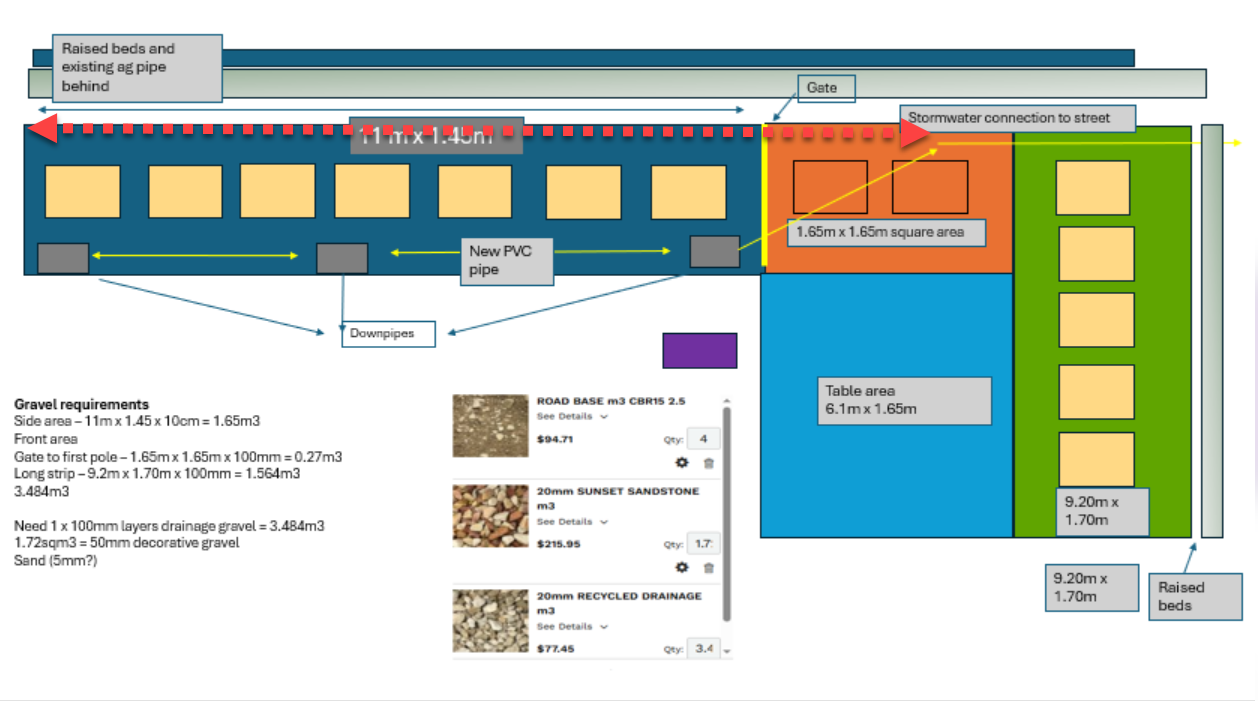
- The side of the house is 11m long and 1.45m wide so not a lot of area to play with.
- Clay type of dirt, high water table after years of rain.
- Removal of pavers (partially done)
- Dig down to bring ground level lower than bricks (currently at least 15cm above the bricks, we're hiring a kanga)
- Slope the ground away from the house and create fall down to where pipe will join stormwater (there is a nice existing fall once you get past the side of the house towards the front)
- Trench and installation of PVC stormwater pipe at correct level (will get plumber for connections) - will use 20mm drainage gravel all around pipe and wrap in geofab
- Create a gravel path with 600mm x 600mm paver steps
- Plan is weed mat + pins, roadbase or 20mm gravel (100mm deep), compact, sand (50mm? deep), compact, install pavers, decorative gravel (50mm deep).
- Lift old pavers out front of the house and reuse side pavers, as well as another gravel path.

Solved! See most helpful response


- Mark as New
- Bookmark
- Subscribe
- Mute
- Subscribe to RSS Feed
- Highlight
- Report Inappropriate Content
Re: How to build a gravel path and drainage?
Hi @FernyG,
A warm welcome to the Bunnings Workshop community, it is fantastic to have you with us.
I'll start by saying you've done some brilliant work so far with your planning. I think you have already hit on every consideration I would make with this kind of project, and you are well and truly on your way to success.
Now, to answer your questions -
Materials -
Yes, you can absolutely reuse materials; they are exactly the same as what you would purchase, they are just all mixed together. If you are using a kanga, you should be able to scrape away in layers to keep distinct materials relatively separate.
It does look like there is sand over the top of gravel or road base, so if you can do a first cut to take away the sand on its own as best you can, then run it through a sieve or wire mesh panel to remove any stones, you can then reuse it.
You could then do much the same thing with the next layer of gravel/road base, but the idea is more to remove the roots and weeds than to isolate stones from soil, as they will be mixed in together anyway. If you are concerned about seeds in the soil, it might be best to get rid of it and buy fresh material, but there is still some risk of seeds being in fresh materials anyway.
There is always going to be a risk of surface-level materials being washed away, but by compacting them, you are minimising that risk. You can use a product like Landscape Lock Concentrated Garden Glue to help lock the surface level stones in place.
Slope -
I believe you are getting your 50mm over 1m figure from the National Construction Code Part 3.1.3 Drainage.
As long as the slope follows a consistent plane without any change in gradient, you won't have any issues laying your pavers. It's when you change the slope, you can run into issues. If you keep the slope consistent, you will have a slope of roughly 75mm over the 1.45m, which isn't huge. You want it to be reasonably level along the 11m plane, but the slope along the 1.45m side won't be too noticeable.
I would consider adding a channel drain against the garden beds rather than an agi pipe, as the slope will be directing your surface water towards that spot. You could then have a plumber connect that channel drain to the stormwater connection.
Trench -
You'd have to check these questions with your plumber, as regulations can be different in different areas. It's always best to check with them, but I imagine 200-300mm out from the house would be roughly what you are looking at.
If the pipe is encapsulated in gravel, which is wrapped in geofab, the geofab is all the separation you need. Its job is to keep soil from eroding between the gravel around the pipe while still allowing water through. I wouldn't overthink this too much; your plumber will do what they need to here.
I hope this helps to clarify a bit.
Let me know what you think and if you'd like clarification or have further questions, please don't hesitate to ask.
Jacob
- Mark as New
- Bookmark
- Subscribe
- Mute
- Subscribe to RSS Feed
- Highlight
- Report Inappropriate Content
Re: How to build a gravel path and drainage?
Hi Jacob - thank you so much for the reply, that is super helpful and I appreciate you taking the time to provide great details! 🙏🙏🙏
- Mark as New
- Bookmark
- Subscribe
- Mute
- Subscribe to RSS Feed
- Highlight
- Report Inappropriate Content
Re: How to build a gravel path and drainage?
No worries @FernyG.
I'm sure you're going to have a successful project, but if you run into any other questions along the way, please don't hesitate to reach out.
If I don't have an answer, I can certainly point you in the right direction.
Jacob
- Mark as New
- Bookmark
- Subscribe
- Mute
- Subscribe to RSS Feed
- Highlight
- Report Inappropriate Content
Re: How to build a gravel path and drainage?
Thanks Jacob - May I trouble you with one more question? With the roadbase / gravel base, I keep reading varied answers about the depth required. Some say 50mm, some 100mm. Could I do the mix of 50mm old stuff seived / weed mat / 50mm drainage gravel 20mm size (or is roadbase better?) then 20mm sand / 50mm decorative gravel. How much base material is required? Also for a gravel path with stepping stones, is a sand layer required if the gravel is well compacted? Perhaps we could concrete the stepping stones? Thank you
- Mark as New
- Bookmark
- Subscribe
- Mute
- Subscribe to RSS Feed
- Highlight
- Report Inappropriate Content
Re: How to build a gravel path and drainage?
Hi @FernyG,
Your gravel or road base is just there to act as a compactable material that will create stability while allowing water to drain through. The thickness is a bit arbitrary because it all comes down to how stable the Earth is beneath it. If you had soft soil, you would want to go with 100mm and compact it; if the soil beneath is relatively compact already, 50mm should do the trick.
I would mentally plan for 100mm of base material, but if you can stomp on the soil and your foot doesn't sink in much, you should be fine with 50mm
If you are laying step stones with decorative gravel around them, I would backfill with 50mm of the sieved material, compact it, add a weed mat, then add 50mm of road base and then compact it. I would then instead of sand, use mortar to set the stepping stones in place, then backfill around them with your decorative stones.
This will give you some solid compaction without the addition of too many new materials.
Let me know what you think.
Jacob
- Mark as New
- Bookmark
- Subscribe
- Mute
- Subscribe to RSS Feed
- Highlight
- Report Inappropriate Content
Re: How to build a gravel path and drainage?
Thank you so much, Jacob! Certainly I’m going to have a lot of big piles of materials sitting on my driveway so if I can avoid a big sand pile to shift as well, that’s desirable!! 😀
- Mark as New
- Bookmark
- Subscribe
- Mute
- Subscribe to RSS Feed
- Highlight
- Report Inappropriate Content
Re: How to build a gravel path and drainage?

Hi again JacobZ … just one more Q on this (promise)! Our plumber will work out the drainage connections but in terms of the gravel, I dug down through sand and roadbase to clay, and that’s the original I assume. BUT, the clay-like dirt is still next to bricks. I don’t know how to tell where the damp proof course is in order to go 150mm beneath it! Should we just go 150mm beneath the last brick - so next to the footing but making sure the footing remains covered? I read that for my 1975 house the DPC may be PVC or tin. Not seen it yet. The inside has 16 bricks to window and I’m down to brick 19 on the outside. I need to keep digging but waiting to get the machine to do it.i cleaned up the bricks a bit to see. I think I can see what looks like weep holes so 150mm down from bottom weephole brick? Or will the DPC be under the weep holes?

Any advice on the DPC or should I ignore that and just go bottom brick? Thank you 🙏

- Mark as New
- Bookmark
- Subscribe
- Mute
- Subscribe to RSS Feed
- Highlight
- Report Inappropriate Content
Re: How to build a gravel path and drainage?
Hello @FernyG
Generally speaking, the DPC sits under the weephole and if you see the weephole the DPC should be visible as well. So technically the top of the gravel walkway should be at least 150 mm below the weep holes, according to Australian building regulations. This clearance is crucial for proper drainage and ventilation, preventing moisture-related issues.
Let me call on our experienced members @Dave-1 and @Nailbag for their recommendations.
If you need further assistance, please let us know.
Eric


- Mark as New
- Bookmark
- Subscribe
- Mute
- Subscribe to RSS Feed
- Highlight
- Report Inappropriate Content

Why join the Bunnings Workshop community?
Workshop is a friendly place to learn, get ideas and find inspiration for your home improvement projects
You might also like


We would love to help with your project.
Join the Bunnings Workshop community today to ask questions and get advice.