Workshop
Ask a question

The Bunnings Workshop community can help with your home improvement projects.

How to fix a squeaky floor

MitchellMc
Bunnings Team Member

Difficulty: Beginner

Squeaking floorboards can be annoying, but fortunately they are easy to fix.


This simple guide will show you how to locate the problem and fix your squeaky floor. 


As this project involves power tools, please follow all safety guidelines provided by manufacturers and use the recommended protective gear. 


Let us know if you have any questions. We’d be happy to assist. 

Video Tutorial

Steps

Step 1

Determine the cause and location of the squeak.  


It's important to identify why the squeak is occurring and to pinpoint its exact location. A floorboard typically squeaks when it is not adequately fixed to the timber joists.   


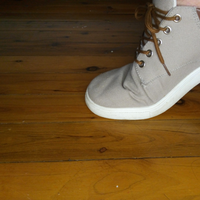
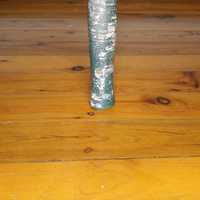
When tracking the squeak, apply pressure to small areas by either pressing your weight down on the floor or by using a hammer handle. You can also ask another person to walk over the area where the squeak is.   


Look for moving floorboards that flex under the load or any place where the floorboards are rubbing together. You might need to access the floor from the underside. You can do this by entering the crawlspace beneath the floor.


Now locate the timber joists that run perpendicular to the affected floorboards. Squeaks are likely to occur near the point where the floorboard is nailed to the joist.


You should also assess the surrounding area to see if there is any visible damage to the floorboards, such as cracks or holes. 
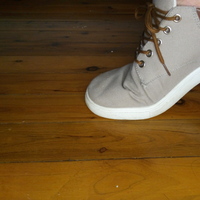
 

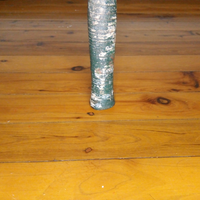
1.1 Locating the source of the squeak.png  1.2 Locating the source of the squeak with hammer.png


Step 2

Punch down nails to secure any loose floorboards to the joists. Loose boards are usually slightly raised compared to others in the surrounding area.  


Apply your body weight to the floorboard to flex it back down and into position. If the floorboards are nailed down, place a nail punch on top of the nail head.


Strike the nail punch swiftly with your hammer. Do this twice to dislodge the timber filler and drive the nail in further.  
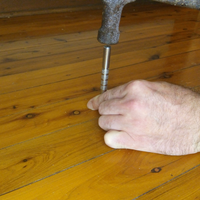
 

2.1 Punching nails back down.png


Step 3

Install additional screws.  


If the floorboard does not remain in the correct position, add another nail or screw to the joint.


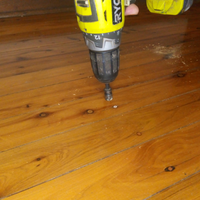
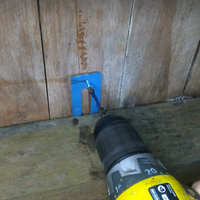
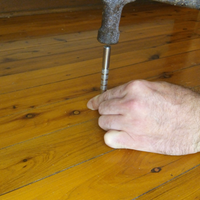
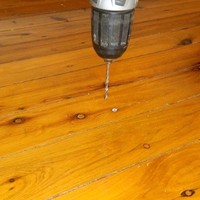
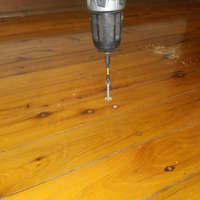
Drill a hole through your floorboard and into the joist below using a 3mm drill bit. 


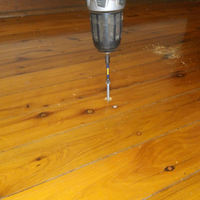
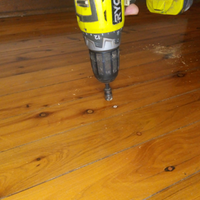
Now countersink this hole with your countersinking bit so the screw head sits below the surface of the floorboard. Drive the screw into the joint with your weight on the floorboard.  


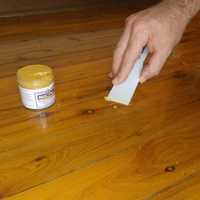
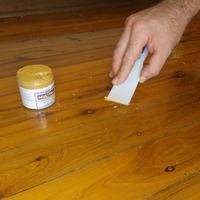
Apply a small amount of wood filler into the countersunk hole using your scraper. Make sure to work from all sides to ensure that the filler is flush with your floorboard. Remove residual filler from around the hole before it has time to set.  
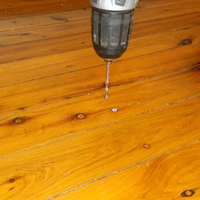
 

3.1 Pre-drilling screw hole.png  3.2 Counter-sinking screw hole.png  3.3 Installing screw.png  3.4 Applying putty to screw hole.png


Step 4

Pack gaps under boards.  


You may find the timber joist has bowed downwards and has separated from the bottom of the floorboards. Tightening them won’t silence the squeak. In this case, it's best to use plastic packers to fill any gap under the floorboard.  


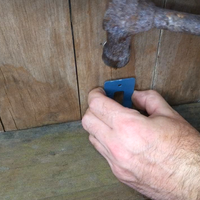
Take your packer and insert its tip into the gap between the floorboard and the joist. Lightly tap the packer until it is secured into the gap. Do not apply too much pressure while tapping as doing so will raise the floorboards above. A snug fit is adequate.  


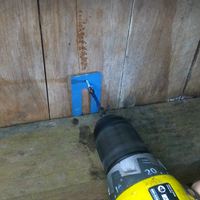
You can do the same on the other side of the joist for additional support too so your floorboards have packers on both sides. Now screw the packer into position with your 16mm timber screws so it doesn't back out over time.  
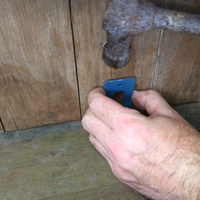
 

4.1 Packing gaps under board.png  4.2 Fixing packer into postion.png


Step 5

Use adhesive to secure floorboards.  


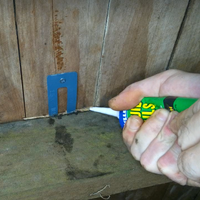
Once your packers are in position, use construction adhesive to fill any remaining voids. Hold the nozzle firmly against the joint and move along it whilst squeezing out the adhesive.  


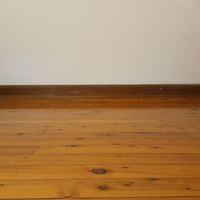
Your squeaking floorboard is now fixed. 
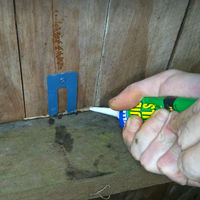
 

5.1 Filling remaining voids.png  5.2 Fixed floorboard.png

Materials

  • Plastic packers  
  • 50mm x 8g timber screws  
  • 16mm x 6g timber screws  
  • Construction adhesive  
  • Wood filler.

Tools

  • Hammer
  • Drill driver  
  • Nail punch  
  • Plastic scraper  
  • 3mm drill bit  
  • Countersink drill bit.

Images

1.1 Locating the source of the squeak.png  1.2 Locating the source of the squeak with hammer.png  2.1 Punching nails back down.png  3.1 Pre-drilling screw hole.png  3.2 Counter-sinking screw hole.png  3.3 Installing screw.png  3.4 Applying putty to screw hole.png  4.1 Packing gaps under board.png  4.2 Fixing packer into postion.png  5.1 Filling remaining voids.png  5.2 Fixed floorboard.png


12 Replies
Akanksha
Retired Team Member
Retired Team Member

Thanks @MitchellMc. Those wanting more advice on fixing or restoring floors may find the following articles helpful:


Don't hesitate to let us know if you need a hand with your floor project. We'd be happy to help.


Akanksha

CSParnell
Amassing an Audience

images - 2023-02-23T193023.675.jpeg


Found the squeak 

sachinriz
Finding My Feet

Hi,


I have this issue on my upper floor so i cannot look underneath the floor or joist. I get the squeaky noise only in small area (0.5 m2). So need suggestions how to fix it.

MitchellMc
Bunnings Team Member

Hi @sachinriz


Do you have floorboards, as in this article, or perhaps floating floors? If you have floorboards, then you can follow the first half of this article up to step three by fixing the boards down from above. Before you start, you might like to see if you can work some talcum powder in-between the boards, as that could make the squeak less noticeable. Make sure to clean up any powder on the surface of your floor, as it can be quite slippery.


Please let me know if you have any questions.


Mitchell


Jeremy_Cutting
Just Starting Out

Hi Mitchell Mc,


I seem to have snapped a couple of 50 mm screws using the second method. I assume this is because I used a cheaper, shorter 3mm drill bit with my Ryobi drill driver that didn't drive far enough into the hardwood joist. 

I've purchased another, more substantial drill bit. Is this all I need to know? 

I'm not keen on snapping any more screws into the hardwood as it's probably not possible to remove them unless you have any suggestions to do this? 


Cheers,

Jeremy 

EricL
Bunnings Team Member

Hello @Jeremy_Cutting 


Using a quality drill bit such as Kango or Sutton should provide you with better performance. Just remember to try and drill as deep as you can to provide a channel for the screw to go into. In regards to the ones that have snapped off they can no longer be drilled out. 


If you need further assistance, please let us know.


Eric


Rusany
Finding My Feet

Hi @MitchellMc. Thanks for the post. My floor is made of pine wood boards, and I cannot access it from underneath. I’m heading to Bunnings to pick up what I need to fix the squeaks from above, including the recommended 50 mm × 8 g timber screws. Could you please advise which countersink drill bit size I should buy? I just want to make sure I get the right bits and avoid any ‘oops’ moments.

JacobZ
Bunnings Team Member

Hi @Rusany,


This Craftright 3 Piece Countersink Bit Set would be my suggestion as it is relatively cheap and gives you multiple options.


It isn't super important to be really precise because you are going to be filling the hole anyway, but in saying this, you don't want your countersink to be double the size of the screw head if you don't have to.


The smallest of the countersink bits should work with an 8g screw, but you can always widen it a bit if needed with the medium-sized bit.


Let me know if you have any further questions.


Jacob


Rusany
Finding My Feet

Thanks @JacobZ .

I tested it out, but I don’t think it was successful. There’s a board in the hallway that is very squeaky. When I step on it, I can feel the board flex and bounce back, which causes the noise.  However, unlike the two boards next to it—which both have a joist underneath their centre—this particular board does not seem to have one (I drilled three holes in different positions along the board centre and could not find the joist). Also, the gap between this board and the next one is relatively large, which attracts dust. How do I explain this, and how can it be fixed? The two edges of the board (near the wall) are stable and not squeaky.

For the other boards, the squeak occurs where there’s no joist underneath, only nearby. Would putting screws down to the adjacent joists help reduce the noise?

Additionally, the countersunk screws appear to be leaving a noticeable mark on the floor. Should I use trim-head screws instead? Any recommendations from Bunnings for this specific purpose?


EricL
Bunnings Team Member

Hello @Rusany 


In order to give our members a better idea of the floorboard's location. Would it be possible for you to post a photo of its current condition?


A trim head screw would be a better option as its head is smaller than a countersunk screw. Will placing screws next to the adjacent joists help in reducing the noise? Any extra support on the panel should stop it from moving and causing the squeaking noise. In regards to the gap, I recommend filling it with timber filler to prevent dust and debris from entering it.


If you need further assistance, please let us know.


Eric


Rusany
Finding My Feet

Hi @EricL,

I have attached my current floor (in the hallway)

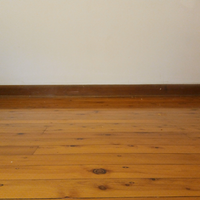
The boards squeak mainly in areas where there is no joist underneath, especially when I put my foot on a single board rather than across two boards. For example, in the photo, stepping in the middle of the board makes it squeak, but standing on the two edges stops the noise. I would appreciate whether it is fixable or if I should consider removing the floor and replacing it with a new one. HallwayHallway 

MitchellMc
Bunnings Team Member

Hi @Rusany,


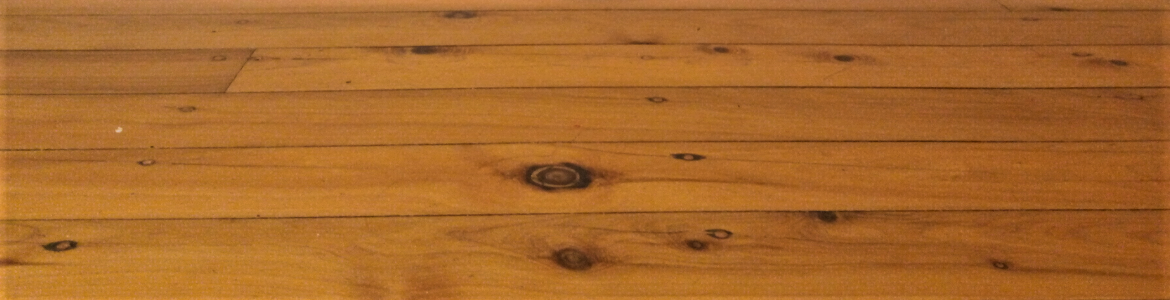
It looks like you have an absolutely beautiful pine floor that could be well over a century old. Floorboards like this are always fixed directly over joists, which run continuously from one end of the room to the other, so there really shouldn’t be any areas without support. This suggests the issue may be due to movement in the boards or joists rather than a missing support. Because of the age and quality of the floor, I would stop attempting D.I.Y. fixes and bring in a professional who is familiar with old flooring. There is no reason to replace the floor, but older floors do tend to squeak, and sometimes it becomes part of living with a period home. A professional should be able to diagnose what is moving underfoot and either reduce the noise significantly or repair the underlying cause without risking damage to the original boards.


Please let me know if you have any questions.


Mitchell


Why join the Bunnings Workshop community?

Workshop is a friendly place to learn, get ideas and find inspiration for your home improvement projects