
The Bunnings Workshop community can help with your home improvement projects.
- Bunnings Workshop
- >
- Discussion
- >
- Outdoor
- >
- Assistance wanted with low-level deck pl...
Assistance wanted with low-level deck plans
- Subscribe to RSS Feed
- Mark Topic as New
- Mark Topic as Read
- Float this Topic for Current User
- Bookmark
- Subscribe
- Mute
- Printer Friendly Page
Share


- Mark as New
- Bookmark
- Subscribe
- Mute
- Subscribe to RSS Feed
- Highlight
- Report Inappropriate Content
Assistance wanted with low-level deck plans
Hi,
I am planning to build a low lying deck in my backyard, I have looked through previous information provided on building low lying decks such as How to plan out a deck and How to build a low lying deck. I have put together a sketch below and I wanted to check if everything is ok and ask a couple of questions.
It will be 6m x 4.6m, with the 6m side along the side of the house and the decking boards will be laid perpendicular to the house side. For the joists I am planning on using H3 90x45 (to minimise the finished deck height) and using tuff blocks rather than poles and cemented in. I have a 300mm overhang on each side and 400mm joist spacing. The tuff blocks will be spaced 300mm in from the end, then 1350mm between them. (from what I can tell the span table shows for 90x45 a continuous of 1800 for 400mm joists so I have extra to spare). In between each of the tuff blocks I will also do a bridging piece of 90x45 timber between each of the joists. Is there anything wrong with my timber sizing/spacing/supports?
It will be placed on top of soil (currently has pavers there, but will need to be removed for height reasons so that top of decking is flush with walking out of house. I will need to make sure there is still a fall away from the house for drainage, and then put something under each of the tuff blocks to make them level - what is suggested here, road base? Also I do worry about weeds going in the soil over time (cause they seem to grow easily in rock garden bed etc) should I be putting some sort of weed matting down underneath?
Lastly I was originally doing at longer than 6m, but sticking with the longest length of timber available. If I was to try and make it longer, whilst keeping the orientation this way, how would I join the two joists together? Would they join on top of a tuff block?
Is there anything else I haven't considered and/or something I could do to make it easier or better?
Thanks in advance
Ben



- Mark as New
- Bookmark
- Subscribe
- Mute
- Subscribe to RSS Feed
- Highlight
- Report Inappropriate Content
Re: Low level Deck Plans
Hi Ben (@Nebin),
Nice work with your plans, you have clearly done the research and are well on your way towards a solid deck.
The spans all look good, and your Tuff Block placement is well within the limits of the span tables. The only thing I would consider changing is the number of joists. In residential applications, 450mm joist spacing is standard, so over your 4.6m width, you could remove a joist and consequently, 5 x Tuffblocks. You don't have to, but it would reduce the costs.
For levelling your Tuffblocks, as you have mentioned, I'd suggest using compacted roadbase. Just dig out around 50-100mm of depth around the location of the Tuffblock, then add some road base and tamp it level with a tamper.
For weed suppression, adding weed matting held in place with some Weed Mat Pins is definitely the way to go.
If you wanted to go longer than 6 metres, you have a few options because the Tuffblocks have a fairly large top to sit your timber on. You could use nailplates on either side of the timber, or you could join them over the Tuffblock with a half lap join like shown below or even a combination of both.

Once tied in with the rest of the deck, either option would be strong and suitable.
Let me know what you think and if you have further questions, please don't hesitate to ask.
I can't wait to see your deck become a reality.
Jacob
- Mark as New
- Bookmark
- Subscribe
- Mute
- Subscribe to RSS Feed
- Highlight
- Report Inappropriate Content
Re: Low level Deck Plans
Thanks that's very helpful!
Regarding joint spacing, thanks for identifying that. I had actually meant to do 450mm spacing, but obviously had a brain snap when I drew these up.
Regarding the weed matting, do you suggest I lay it down before ( I add in the road base (underneath) to be compacted and leveled or after ( on top of it)?
- Mark as New
- Bookmark
- Subscribe
- Mute
- Subscribe to RSS Feed
- Highlight
- Report Inappropriate Content
Re: Low level Deck Plans
Hi @Nebin,
It depends on how you are doing things.
If you were going to add a layer of road base over the whole area, then adding it before the road base would be fine, but if you were just going to add small pads underneath the Tuffblocks, I would add it after you've compacted and levelled the road base pads.
Let me know if you have any further questions.
Jacob
- Mark as New
- Bookmark
- Subscribe
- Mute
- Subscribe to RSS Feed
- Highlight
- Report Inappropriate Content
Re: Low level Deck Plans
Hi @JacobZ , I'm only getting now to actually about to the start the project and order the materials. However, I was looking at ordering the Builders Edge Pedestal feet instead of the tuff blocks due to the adjustability to compensate for any unevenness and drainage. slope away from the house . I am unsure about the amount I need though. In a few other posts on the sites, it was suggested that one was needed every metre along the joist, but from how I am reading in Pedastal feet document for 90x45 H3 timber at 450mm spacing, I will need one every 750mm (for the mini and small pedestal). This would mean I need 9 per row (assuming I can still have 300mm overhang at each end), which is almost double the amount of tuff blocks. Am I reading it correctly or am I missing something?
Thanks,
Benjamin

- Mark as New
- Bookmark
- Subscribe
- Mute
- Subscribe to RSS Feed
- Highlight
- Report Inappropriate Content
Re: Low level Deck Plans
Hi @Nebin,
Thanks for bringing this to our attention. I believe you have read that correctly, and the pedestal feet have a max spacing of 750mm. I've contacted the manufacturer, but at this stage, it appears that the Tuff blocks would be the better choice, albeit without the adjustment.
Mitchell

- Mark as New
- Bookmark
- Subscribe
- Mute
- Subscribe to RSS Feed
- Highlight
- Report Inappropriate Content
Re: Low level Deck Plans
Thankyou very much. Since the mini and small pedastool are actually cheaper, it is only marginally more expensive to have that many pedastool and with the massive time saving/ease of having them adjustable rather than adjusting ground height I am going to go with them instead and can go onto of the existing pavers that are not even. With this change, and remembering about the picture frame edge I have drawn up a new plan and wanted to confirm a couple of final things before ordering

In this image, on the right hand side is against the house. I have the 6m joists running parallel to the house edge and the 140mmwide decking boards will run perpendicular to the house and the joists. I have the joists spaced at 450mm, the pedastools are 300mm in from each edge and 695mm apart from each other to be within their recommendation. The timber will all be H3 90 x 45mm. I plan on attaching bearing protection tape along all of top to help with water protection and will run weed matting over the ground before I start putting down the deck. The few additional questions
1) I have added an extra 6m long piece on the left hand side, that will be 140mm apart away from the joist so that it can support one decking board running parallel to the house for the picture frame edge. Is it right that this can be not on pedastools, and just attached with small timber cut-offs, to space it appropriate?
2) To maximise the use of the space I had aimed to have the first supported deck 300mm from the house (right hand side of image), but I realised the end of the boards wouldn't be supported. Can I do a similar thing with that side, running an extra joist not supported by pedastools only with the cross timber pieces, or is that likely too big of a section not supported? What would be the biggest seperation you would recommend?
3) the two side pieces of timber running down the ends of the joists (top and bottom in picture), can they just be screwed into the joists, or should I be using joist hangers for them?
4) I was planning on using 14g*100mm screws for all the timber joins, does that seem reasonable? Is there anywhere I should be using the joist hangers?
5) Is there any other obvious errors or things I might have missed?
Thanks again both of you for your help - really appreciate the insights!!
- Mark as New
- Bookmark
- Subscribe
- Mute
- Subscribe to RSS Feed
- Highlight
- Report Inappropriate Content
Re: Low level Deck Plans
Hi @Nebin,
Typically, double joists are created by sandwiching 100mm long blocks, using the same 90x45, between the two joists, at 450mm intervals. This creates a double joist that is 135mm wide. This is fine to support a 140mm wide decking board, and it is fine for the support to be on the inner of the two joists.
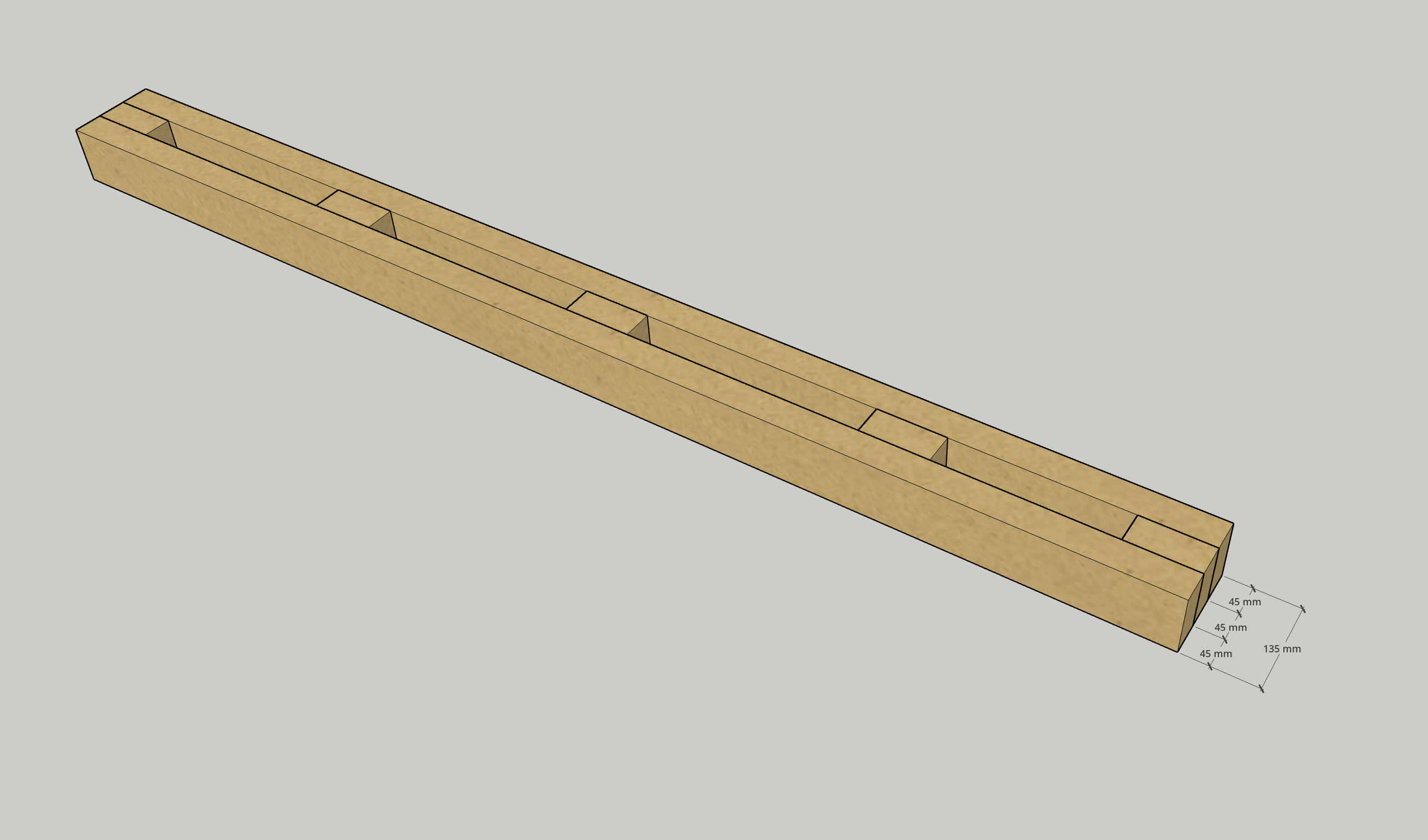
To answer question 2, I would not suggest that the width of this double joist be increased. A 300mm lateral overhang will not be supported on its outside edge and would likely fail fairly quickly. You could use a double joist like above, but you would need to move it much closer to the wall, as it could not be as wide as you are proposing. If there is a reason this isn't possible, please let me know so I can assist you with a solution.
The two side pieces you are referring to are typically called rim joists, and they are not a load-bearing, structural framing member in the same sense as a joist or bearer, so there is no requirement for you to use joist hangers.
Your design would not require any joist hangers, as every joist is supported by pedestals. Joist hangers are only required when you are attaching a joist to a bearer, as the load applied to the joist needs to be transferred through that connection into the bearer. 14g 100mm screws like these Buildex® 14G x 100mm Class 4 Bugle Batten Screws would be fine for all of the framing connections in your deck.
There are no obvious flaws in your design. It looks like you're going to end up with a very strong, well supported deck.
- Mark as New
- Bookmark
- Subscribe
- Mute
- Subscribe to RSS Feed
- Highlight
- Report Inappropriate Content
Re: Low level Deck Plans
Thankyou that is helpful. I should be able to make the double joist work on the house side so I will just do that.
Regarding the double joist on the opposite end to the house though, it is 135 wide which will fitting the 140mm wide board , but it also is supposed to support the end of the deck plank. I assume the end of the decking board would need to be on around half of the joist, i.e 20mm into that. Which, depending on the gap between the boards would still by 27.5mm. If I mounted I decking board on the side, would have almost 10mm overhang. How is this normally worked around, or is there usually the slight overhang?
- Mark as New
- Bookmark
- Subscribe
- Mute
- Subscribe to RSS Feed
- Highlight
- Report Inappropriate Content
Re: Low level Deck Plans
Hi @Nebin,
A slight overhang is not really an issue. They are fairly common and typically look quite nice with a fascia board covering the framing timber as long as the overhang is consistent. You'll still have the vast majority of the decking board supported, and with two screws across the board, you wouldn't have any issues with rolling.
I wouldn't worry about it. It will still look good.
Let me know what you think.
Jacob

Why join the Bunnings Workshop community?
Workshop is a friendly place to learn, get ideas and find inspiration for your home improvement projects
You might also like


We would love to help with your project.
Join the Bunnings Workshop community today to ask questions and get advice.