
- Bunnings Workshop
- >
- Discussion
- >
- Outdoor
- >
- How to build low level floating deck and...
How to build low level floating deck and not cover weep holes?
- Subscribe to RSS Feed
- Mark Topic as New
- Mark Topic as Read
- Float this Topic for Current User
- Bookmark
- Subscribe
- Mute
- Printer Friendly Page
Share


- Mark as New
- Bookmark
- Subscribe
- Mute
- Subscribe to RSS Feed
- Highlight
- Report Inappropriate Content
How to build low level floating deck and not cover weep holes?
Help please. I have been ruminating over this for quite some time and can’t decide what’s the best way to build my floating deck.
PLAN SO FAR
- Decking boards will be running parallel to the sliding door
- Picture framing
- 90 mm merbau decking boards (apparently less subject to cupping in low profile decks)
- Adjustable (or fixed) pedestal supports
QUESTIONS
1. How would you suggest I frame my deck so as not to block the weep holes and keeping maximum support for the picture framing and so people can step at the edge?
2. Should I deck over the brick sil or just deck up to it?
3. Should I make the finished deck height level with brick sil or some amount lower?
4. Given my height is restricted to approximately 190 mm if the deck is going to be flushed with the brick sil what framing members should I use?




- Mark as New
- Bookmark
- Subscribe
- Mute
- Subscribe to RSS Feed
- Highlight
- Report Inappropriate Content
Re: Weep holes and a low level floating deck
Hi @maker_m82,
The first thing I note is your decision to use 90mm merbau decking. I should note that our 90mm merbau decking's installation guide recommends a minimum ground clearance of 400mm, so if you were to use it in this situation, it would likely not be covered by the warranty. If instead, you used Ekodeck Decking, the minimum ground clearance is 90mm, which would be fine with your project. Ultimately, you could still use the merbau, but you would not be covered by a warranty if there were issues deemed to be due to the proximity to the ground.
To frame your deck up to the brick wall without blocking the weep holes, I'd suggest your joists should not have a rim board along the end; instead, the joists should butt into the brick wall with blocking between them around 150-200mm back from the wall. Something along the lines of this -
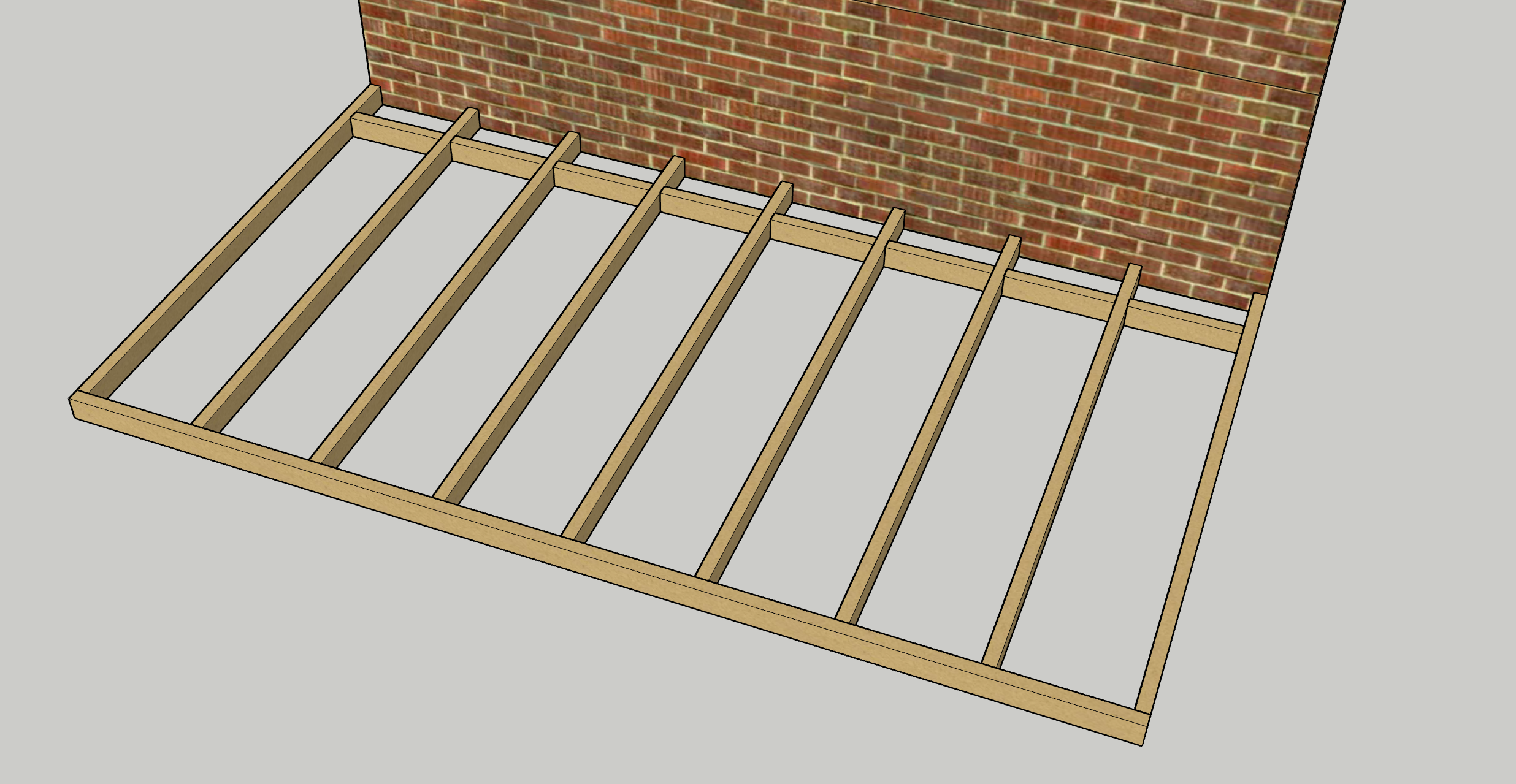
You would be better off having the decking boards finish flush against the brick sill because they are meant to allow water to drain away from the door. If you installed decking over the top of them, you would be removing this function by creating a flat surface over them.
Flush with the brick sill is fine, but there should be a gap between the timber and the brick that will allow water to drain through.
Due to the limited height, it would be best to use 90x45 framing, as with a 19-22mm thick decking board, this will leave you with approximately 40mm beneath the framing, which would allow you to use Builders Edge 35 - 60mm Smallfoot Pedestal Feet for support.
90 x 45mm Outdoor Framing H3 Treated Pine is a common choice for low-level decks, but if you want to ensure your deck lasts as long as possible, I'd suggest using 90 x 45mm H4 Treated Pine as it is treated for use in close proximity and direct contact with the ground.
Let me know what you think. I am more than happy to assist further with design and materials.
Jacob
- Mark as New
- Bookmark
- Subscribe
- Mute
- Subscribe to RSS Feed
- Highlight
- Report Inappropriate Content
Re: Weep holes and a low level floating deck

Hi @JacobZ, cheers for responding.
Im not worried about warranty. My budget doesn’t allow for composite boards as they are almost 3x the cost.
The specrite fact sheet does allow for lower than 400mm however it states that more ventilation must be considered. This is why I’ve chosen 90x45 instead of 140x45.
As for the air gap clearance, we reach different values on that. Am I overlooking some.
190-22-90=78. My clearance would be 78mm from the concrete the bottom of the framing.
As H4 framing, Bunnings can only special order this (from what I’ve seen) and I’ve been quoted long lead times with anything “special order”.
Also h4 is almost 2x the price.
Is the benefit of using H4 worth the extra expense and lead times or is it only marginal increase in benefit based on my 78mm clearance?
Another question I have is how to builders justify using 90 x 45 joists in a single layer deck construction when in that particular layout the joists are actually acting as bearers and according to bearer span tables, a 90x45 bearer should be doubled.
Final question (for now haha)
How do I frame the overhang along the left of the deck so the pedestals can’t be seen.
in the picture I’ve added the pedestals on the left outer most joist, cantilevered the bottom rim board out to support the deck edge (black) but I can’t work out a structural way to support it at the top since I can’t use a rim board the same way due to the weep holes. I thought about using blocking, but blocking would not provide the same structural support at the cantilevered rim board I don’t think.
What do you suggest in this situation.
- Mark as New
- Bookmark
- Subscribe
- Mute
- Subscribe to RSS Feed
- Highlight
- Report Inappropriate Content
Re: Weep holes and a low level floating deck
Hi @maker_m82,
If you're not worried about the warranty, then you can use the merbau. I just thought I'd mention it to make sure you were aware.
Yes, you are right about the clearance. I was mentally working with the idea you had 150mm of height to work with and didn't think to double-check. You would have 78mm of clearance if you are using 22 mm-thick decking boards.
I always recommend using H4 on these low-level decks because there is always going to be potential for rot. After all, the airflow beneath the deck is limited, so moisture can build up beneath the deck, and H4 timber is treated with a fungicide that will help prevent the frame from rotting in damp conditions. You can certainly use H3 framing, but it just won't handle the moisture as well as H4. Again, I just thought I'd mention there are other options so that you are aware.
In this layout, the 90x45s are not actually acting as bearers. A bearer becomes a bearer when it is directly supporting other joists through a structural connection, whether it is with a joist hanger or by sitting on top of the bearer. In this layout, as each joist is directly supported by the pedestals beneath it, you would use the joist span tables to determine where the supports need to sit. So, using the Hyne Timber Joist Span Table as a reference, you would need a pedestal every 1400mm under each joist.
In this situation, I would suggest you create a double joist by adding a 100mm or so wide piece of blocking every 450mm and then set the pedestals underneath the inside joist. The overhang is minimal and would not be a concern structurally, but still enough to cover your pedestal feet.
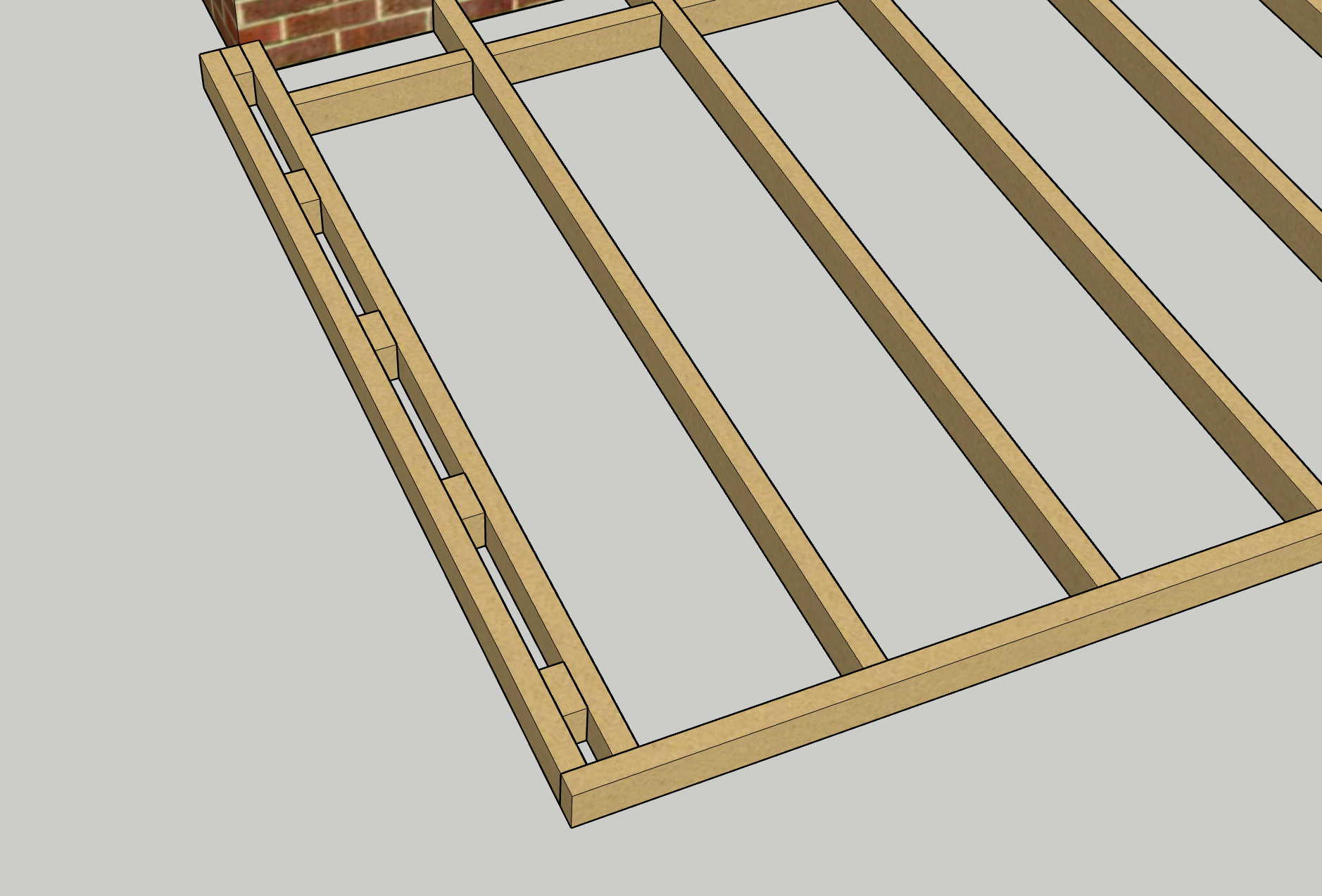
Let me know what you think and if you have any further questions or concerns, please don't hesitate to add them to the discussion.
Jacob
- Mark as New
- Bookmark
- Subscribe
- Mute
- Subscribe to RSS Feed
- Highlight
- Report Inappropriate Content
Re: Weep holes and a low level floating deck
Hi @JacobZ
Thanks again for your response. I have a few more questions.
1. What fixing’s (and how?) would you recommended for the following.
- Bottom rim board to joists
- Field blocking in between joists
- Edge blocking to outer joist (The overhang on the left-hand side)
- Pedestals to joists
- Pedestals to concrete patio base.
- Decking boards to joists
2. Should I use joist tape?
3. Do I need to incorporate a slope away from the house in both directions?
4. Given the low profile nature of the deck resulting in reduced ventilation, do you think it makes a difference if I use 90 mm or 140 mm decking boards? My way of thinking is that 90 mm boards will be subject to less cupping and provide a little more ventilation due to slightly more gaps. What’s your opinion on this?

- Mark as New
- Bookmark
- Subscribe
- Mute
- Subscribe to RSS Feed
- Highlight
- Report Inappropriate Content
Re: Weep holes and a low level floating deck
For your deck @maker_m82, here’s how I’d handle the fixings: the rim or fascia board can just be screwed to the joists using standard decking screws. For noggins or blocking between joists, use something like 75 mm bugle screws through the face of the joist into the ends of the noggins. These screws will also join your outer framing to the joist ends, but I'd switch to 100mm. Bugle screws are your mainstay for this deck.
For the pedestals, they don’t typically get fixed to the joists. The joists just sit on top of them, since it’s a floating system. Some pedestals may have a small hole where you can insert a standard timber screw for extra security, but there’s no need for a heavy-duty bugle screw. Similarly, you don’t need to fix pedestals to the concrete base; they simply sit on it.
Decking boards should be attached to joists with decking screws, ideally 12-gauge self-cutting screws, to avoid pre-drilling every hole. Joist tape is a good idea if it’s in your budget, as it helps protect the timber from moisture over time.
Regarding slope, the deck itself can be perfectly level. The main thing is ensuring the patio beneath is already graded away from the house to avoid any water pooling under your low-level deck. There’s no need to slope the deck in any direction.
You might like to check out this guide on How to build a deck as it will answer many of your questions.
Please let me know if you have any questions.
Mitchell

- Mark as New
- Bookmark
- Subscribe
- Mute
- Subscribe to RSS Feed
- Highlight
- Report Inappropriate Content
Re: Weep holes and a low level floating deck
Hi @MitchellMc
Thanks for your response and recommendations. Could I trouble you for a little bit more detail please?
For the bugle screws for the framing what gauge should I be looking at?
I live near the coast (6kms away) and I think read somewhere that it’s best to use stainless steel for decking board screws in this situation.
Do you think I should use stainless for the framing bugle screws as well or will galvanise be sufficient?
When it comes to joining the outer frame to the joist ends, you suggested 100 mm bugle screws, could I use joist hangers or the vehicle screws be better strength wise?
Also, can you give me your opinion regarding whether to use 90 mm or 140 mm mobile decking boards in this low profile deck with reference to cupping.
Finally, are you able to give me some sort of indication how to strengthen the edges of my deck as I’m going to want to put things like pot plants and barbecues and furniture all around the edges? Obviously furniture will spread its weight over a few different joists and pedestals, however pot plants generally won’t so their weight will probably feel more localised between pedestals and may bow the edges.
- Mark as New
- Bookmark
- Subscribe
- Mute
- Subscribe to RSS Feed
- Highlight
- Report Inappropriate Content
Re: Weep holes and a low level floating deck
The 14g, which I linked to above, would be the go @maker_m82. Buildex® 14G x 100mm Class 4 Bugle Batten Screws - 25 pack.
Yes, I'd switch to stainless bugle screws, given the proximity to water.
You can use joist hangers, though finding corrosion-resistant ones could be an issue.
The wider the decking board, the more likely it is to cup. If you do go with the wider 140mm, I would go for a larger gap between them, something like 8mm.
I would just advise placing the pots on top of a joist. Unless we are talking hundreds of kilos here, and if that's the case, you should add additional feet support and framing in those areas. Anything up to 15-20kg can just sit on the decking between joists.
Mitchell
- Mark as New
- Bookmark
- Subscribe
- Mute
- Subscribe to RSS Feed
- Highlight
- Report Inappropriate Content
Re: Weep holes and a low level floating deck
Thanks @MitchellMc @JacobZ for your help so far.
Could you by any chance review my design and provide further advice or any changes you think are needed?
I understand this is quite a complex post but I would really appreciate feedback. I have been ruminating on this for months. Ha ha
My concerns are cost, deck bounce, rot and cupping.
In conjunction with the dimensions and comments in the drawing, my planned deck is;
- Installed over concrete under a pitched roof
- 140x19mm merbau with picture framing
- Merbau boards installed bark side down. (End grain “smiling”)
- 90x45mm H3 treated pine framing.
- Joist tape
- Builders edge pedestals (Big foot xL)
- 190mm finished deck height
- Height above concrete of lowest face of joists is 81mm (190-19-80).
- Deck slope approximately 5-10 mm (1-2mm/m)
FIXINGS
- Decking screws - Titan 12G x 65mm Decking Bugle 304 Stainless Steel
- Framing (joist blocking) - Buildex® 14G x 75mm Class 4 Bugle Batten Screws
- Framing (Rim board to joist) - Buildex® 14G x 100mm Class 4 Bugle Batten Screws
- Framing (edge blocking and doublers) - Buildex® 14G x 125mm Class 4 Bugle Batten Screws
Total cost so far:
- using Merbau boards $5227
- using Ekodeck boards $6078
QUESTIONS
1. Will my deck design be stiff and relatively stable with cupping?
2. Are there any suggestions to reduce my overall cost that won’t affect stiffness or rot and cupping?
3. Block around posts. What’s your opinion? Can it be done better?
4. How do I do a gap at the mitre joints of the picture frame to accommodate expansion without looking real ugly?
5. Bottom rim board and blocking - I’ve chosen 90x35 here in order to allow for a 20mm overhang of boards and fitting of a fascia board. This is governed by the amount of deck boards and spacing I’m happy to accept. If I use 90x45mm here then my framing will be 20mm visible.
8. Does install time of year and temperature affect the board gaps? Eg. install boards in summer at 8mm gaps, then in winter gaps become 10mm. How do you suggest I tackle this? I’m in Melbourne.


- Mark as New
- Bookmark
- Subscribe
- Mute
- Subscribe to RSS Feed
- Highlight
- Report Inappropriate Content
Re: Weep holes and a low level floating deck
That looks great @maker_m82. My only adjustment would be to possibly consider reducing your joist supports to 1000mm centres instead of 1252mm. Although 90 x 45mm can span that far, 1000mm spacing ensures a solid deck with no bounce.
Mitchell

Why join the Bunnings Workshop community?
Workshop is a friendly place to learn, get ideas and find inspiration for your home improvement projects
You might also like


We would love to help with your project.
Join the Bunnings Workshop community today to ask questions and get advice.