
The Bunnings Workshop community can help with your home improvement projects.
- Bunnings Workshop
- >
- Discussion
- >
- Whole of House
- >
- How to dismantle shelves without damagin...
How to dismantle shelves without damaging walls?
- Subscribe to RSS Feed
- Mark Topic as New
- Mark Topic as Read
- Float this Topic for Current User
- Bookmark
- Subscribe
- Mute
- Printer Friendly Page
Share


- Mark as New
- Bookmark
- Subscribe
- Mute
- Subscribe to RSS Feed
- Highlight
- Report Inappropriate Content
How to dismantle shelves without damaging walls?
Got these shelves in our walk in pantry and getting a cabinet maker to install cabinets instead
To save some cash I'll take off all the existing shelves. Assumed these were screwed but I was wrong. They are all nailed in with a nail gun and the nails are recessed in

I don't want to damage the walls prying out the supports if I can avoid it
I was thinking of using a small hole saw to drill out holes around each nail and then pulling the nails out with pliers
Unless someone has a better idea?
- Labels:
-
Renovation
-
Repairing
-
Tools and Materials


- Mark as New
- Bookmark
- Subscribe
- Mute
- Subscribe to RSS Feed
- Highlight
- Report Inappropriate Content
Re: How to dismantle shelves without damaging walls
Hello @pat83
Welcome to the Bunnings Workshop community. it's sensational to have you join us, and thanks for sharing your question about your timber shelves.
I propose starting with the shelves instead of the supports. I suggest investigating to see if the shelf is screwed, nailed or glued in, if it is screwed in then the screws will need to be removed and the shelf can gently be tapped to remove it from the supports. But if it is nailed or glued in then stronger force from the hammer will need to be applied to dislodge the shelf. To prevent damaging the shelf surface, I suggest using a timber off cut as a buffer for the hammer.
Once the shelves are off you now have more space to address the shelf supports. I recommend using a Craftright 380mm Wrecking Bar. Unfortunately, it will be unavoidable that some parts of your wall will get damaged due to the tools in use. Gently tap the sharp edge of the wrecking bar under the shelf support and use it as a lever to lift the shelf support off the wall. If adhesive was used, you'll see the adhesive pattern on the wall, or it will tear off part of the plasterboard paper.
Once you get the hang of it, you'll be able to lift the panels off the wall and hopefully causing only minimal damage.
Let me call on our experienced members @Dave-1 and @AlanM52 for their recommendations.
If you need further assistance, please let us know.
Eric

- Mark as New
- Bookmark
- Subscribe
- Mute
- Subscribe to RSS Feed
- Highlight
- Report Inappropriate Content
Re: How to dismantle shelves without damaging walls
Thanks for the reply
Yes the shelves will be removed first . I was more asking how to remove the supports when I am.uo.to that
I might also try putting a screw in and try pulling out the timber by the screw and see if that works

- Mark as New
- Bookmark
- Subscribe
- Mute
- Subscribe to RSS Feed
- Highlight
- Report Inappropriate Content
Re: How to dismantle shelves without damaging walls
Hi @pat83,
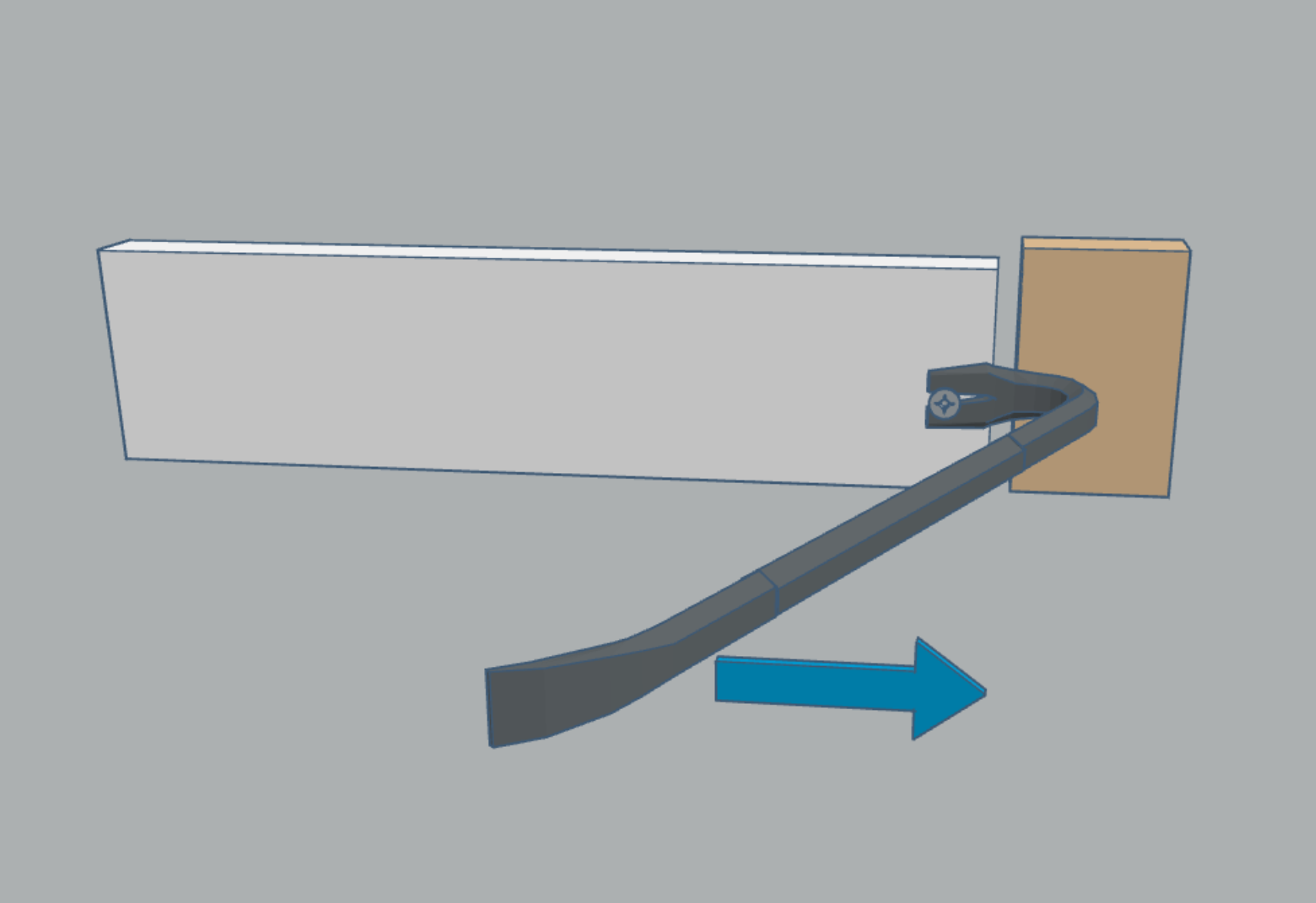
The screw idea might work. I'd suggest you use a wrecking bar and a scrap piece of timber to protect the wall. Lever against the scrap timber. This should hopefully dislodge the nails and release the mount from the wall, allowing you to pull it away.
I've created the rendering below to illustrate.
Please let me know if you have any questions.
Mitchell

- Mark as New
- Bookmark
- Subscribe
- Mute
- Subscribe to RSS Feed
- Highlight
- Report Inappropriate Content
Re: How to dismantle shelves without damaging walls
Good Morning @pat83
Im thinking the same lines as both @EricL and @MitchellMc in removing the supports, slight difference is I would try using the blade of a wide metal thick spatula/paint scraper in place of the extra timber that @MitchellMc has drawn. I still dont think you will escape totally free from imprinting the plaster but its worth a shot.
Once the top has been removed, I would start with the point closest to you and gently lever it, with a pry bar or screwdriver (With another screwdrivers handle underneath the blade to provide a fulcrim, all you need is a couple of mm and then you work your way down the short length doing the same. Then redo, it becomes easier as you work your way along in stages then one massive pry to do it in one go. The longer rear piece will be the same. I have done this in my old alcove and it worked well.
The paintscraper I am suggesting to rest the pry bar on is this type 100mm Sharp Edge Paint Scraper
The large flat blade screwdriver size and length I am thinking of is Stanley 12 x 300mm Square Shaft Screwdriver (the thinner the tip the better to slip under the support but ususaly that shortens the length of the screwdriver)
If you tap the paint scraper up under the support, then tap the flat blade screwdriver between the metal blade and the support hopefully it will easy out of the nail. Dont go superman, go slow and take it easy. Once the timber is off the nail will still be in place. Use a clawhammer Stanley 20oz / 565g Fibreglass Claw Hammer with the arc resting back on the paint scraper so it dosnt imprint the plaster when levering.

Just as an example fo what it can turn out to be  This was from 2013 so excuse the pic quality lol (I had dropped my old ph)

This is one reason that even being cautious you will end up with some form of plastering/repairing to do. The effort expended in trying not to mark compared to being cautious when renovating is a seesaw. I think its better to be wise and acknowledge that you will have plaster work then try and avoid it.

That wall edge was all timber facing around it. I wanted a clean, straight edge

Yes you will feel like "What have I bitten off" but its worth it

You can see this alcove use to be part of the bathroom, go figure. The previous owners somewhere along the way did that. I just layed carpet tiles over it I also had to source the similar floorboard as I pulled up thebaseplate that they had left there.
Dave

Why join the Bunnings Workshop community?
Workshop is a friendly place to learn, get ideas and find inspiration for your home improvement projects
You might also like





We would love to help with your project.
Join the Bunnings Workshop community today to ask questions and get advice.