
The Bunnings Workshop community can help with your home improvement projects.
- Bunnings Workshop
- >
- Discussion
- >
- Garden
- >
- Re: Garden steps on slope
How to build garden steps on slope?
- Subscribe to RSS Feed
- Mark Topic as New
- Mark Topic as Read
- Float this Topic for Current User
- Bookmark
- Subscribe
- Mute
- Printer Friendly Page
Share


- Mark as New
- Bookmark
- Subscribe
- Mute
- Subscribe to RSS Feed
- Highlight
- Report Inappropriate Content
How to build garden steps on slope?
Hello heroes of handywork!
Ive another project. I'm putting in steps alongside the concrete driveway. I'm planning on 15 steps using 2 x 400 x 400 pavers for each step with a 200 riser, but as I want around a 120 rise, I'll have to embed them under the ground a bit. Give me your tips please...do I used concrete, cement or mortar? The Handyman who is helping me says to use cement, but Im worried it won't have the strength. I was going to use a bed of concrete, then affix the risers with mortar, so please let me know the best solution. Also. I was thinking of using 2 pavers per step (800mm wide) but would 1 x paver suffice - would it be wide enough. Would it look OK, or should I stick to 2 pavers width?




- Mark as New
- Bookmark
- Subscribe
- Mute
- Subscribe to RSS Feed
- Highlight
- Report Inappropriate Content
Re: Garden steps on slope
Hi @ezzie,
It's fantastic to see you have another project in the works. I'm excited to help out where I can.
Functionally, I think an 800mm wide step would be much more user-friendly, but it is up to you. It might be worth laying them on the ground so you can visualise what it might look like before making a decision.
The main thing you'll need to focus on is retaining the soil and creating compacted pads for the pavers to sit on.
To create paver steps that would last, you would need to create what is essentially a series of small retaining walls that step up incrementally along the slope. Unfortunately, I'm not confident your pavers would retain soil particularly well if it is simply set on their side and mortared to the existing soil and some form of base, as the contact area from the side of the paver to the mortar would be relatively small and the soil behind the paver could very easily erode, which could cause the pavers to shift. I'd suggest installing something like a retaining wall block instead, as it has enough weight to retain the soil behind it, and a paver can be attached over the top of it with mortar. If you were set on the paver being the face of the riser, we could attach it to the front of the block using mortar.
When the basic layout of the steps is in place, you would create the treads by compacting crusher dust or road base with a tamper to provide a stable base and then using mortar to set your pavers in place.
Allow me to tag our experienced members @Tara86, @Nailbag and @AlanM52 for their thoughts on the best way to go about this job.
Let me know what you think, and if you have questions or concerns, please don't hesitate to add them to the discussion.
Jacob
- Mark as New
- Bookmark
- Subscribe
- Mute
- Subscribe to RSS Feed
- Highlight
- Report Inappropriate Content
Re: Garden steps on slope
Thanks Jacob...ooh a bit more complicated than I thought. I looked at the tje blocks you suggested and at 200 length, Id need x 4 each step which would take the cost alone if the blocks to over $500. I looked at I/N: 3041942 blocks, but at 300mm each, again expensive and I'd have to cut one somehow. I presumed as I'd be setting the verticals a little in the ground that they'd have capacity to hold firm. So on materials, I just use mortar? No concrete?
- Mark as New
- Bookmark
- Subscribe
- Mute
- Subscribe to RSS Feed
- Highlight
- Report Inappropriate Content
Re: Garden steps on slope
...and thanks for responding quickly. This is a project for this weekend. How many bags of mortar and how many bags of crusher dust do you think i need for the 15 steps?

- Mark as New
- Bookmark
- Subscribe
- Mute
- Subscribe to RSS Feed
- Highlight
- Report Inappropriate Content

- Mark as New
- Bookmark
- Subscribe
- Mute
- Subscribe to RSS Feed
- Highlight
- Report Inappropriate Content


- Mark as New
- Bookmark
- Subscribe
- Mute
- Subscribe to RSS Feed
- Highlight
- Report Inappropriate Content
Re: Garden steps on slope
Hi @ezzie,
Are these the pavers you are planning to use here?
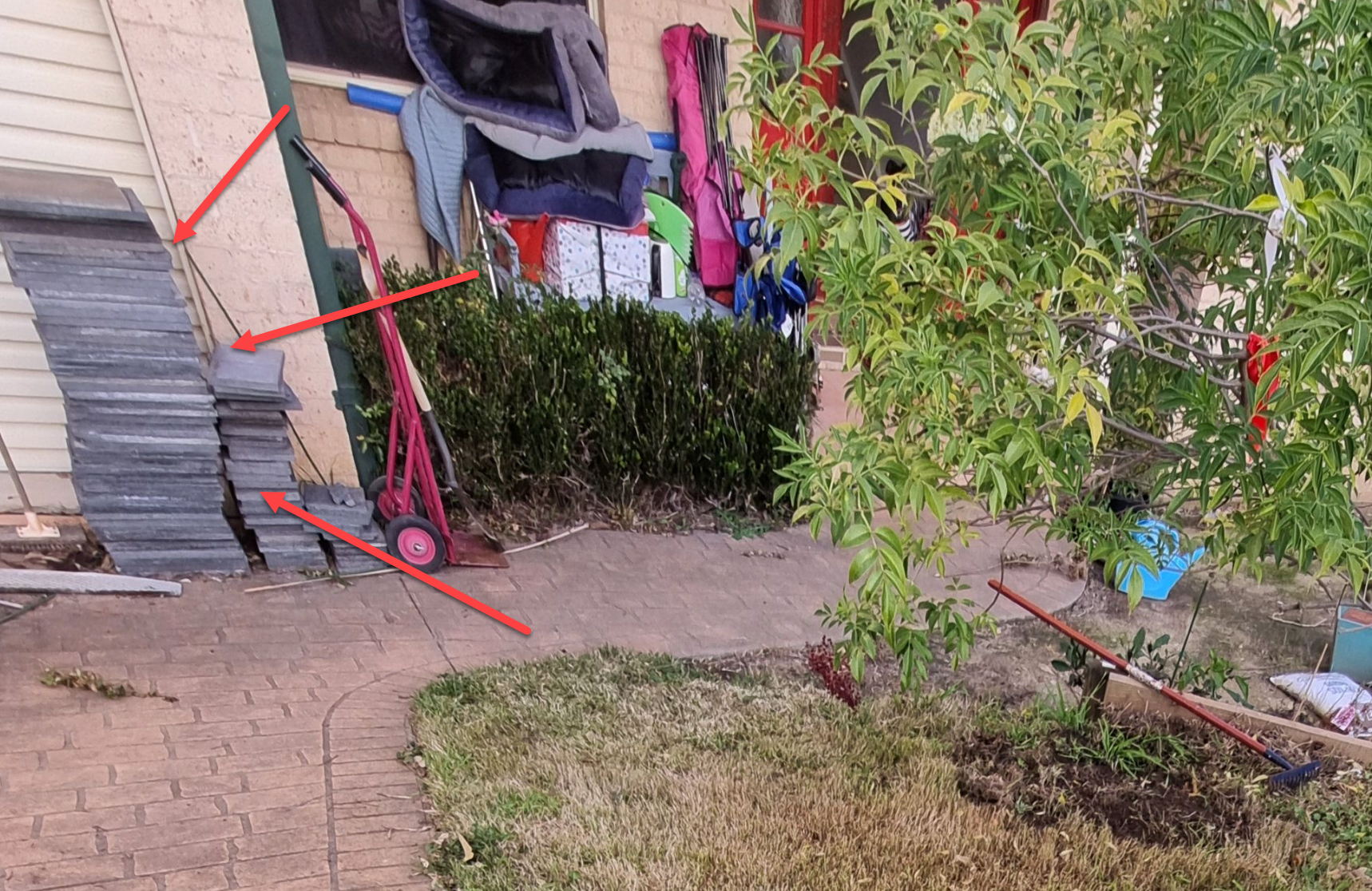
How thick are they? They look like they are about 20mm thick at the most.
Unfortunately, if these are the pavers you are using and they are as thin as I am estimating, there is no way they would be strong enough to retain soil long term. Keep in mind that they need to retain the weight of the soil plus any groundwater that sits in that soil. Even though the rises are only 120mm, I couldn't say with any confidence that they would be able to resist the force of the soil pushing on them long term.
You could still use them for the landings and to clad the risers, but they would need to be supported by something with the strength to retain soil.
@AlanM52's solution of installing timber sleepers with stakes would considerably reduce the price and is a tried-and-true method you could be confident would work.
For your landings, I would be estimating at least 2 x 20kg bags of crusher dust or road base per step and the same amount of mortar to fix your pavers in place. So, let's say 30 x 20kg bags of base material and 30 x 20kg bags of mortar.
Let me know what you think.
Jacob
- Mark as New
- Bookmark
- Subscribe
- Mute
- Subscribe to RSS Feed
- Highlight
- Report Inappropriate Content
Re: Garden steps on slope
Thanks Jacob, yes the pavers are 20mm. I may be out of my depth here, I got very confused by tent pegs, cement sheets, digging back and where to put retaining wall blocks. I'm not going to use crushed gravel as underbed, as then I'd have to retain it at the sides, making it a more complex job. My plan is to dig each step (the ground is mostly compressed clay). Then I've bought quick-set concrete to use as a bed for the tread and riser for strength
- Mark as New
- Bookmark
- Subscribe
- Mute
- Subscribe to RSS Feed
- Highlight
- Report Inappropriate Content
Re: Garden steps on slope
Hi @ezzie,
The problem with using clay as a base for any kind of hardscaping is that it is prone to moisture retention and expansion. If the clay becomes waterlogged, it can expand, shifting everything that sits on it.
Without a proper base and soil retention structures, there's a high likelihood that your stairs will not last the test of time. This is not to say they won't work for some time, but over the course of many rainy days, there will likely be movement.
I don't want to completely deter you, but I want to give you the facts so you can make informed decisions.
You seem fairly happy to give it a crack and see how it goes, which is great. I just want you to know the possibilities. Ultimately, the pavers will not be damaged, and mortar and concrete can be removed, so you can always try again if something goes wrong.
Let me know how you go and if you have further questions, please don't hesitate to reach out.
Jacob
- Mark as New
- Bookmark
- Subscribe
- Mute
- Subscribe to RSS Feed
- Highlight
- Report Inappropriate Content
Re: Garden steps on slope
Good advice. Im hoping that 30 years of having a lawn on it, and not digging too deep will mean there's a mix of clay and soil. Also being on a steep slope should help with drainage. You'll be impressed, I dropped in on Bunnings last night on my way to dinner and picked up 45 Brighton masonry bricks!

Why join the Bunnings Workshop community?
Workshop is a friendly place to learn, get ideas and find inspiration for your home improvement projects







We would love to help with your project.
Join the Bunnings Workshop community today to ask questions and get advice.