The Bunnings Workshop community can help with your home improvement projects.
Hi Team,
I have a little challenge with a water leaking aluminum sliding door frame.
Current Status:
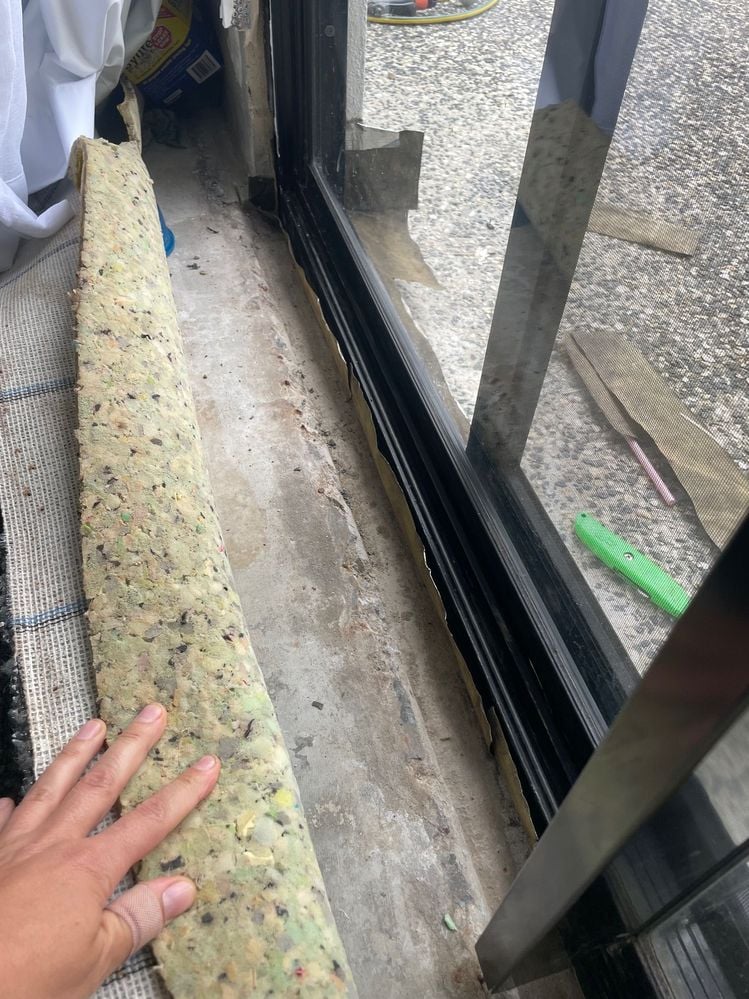
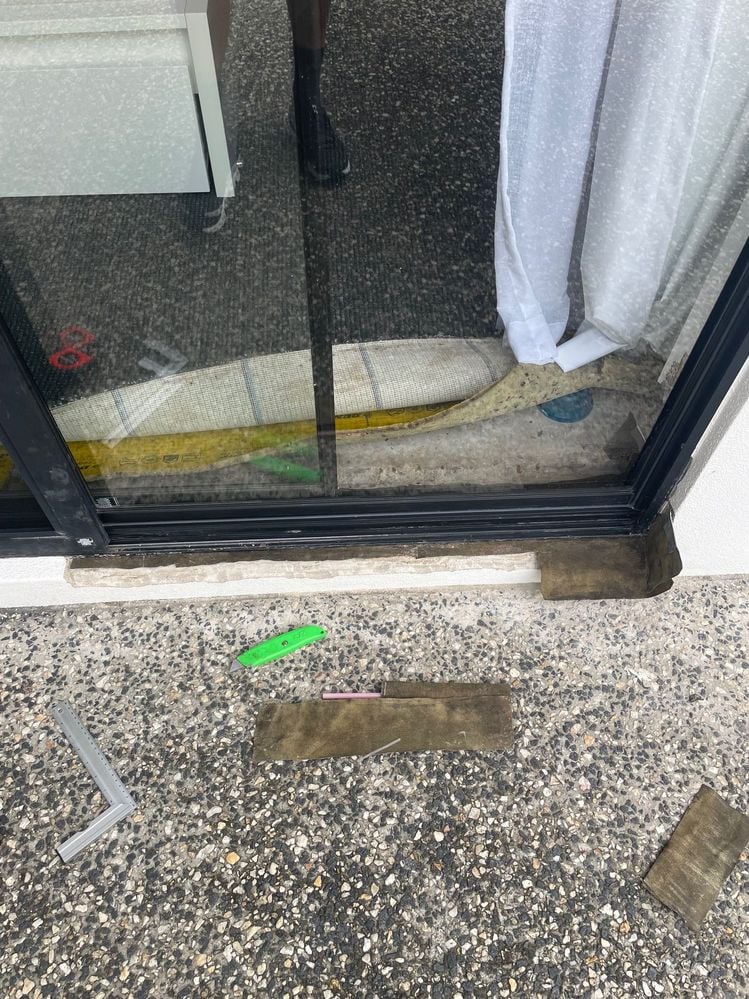
I have removed damaged render/concrete in around and below the aluminum frame. I have installed bituminous flashing under the base of the frame and the affected side. You should be able to see this in the images.
The inside has a channel/gap between the aluminum door frame and the floor slab that needs to be closed/sealed.
The outside has damaged render or brickwork beneath the threshold that you want to rebuild and weatherproof.
Goal:
Seal and close the internal channel next to the frame.
Overlay flashing correctly (tie into the wall or slab as needed).
Rebuild/render the damaged area externally, integrating the flashing to maintain water-tightness.
It would be great to get recommendations to what materials to use and what to do first...
thanks a lot,
Lars
Welcome to the Bunnings Workshop community @LarsG. It's a pleasure to have you join us, and many thanks for your question about sealing a sliding door.
It looks like you’ve made a solid start, and what you’re doing generally makes sense. However, one thing to keep in mind is that the main defence against water getting from the outside to the inside—especially under a sliding door—is sealing the joint between the bottom of the door frame and the concrete slab. The flashing you’ve added under the frame may help divert water, but it doesn’t necessarily stop it from creeping underneath the frame itself. From your photos, the external render seems to be built up quite high to the bottom lip of the door, which may be part of the issue. Could you tell us a bit more about how the leak was occurring? Was the water creeping under the frame and then making its way inside?
If the water is entering underneath, then I’d suggest sealing that area directly. Flashing is typically used to divert water away from a surface or to shed rainwater outward, but it’s not a watertight seal on its own. In this situation, I’d actually recommend removing the flashing you’ve installed and instead using a flexible polyurethane sealant—something like Sikaflex 11FC—on both the inside and outside bottom edge of the frame where it meets the concrete slab. This will form a proper seal and stop water from penetrating underneath.
Once that base seal is in place, you can go ahead and rebuild or re-render the damaged area on the outside. After the render has cured, I’d run another bead of Sikaflex along the joint between the new render and the door frame to create a secondary seal. That way, the frame is sealed to the concrete on both the inside and outside, and the exterior render is also sealed to the frame. This should give you a much more watertight outcome and help prevent any future water ingress.
Please let me know if you have any questions.
Mitchell
Hi @MitchellMc ,
thanks for your quick reply. You are spot on. The water came through the frame and made it's way to end corner of the frame and found a way inside.
My idea was to use the flashing (pan) to basically make sure that the water can't get in anymore and if water makes it way into the frame that it can run out. Especially in the corner. Thought about a little drainage pipe / weep hole in the corner as well but that might get too technical ![]()
When I installed the flashing I noticed a couple of wet spots underneath the frame. If I would seal it off, where could the water go, if it finds its way in?
I fully agree that they built the external render too high and it is flush with the frame, so water can't run down.
Do you think I could cut the flushing on the outside all the way back to the frame and then seal it off and bringing the render only up to the bottom part of the frame lip, so that i have an edge to proper seal it?
And then on the inside , just leave a small lip / fold it up and seal to the concrete underneath (photo of the idea attached) - or is that not ideal?
Just worried that if I take the flashing out that I might not be able to find/close the gap in the corner. As the frame / door are 20 years old, I won't to put in as many options as I can (until there is enough budget for a new door)...
Last question - what material / product would you use for the inside floor gap and external rendering? Any recommendations?
thanks a lot for your input.
Cheers,
Lars
Thanks for the follow-up and the extra detail @LarsG —really helpful in understanding what you're working with.
I think your approach is logical, especially given the age of the door and the fact that you're trying to make the best of a tricky situation until a full replacement is viable. I completely agree with your thinking around flashing and the idea of managing any water that finds its way into the frame by giving it a clear path out. In an ideal world, the frame wouldn’t be letting water in at all—but since it is, we have to work with that.
You’re right to be cautious about sealing everything up too tightly without considering where any water that does get in might go. If you seal off the bottom and sides entirely and water still manages to find a way in, you risk trapping it and causing long-term damage. That’s why your idea of folding up the inside flashing slightly and sealing it to the concrete sounds like a good compromise. It won’t be perfectly waterproof, but it will help direct moisture away and make future issues more manageable.
As for cutting the external flashing back to the frame and sealing the render lower—yes, that could work, and in theory it would allow you to seal directly to the frame instead of trying to work around a poorly positioned render line.
For patching inside, Quickset Mortar is a good call as it sets quickly and bonds well. For outside rendering, you could either use a dedicated exterior render mix or continue with the mortar if you’re only touching up—just rough up the finish while it sets if you're trying to match a stippled look.
Mitchell
Workshop is a friendly place to learn, get ideas and find inspiration for your home improvement projects
We would love to help with your project.
Join the Bunnings Workshop community today to ask questions and get advice.