
The Bunnings Workshop community can help with your home improvement projects.
- Bunnings Workshop
- >
- Discussion
- >
- Whole of House
- >
- Re: How to fix scraping sliding door?
How to fix scraping sliding door?
- Subscribe to RSS Feed
- Mark Topic as New
- Mark Topic as Read
- Float this Topic for Current User
- Bookmark
- Subscribe
- Mute
- Printer Friendly Page
Share


- Mark as New
- Bookmark
- Subscribe
- Mute
- Subscribe to RSS Feed
- Highlight
- Report Inappropriate Content
How to fix scraping sliding door?
Hi all!
I've learned so much from the insight of you all over the years, and I'd be grateful for the community's thoughts on a small situation we're currently experiencing.
In short, our property has two almost-identical white wooden sliding doors separating each of the bedrooms from their respective en suites. As the below image makes clear, these doors appear to be scraping the door frame (or something in the space recessed within the wall) in a number of places leading to lifted paint and gouges in the body of the door.
It is almost as if the door itself is too thick or fat to fit in the space made for it.
We've been in this property for over five years now, and - as far as we can recall - the issue has existed since we bought the place.
Neither of the doors are particularly smooth to open or close, but we had previously just attributed that to the wheels/tracks and whacked some WD40 on them (to limited avail). They can also be unpredictable and inconsistent in the force that they require to move them - sometimes light touch, and sometimes requiring much more. All of that said, I do not believe that the damage to the doors has worsened in the time that we've been here and I haven't seen any shaved wood or paint chips on the floor, for example.
Any suggestions? Is this a case of sanding/shaving down the door so it is skinnier/narrower? If so, is that something we can readily do ourselves (and how)? If not, what type of tradesperson are we after and what should we be asking them to do?
Thanks very much in advance,
Aaron



- Mark as New
- Bookmark
- Subscribe
- Mute
- Subscribe to RSS Feed
- Highlight
- Report Inappropriate Content
Re: How to fix scraping sliding door?
Hi @amoss12000,
Welcome to the Bunnings Workshop community, it is wonderful to have you with us.
For us to narrow down our approach, can I ask you to take a couple of photos and a few measurements so we can work out what the actual problem is?
Can you fully open the door so that the door is inside the pocket and take a photo of it? Can you also take a photo of the track at the top of the door?
Can you measure the thickness of the door as well as the thickness of the pocket and let me know what their measurement is? Is the opening of the pocket the same width the whole way from top to bottom?
I can't imagine that when the door was installed that they intentionally made it so tight that it would rub, so I suspect something has shifted or expanded, since this time. Narrowing down what has shifted or expanded is going to direct our approach.
My guess, based on what I can see, is that this timber here, or its counterpart on the other side of the opening is what the door is catching on.
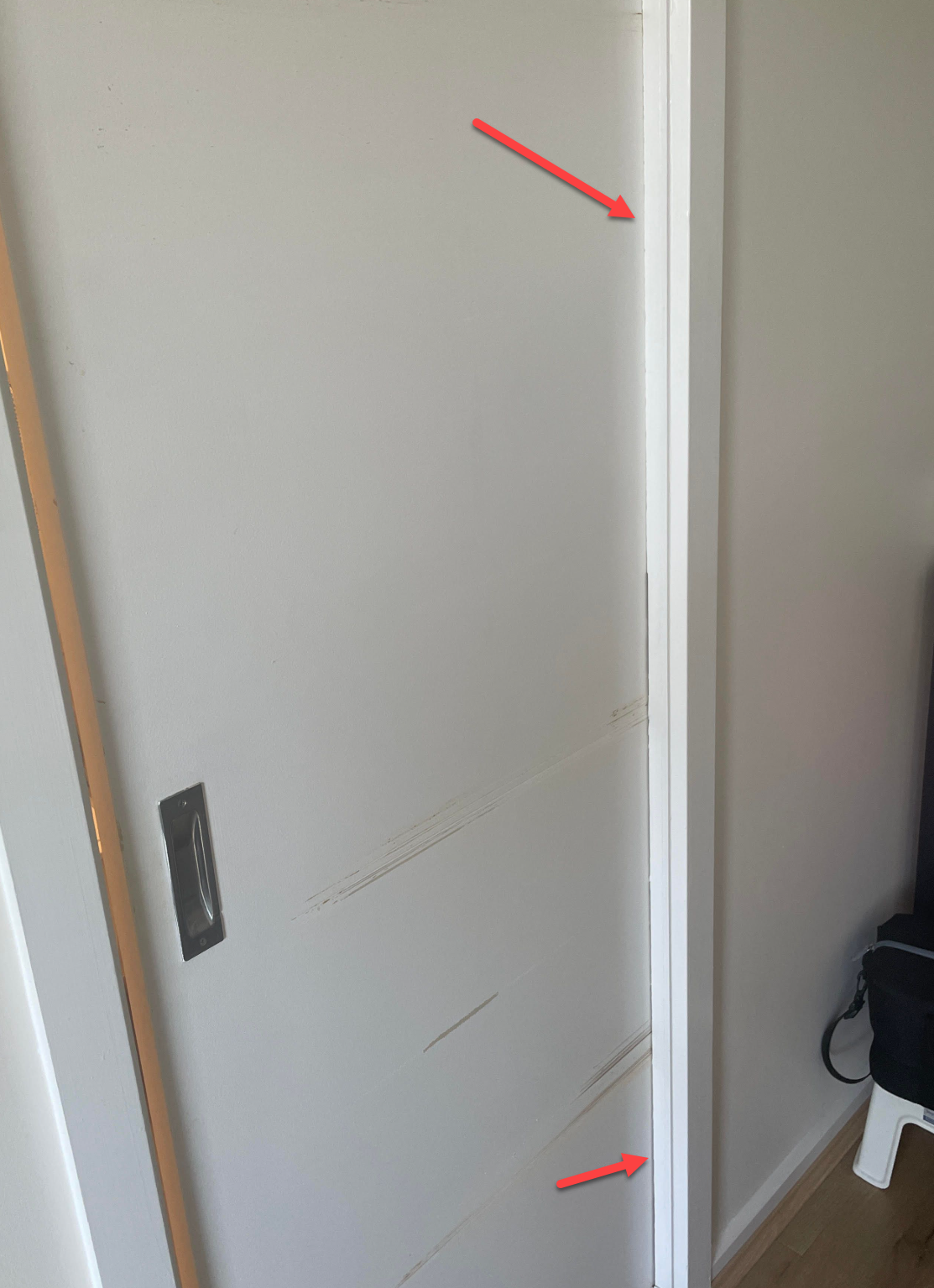
Moving the timber that it is catching on is going to be much more achievable than shaving down the thickness of the door.
If you can respond to my questions above and add the photos in the discussion, we should be able to narrow things down and come up with a plan of attack.
I'll assist further when you have responded.
Jacob
- Mark as New
- Bookmark
- Subscribe
- Mute
- Subscribe to RSS Feed
- Highlight
- Report Inappropriate Content
Re: How to fix scraping sliding door?
Hi Jacob,
Thanks very much for your willingness to assist!
Attached is a series of photographs responsive to your questions as best as we are able.
Unfortunately, the door does not open fully so as to sit flush with the frame, but instead hits some form of hard stop with 50mm of the door protruding. This also means that we are unable to effectively measure the thickness of the pocket, as the door protrusion is in the way.
Otherwise, the door is consistently 34mm thick from top to bottom. On the bathroom side of the door, the space between the door and the frame/pocket appears uniform from top to bottom. This is not the case on the bedroom side, as the space is visibly greater at the bottom of the door than it is at the top (by our estimates, differing by 1mm or so).
As one of the close-up photos also indicates, there is a little "notch" carved out of the door frame on the bedroom side for the protrusion of the top of the metal handle plate. No equivalent notch appears to exist for the bottom of said plate.
Hopefully this makes sense? Please let me know if you would be assisted by any further information or media, and we will do our best to get it to you promptly.
Thanks,
Aaron


- Mark as New
- Bookmark
- Subscribe
- Mute
- Subscribe to RSS Feed
- Highlight
- Report Inappropriate Content
Re: How to fix scraping sliding door?
Hi @amoss12000.,
I suggest you back off the track screws and then test how the door slides back and forth.
The whole thing (track & door) may find it's own center and be a bit easier to slide but likely there will still be some scraping/jamming.
Hopefully that will give us some clues and to move forwards the door will likely need to be removed to examine the cavity.
Standing by...

- Mark as New
- Bookmark
- Subscribe
- Mute
- Subscribe to RSS Feed
- Highlight
- Report Inappropriate Content
Re: How to fix scraping sliding door?
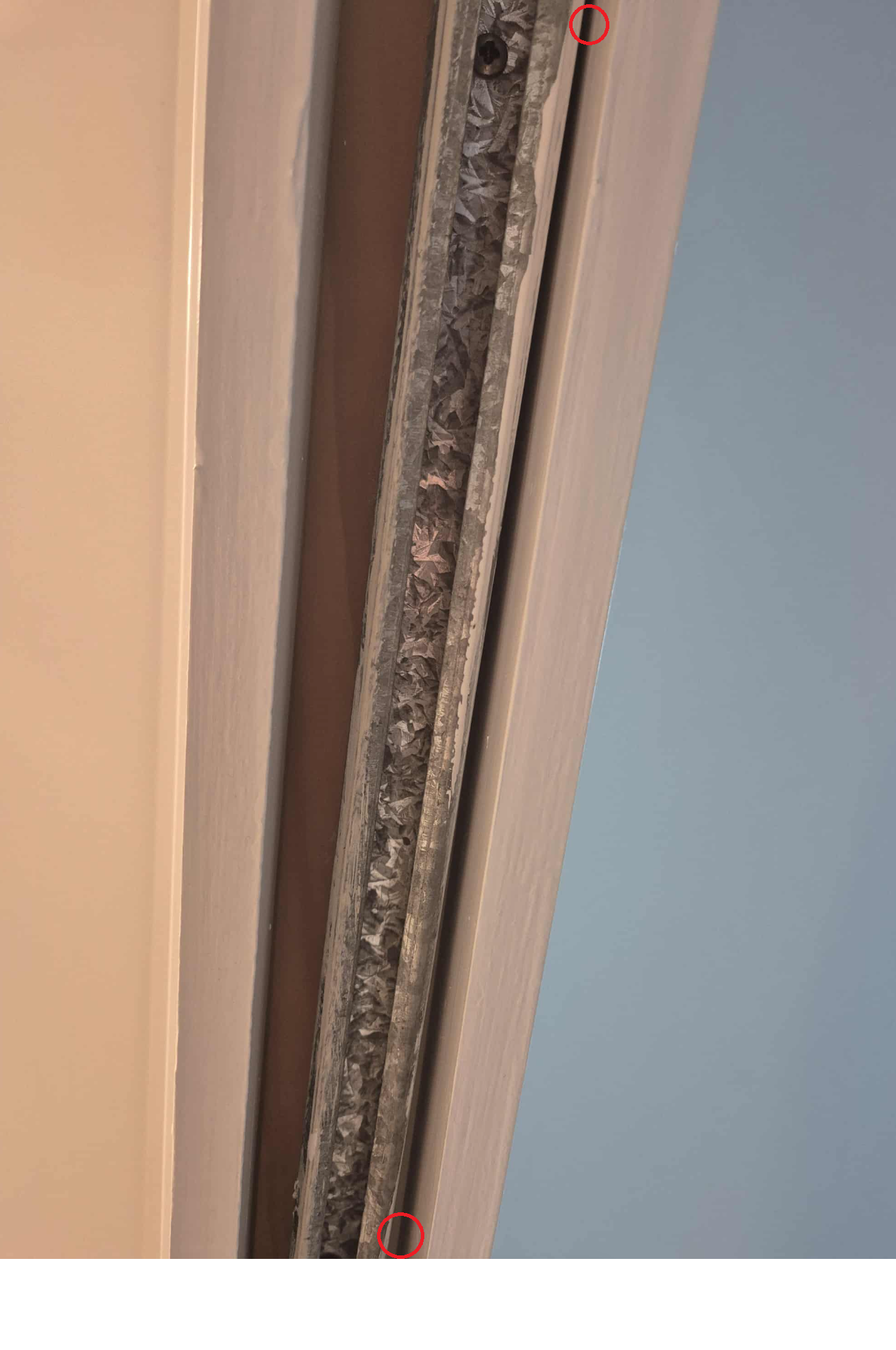
That's a bit of an unusual one @amoss12000. It's peculiar that the lower section, which appears to have more of a gap between the door and the trim, is the area with the most damage. Up higher, where the trim is tighter, there is less visible damage. That leads me to believe that it's not the trim causing the jambing, but actually something inside the cavity assembly. That being said, cavity units are fairly standard and should function well with a 34mm door.
As @AlanM52 mentioned, you could undo the track and shift it slightly to the bathroom side, as it looks off-centre, at least at the end of the track. See in the image below how there is a larger gap from one end to the other? If you undo the last couple of screws, push the track slightly to the other side to free up some room and refix it, that might provide more of a gap on the offending side. My theory would be that the track has been fixed at an angle and is not perfectly centred. Depending on your level of expertise, you may want to consider hiring a professional for the job.
Please let me know if you have any questions.
Mitchell

- Mark as New
- Bookmark
- Subscribe
- Mute
- Subscribe to RSS Feed
- Highlight
- Report Inappropriate Content
Re: How to fix scraping sliding door?
Thank you both!
We haven't had a chance to test these suggestions out yet, but we will do so as soon as we can and revert.
- Mark as New
- Bookmark
- Subscribe
- Mute
- Subscribe to RSS Feed
- Highlight
- Report Inappropriate Content
Re: How to fix scraping sliding door?
Hi @MitchellMc, @JacobZ and @AlanM52!
Apologies for the delayed reply in following this up, but we only just found some time to test out your (helpful!) suggestions.
Unfortunately, despite testing a couple of different track alignments, we didn't observe any meaningful change to the issue.
Time to call in the specialists, I think! Greatly appreciate your assistance.
- Mark as New
- Bookmark
- Subscribe
- Mute
- Subscribe to RSS Feed
- Highlight
- Report Inappropriate Content
Re: How to fix scraping sliding door?
Thanks for the feedback.
Cheers

Why join the Bunnings Workshop community?
Workshop is a friendly place to learn, get ideas and find inspiration for your home improvement projects
You might also like








We would love to help with your project.
Join the Bunnings Workshop community today to ask questions and get advice.