Steps
Step 1
Design, Planning and Project Management
Take one look at this room and it’s obvious something wasn’t right, or inviting.
 The Old bathroom
The sliding door barely closed and offered no privacy. The vanity was squeezed so close to the doorway that walking in felt cramped and uncomfortable. And despite the room having a decent footprint, a huge section of it sat completely unused. It didn’t feel considered, inviting or functional. Thus, we only used the toilet in here since 2022 (our sons birth) as we didn't hate the primary bathroom.
We initially planned to do a quick refresh, and this room would be the aesthetic template for our future washroom and primary bathroom renovations. A new vanity, some updated fittings, maybe a coat of paint. But the more time we spent in the space, the more frustrated we became. The layout just didn’t work. It made the room feel smaller than it was and didn’t reflect the feel of the rest of our home. That’s when we made the decision to go further than surface-level updates. We needed to rework the room completely.
We started with sketches on graph paper. We mapped out every corner of the ensuite, trying different layouts and figuring out how to make the most of the space we had. We quickly realised the existing zones for the shower and toilet actually worked well, they had good access, natural light, and the right proportions. So we left them mostly in place.
 Original
 New Design
The breakthrough came when we decided to move the vanity to the wall opposite the entry. That one change opened up the entire room. But it wasn’t as easy as just shifting things around. To make it work, we had to tear down the existing entry wall and rebuild it from scratch. We needed space to run new plumbing for the wall-hung vanity, plus structural reinforcement to support the cabinet and basin. At the same time, we would have to take out the old sliding track and framed up a proper doorway with a hinged door. That change alone would improve privacy, access, and the way the entire room flowed.
Once we had the plan locked in, I put the layout through an AI visualiser to bring it to life... Nice
 The AI Visualisation of the Room
One of the biggest costs in every quote we received from bathroom renovation companies was project management. We kept seeing it as a vague, expensive line item, often several thousand dollars on top of trades, materials, and finishes. So we made the decision to take on that role ourselves. And it turned out to be one of the smartest choices we made.
We already had a fantastic builder we trusted, and he brought along his regular plumber and electrician. That core team gave us a solid foundation. For waterproofing and tiling, we turned to Hipages and began requesting quotes. After meeting with a few different trades, we found a great fit who was reliable, communicative, and happy to work within our timeline.
While we were finalising the tiler, our builder, plumber, and electrician each visited the site, the builder always present so he could relay exactly what was needed and where based on our design. They walked through the space with us, reviewed the plan, and gave input on what they’d need in terms of access, prep work, and timing. It meant everyone was on the same page from the start, and we could step confidently into the next phase.
Step 2
Site Prep and Demolition
Once the layout was finalised and all our trades were on board, it was time to rip into the demo. This part of the project was surprisingly personal. Liz had been looking forward to it for weeks. She saw it as the perfect kind of stress relief. She threw on the protective gear we won from Bunnings Oxley’s opening weekend giveaway and claimed the room as hers.
We kept the prep simple. With the ensuite already cleared and the door shut, Liz jumped straight in. She started by removing all the fixtures and fittings. The old mirror, vanity, robe hooks, toilet roll holder. Everything that could be unscrewed was gone within minutes. Then came the real fun. She took a hammer (and a sledgehammer once or twice) to the walls and made fast work of the plasterboard. This also involved going around and taking out the hold nails and smoothing over any left over plastrboard on the wood.
 Walls Done
Once that was cleared, she moved on to the floor tiles and the shower screed and absolutely owned it with a chisel and tile smasher. Watching her go was honestly impressive. She took that room down with focus and a bit of joy.
 Tiles Done
 Cleared Room
Recovering from a surgery, I thought I’d be helpful and take on a smaller task. I wanted to get rid of the peeling paint on the ceiling. One tap with the chisel and the entire sheet came crashing down on my head. Turns out the ceiling was barely held up at all. Nothing but the surrounding walls. That moment gave us a solid laugh and confirmed we were doing the right thing starting this bathroom first.
 The Roof Collapse
Once everything was stripped out and cleaned up, our builder came in to remove the front wall. He then rebuilt it with framing to support our new full-sized hinged door and created the cavity depth we needed for the floating vanity and mirror cabinet. It was a small structural change that made a big difference to the layout and flow of the space. He also went around the room and added the fixings we would need for things to be mounted later.
 The Builder
By the end of this stage, the ensuite was a clean shell. And for the first time, we could actually see the new layout taking shape.
 View of the Ensuite once the wall was up
Step 3
Plumbing and Electrical Rough-In
Before we could close anything up or start sheeting the walls, we needed our licensed trades to come in and set the groundwork. This stage was all about getting the hidden stuff right, the wiring, the pipes, the prep work that makes everything else function smoothly.
First, our electrician came in to run the new wiring. We had planned for a power point inside the mirror cabinet and where on the wall a control switch for the IXL 3-in-1 light, heat, and exhaust unit. He also set up cabling for an additional power point that would control our heated towel rack, and the ceiling unit and ensured that everything was safely routed through the framing with future installation in mind.
 Electrical
Shortly after, our plumber arrived to rough in all the water and waste lines. Because we had moved the vanity to a completely new wall, new plumbing had to be run through the freshly framed cavity, and he had to dig a new pipe for our vanity waste. We also made a small adjustment to the toilet location, shifting it slightly to sit more comfortably under the window. In the shower, he positioned the in-wall mixer, overhead rain head, and handheld hose to suit the final tile layout and fixture spacing. The piping was mortered in once final positioning was confirmed.
 Vanity Area
 Shower Area
We used licensed trades for both plumbing and electrical work because it’s not just about doing the job right. It’s also about meeting safety codes and getting compliance certificates. These certificates are important if you ever sell the house or need to show that everything was done to Australian standards. It also gave us peace of mind knowing the work behind the walls was done properly especially when you won’t see any of it again once sheeting goes up.
By the end of this stage, we had visible pipes and cables in all the right places. Everything was measured, double-checked, and ready for the next step: wall sheeting and prep.
Step 4
Wall Sheeting and Prep Work
First up was the ceiling. We used standard plasterboard for this, which is perfectly suitable for bathroom ceilings when paired with the right paint and ventilation. The original ceiling had come down during demolition, and after seeing how poorly it had been installed, we were glad to replace it from scratch. Our builder helped us lift and fix the new plasterboard sheet into place, making sure it sat flat and secure. We cut openings for the IXL ceiling unit and marked out cable positions so the electrician could return for final install later.
Once the ceiling was in, we moved on to the walls. For all wet areas, we used villaboard—fibre cement sheets specifically designed for bathrooms. It’s moisture-resistant, tile-ready, and far stronger than plasterboard.
Liz, our builder, and I tackled this together. We measured, cut, and installed the sheets one by one, starting with the shower wall and working our way around the room. The most time-consuming part was getting clean cuts around all the mixer taps, toilet waste, niche edges, and electrical points, but the effort paid off.
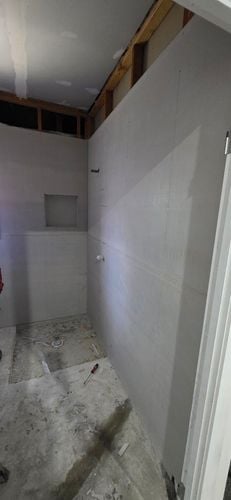
After all the sheets were fixed in place, we taped the joins with mesh tape and sealed them using a fibre cement base coat. This step takes time to do properly, especially if you want your tiles to sit flush and look sharp. We ran a straight edge and hand-checked every join, filling and sanding as needed until we were confident everything was smooth and level.
We also marked all the final mounting points—vanity, mirror cabinet, robe hooks, shower rail—so the trades would know exactly where everything needed to be installed. With the ceiling done and walls ready, the room finally looked clean, sharp, and fully prepped for the next step: waterproofing.
Step 5
Waterproofing
With the structure locked in and the sheeting complete, it was time to hand the space over to our waterproofer. This is one of those stages that happens quickly but is absolutely critical. It’s not the most glamorous part of a renovation, but if it’s not done right, you’re asking for trouble down the line.
We hired a licensed waterproofer through Hipages who had great reviews and clear communication from the start. After inspecting the room and checking the villaboard prep, he got to work laying the shower bed, and then primer across all the floors and wall junctions. Once that dried, he applied a two-part waterproofing membrane across all the necessary areas—shower walls and floor, around the vanity zone, and along every internal corner and junction. He was thorough and clean, and we could tell he took pride in doing it properly.
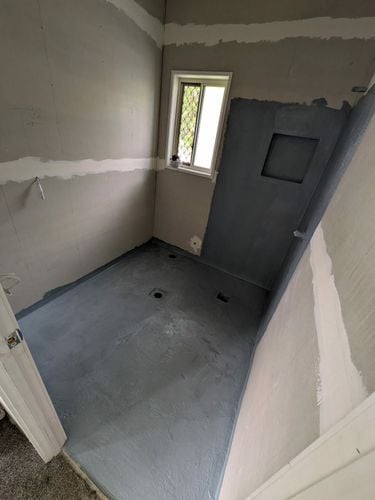
He also waterproofed the built-in shower niche, making sure it was fully sealed before tiling. Every section was double-coated and left to cure for the recommended time before anyone stepped foot back in the room.
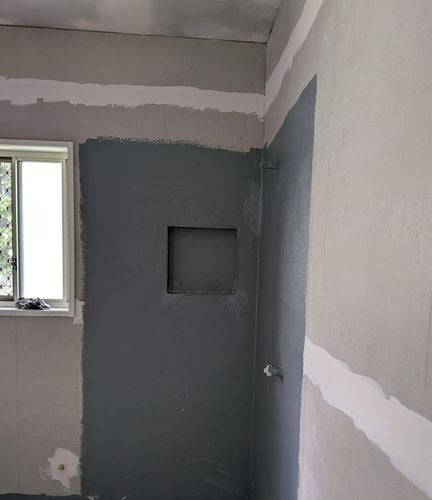
Using a licensed waterproofer meant we received a certificate of compliance, which not only protects us long-term, but also keeps everything above board if we ever sell or renovate again. This step took a few days.
Step 6
Tiling
Tiling was the point where the bathroom really started to feel finished. After weeks of framing, rough-ins and prep, finally seeing surfaces take shape made all the effort feel worth it.
We used the same company that did our waterproofing, but a separate tiling team took over. One tiler focused entirely on the floor, while the other specialised in wall tiling. That division of labour worked brilliantly, especially since laying floor tiles isn’t just about looks—it’s about drainage, alignment, and setting the stage for the rest of the room.
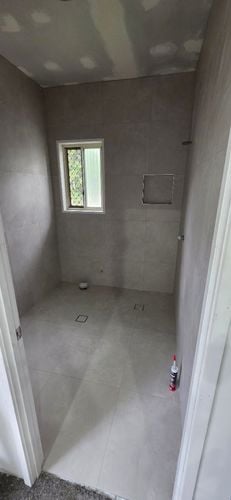
Our builder ensured they were on the same page for around the door and window trim to work with how he was going to make it. They started with the floor. Our tiler carefully mapped out the pattern to ensure a balanced layout with clean lines leading toward the drain. With two linear tile grates to work around, he took extra care ensuring the tiles sloped correctly toward both without creating harsh angles. It’s one of those things you don’t notice when done right, but it makes all the difference in usability and finish.
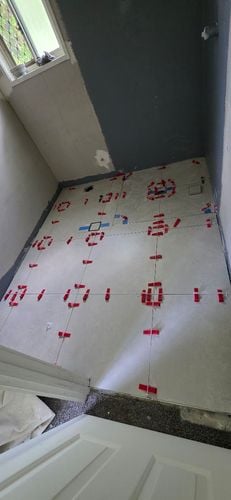
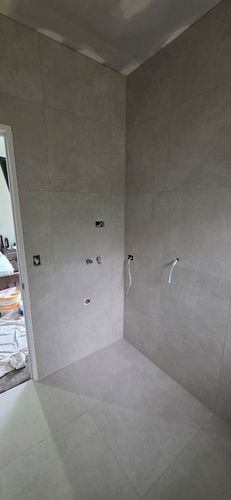
Once the floor was laid and had time to set, the wall tiler came in. He worked from the floor up, using the same 600x600mm matte white tiles we chose for the floor. It was a bold decision using the same tile for both surfaces, but it paid off. The consistent colour and texture created a calm, seamless flow that made the room feel bigger and brighter.
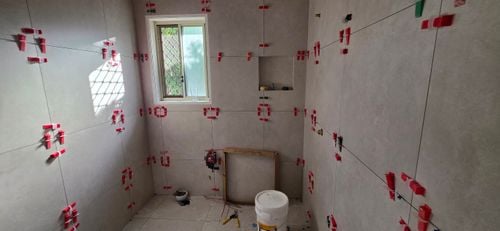
The shower niche was neatly tiled with tight corners and clean grout lines, and around the toilet, vanity, and window, everything was cut to precision. For grout, we used a light grey, which not only looked great but will hold up well to wear and cleaning.
The process took a few days including drying time, but the result was everything we hoped for. Clean lines, smooth transitions, and a room that finally looked like it was almost ready to use.
Step 7
Roof, Window & Trim Paint
With the tiles cured and the room still empty, this was the perfect time to take care of the ceiling and paintwork. No lights were installed yet, no fittings to paint around, and the room was still wide open, making it much easier to move around, tape things off, and get the job done cleanly.
We patched the screw holes and joints, then sanded it all back to a smooth, even surface. From there, we applied one coat of prep, followed by two coats of bathroom-grade ceiling paint.
The window frame had that classic yellowy-cream colour that homes from this era love to cling to, and it stood out like a sore thumb against the clean new tile and white. I gave it a quick rub back with 200 grit sandpaper to help the paint bond properly, then masked it up thoroughly. I used a semi-gloss acrylic white spray paint designed specifically for trim and windows, and it instantly lifted the whole whole thing. Doing this while the room was already prepped for ceiling painting made it super efficient—no need to worry about overspray or paint splatter with everything already covered.
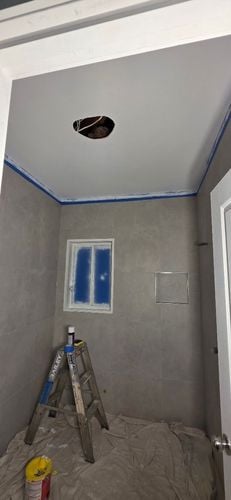
Because the room was still clear, we could lay down one full sheet to protect the floor. It made the whole job much faster and neater. We also painted the new internal door and architraves in the same base coat and finished it off with the aquaenamel, which tied everything together with a crisp, clean finish.
Step 8
Fixtures and Fit-Off
This was one of the most satisfying stages, finally seeing all the effort come together in the form of a usable space. Liz, our builder, and I took this one on together.
We started with the vanity. The builder helped us line everything up, made easier with a heap of photos showing where things needed to be, and once it was in position, we got the basin in (not sealed or fitted though, that's for the plumber later. The mirror cabinet came next, and getting that mounted straight was a bit of a mission. We had to account for weight, placement over the vanity, and where the power point was hidden behind the tiles and create a hole in the cabinet for it.
The heated towel rail was thankfully a quick install. Our electrician had done the hard part earlier by pre-wiring the spot, so it just clicked into place with minimal fuss. The toilet roll holder went in easily too, fixed to the left wall within arm’s reach from the toilet.
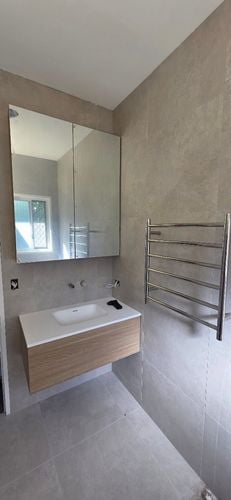
Then came the big one—the shower screen. That part had all of us holding our breath. One slip, one bump, and that thing could have shattered. Our builder had already pre-marked and reinforced all the fixing points in the walls earlier in the build.
Thanks to that preparation and our careful planning, we knew exactly where everything needed to go, and we had confidence the supports behind the tiles were solid. We worked slowly and steadily, each of us holding a panel while the builder carefully slotted everything into place. Once it was locked in, we all exhaled at once. The glass was moved to level on plugs, with the frame being fixed securely once it was all level and where it needs to be. After that silicone dried, the plugs were removed, and silicone replaced it on the floor.
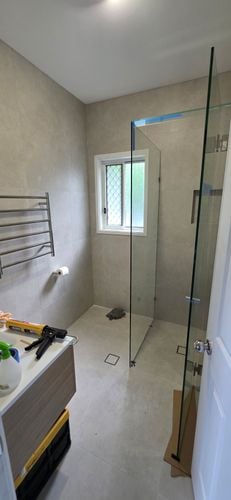
After that, the builder ran a clean line of silicone around the ceiling where it met the tiles, which just tied the whole room together. It’s the kind of finishing touch that you don’t always notice, but without it, something would feel off.
It was surreal standing in the room at this point—clean, bright, everything where it should be. For the first time, it felt like a bathroom again. And not just any bathroom, but one we’d put our hands on nearly every part of.
Step 9
Electrician and Plumber Return
With the major structural and visual work complete, it was time to bring the licensed trades back in to finish everything off.
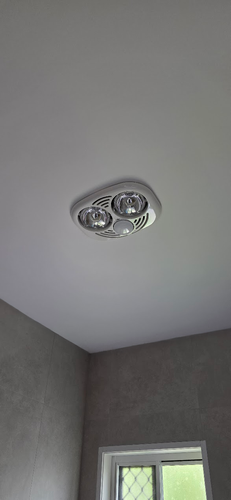
Our electrician came in first to wire in the powerpoints, ensure the heated towel rack was working, and hook up the IXL fan unit in the ceiling with its controller. Since all the hard work had already been done earlier, wiring run and switch placements finalised, it was just a matter of connecting the dots. That meant no guesswork, no scrambling. Everything slotted right into place.
Then the plumber returned to connect the basin tapware, the pop-up waste, the toilet, and the shower fittings. It might sound simple, but this is where a lot can go wrong if things haven’t been lined up just right. Fortunately, our earlier planning with the builder had ensured all the pipework and wall placements were perfect.
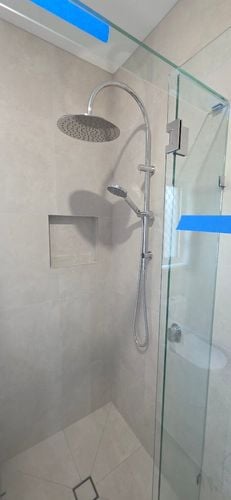
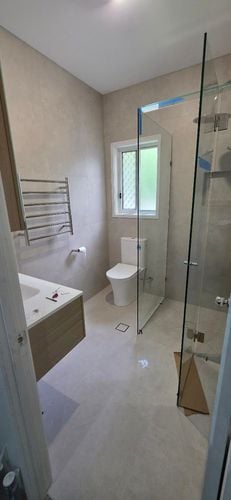
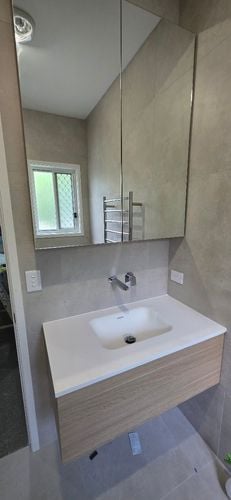
Once they were done, the room was finally functional. We had power, water, and light—all flowing exactly as intended.
Step 10
Finishing Touches and Final Walkthrough
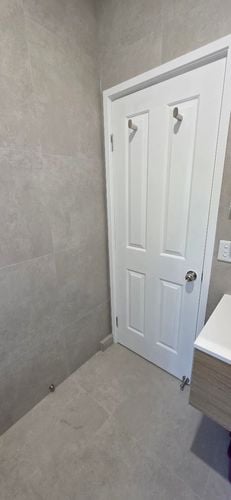
With all the big pieces in place and the trades signed off, it was time to tackle the last few details. We made sure the window frame, door and trim were all painted in fresh semi-gloss white to match the rest of the space. Then we installed the final fittings: the vanity handle went on, the behind-the-door robe hooks were fixed into place, and the magnetic door stopper was screwed into the new door. These were simple jobs, but incredibly satisfying.
We also added 3 clear adhesive bumpers to the edge of the right-hand mirror cabinet door spaced out evenly along the whole thing. Since the glass opens toward the tiled wall, we didn’t want it making direct contact. These little stick-on buffers act as soft stoppers—protecting both the mirror and the tiles from chips and knocks. It’s a tiny upgrade that makes the cabinet feel solid, quiet, and thoughtfully finished.
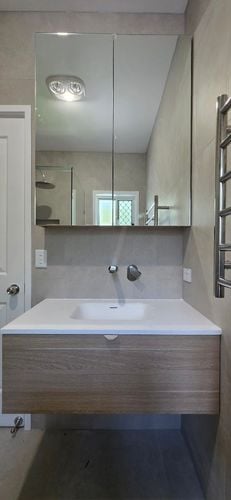
The builder helped with a final once-over—sealing up any last gaps with silicone, checking everything was level, secure, and clean. Liz and I did a full tidy-up and wipe-down, getting the tiles sparkling and pulling off the final bits of tape and packaging.
This was the moment the room felt done. After all the planning, prep, demolition, dust, decision-making, and nerves—we had a calm, clean, completely reimagined space. A bathroom that actually works, both in layout and style.
What made it even better was knowing we managed the whole thing ourselves. In total, this cost us roughly $11,000. From the lowest quote we got, we saved $19,000 just by taking on the project management, and we still got professional results by working with great trades and doing the hands-on work we could. It was a huge effort, but every time we open that door now, we’re reminded it was absolutely worth it
 Before
 After
After


