
The Bunnings Workshop community can help with your home improvement projects.
- Bunnings Workshop
- >
- Discussion
- >
- Garden
- >
- Re: How to fix garden drainage?
How to fix garden drainage?
- Subscribe to RSS Feed
- Mark Topic as New
- Mark Topic as Read
- Float this Topic for Current User
- Bookmark
- Subscribe
- Mute
- Printer Friendly Page
Share


- Mark as New
- Bookmark
- Subscribe
- Mute
- Subscribe to RSS Feed
- Highlight
- Report Inappropriate Content
How to fix garden drainage?
Hi,
I’m looking for advice on a drainage issue with an in-ground garden bed.
In heavy rain, the back of the garden bed (see red line Photo 1) will fill with water and eventually create a hole that then flows into the garden and under the retaining wall (see blue circle Photo 2). I dug out the back of the garden bed and there is no drainage.
I was considering laying agi pipe along the red line and am wondering if that is the best solution? If it is, the second question is where should the pipe end? On the other side of the retaining wall, the yard slopes down to the fence line (see red lines Photo 2).
Any advice would be great.
Thank you,
HTV




- Mark as New
- Bookmark
- Subscribe
- Mute
- Subscribe to RSS Feed
- Highlight
- Report Inappropriate Content
Re: How to fix garden drainage?
Hi @HTV,
Welcome to the Bunnings Workshop community, it is fantastic to have you with us.
Having a look at the height of the retaining wall, specifically where I've put an arrow below -
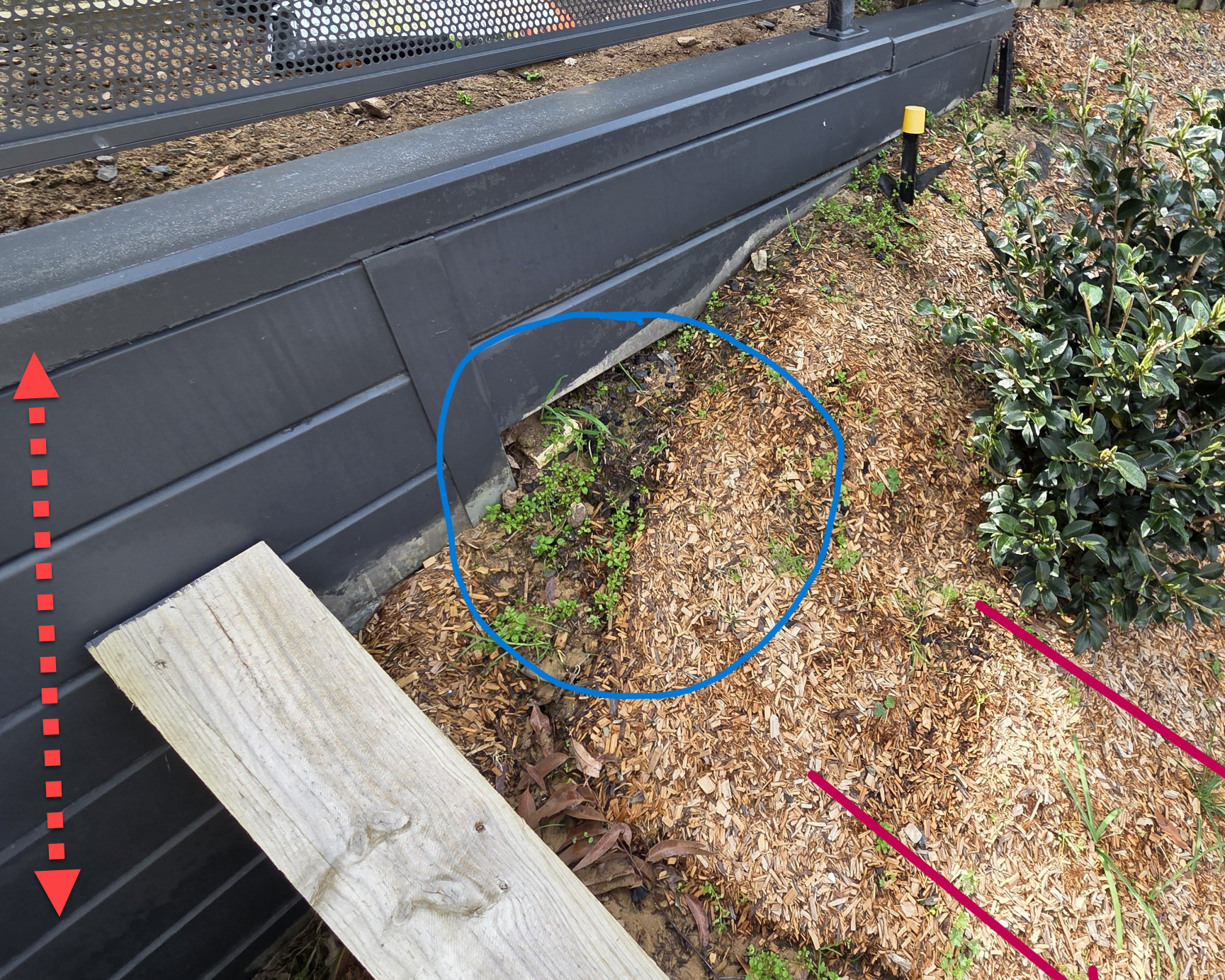
I'd be surprised if there wasn't already an AGI pipe running along the back of the wall; it may just not extend up to the point where you are experiencing erosion. In most areas, retaining walls over one metre high need council approval because they must safely withstand heavy soil loads, which are compounded when the soil gets wet. As part of the approval process, there is almost always a requirement to incorporate proper drainage to prevent water pressure build-up.
The first thing I would be doing is excavating around that end of the garden bed to see if there is already an agi pipe there. If there is, you could grab a length of agi pipe in the corresponding diameter, lay it along the full width of the garden bed, and connect it with a draincoil coupling.
If there is no existing agi pipe, I’d install one along the full length of the retaining wall and have it either connected to the stormwater system by a licensed plumber or directed into a soak well to ensure that water is properly diverted away from the wall.
Do you have access to your home's plumbing plans? If so, is there a stormwater pipe that runs anywhere near the retaining wall? If not, is it possible to get some images showing more of your yard to see if there is a logical place to install a soakwell as an endpoint for the agi pipe?
I would also look at adding a plinth to cover the eroding gap. The plinth can be held in place with plinth pegs or wooden stakes, then the garden bed can be topped up with some more mulch to cover and conceal it.
Allow me to tag our knowledgeable members @Nailbag, @Noyade and @TedBear to see what they think.
Jacob
- Mark as New
- Bookmark
- Subscribe
- Mute
- Subscribe to RSS Feed
- Highlight
- Report Inappropriate Content
Re: How to fix garden drainage?
Thanks, Jacob. Really helpful response.
Great point, I am confident there is existing agi pipe behind the line you've drawn and that might be the best solution.
Come to think of it, under the red line on my initial Photo 1 was a treated pine floor (unsure if it covers the entire garden bed). The water would be getting trapped on that and then redirecting under the retaining wall. From my limited research, should it have a timber floor? I thought the floor would just be the soil? Perhaps under that timber floor is the agi pipe and if I remove the timber, it's problem potentially solved...
- Mark as New
- Bookmark
- Subscribe
- Mute
- Subscribe to RSS Feed
- Highlight
- Report Inappropriate Content
Re: How to fix garden drainage?
Hi @HTV,
I can't see any logical reason for there to be a timber floor beneath your garden bed. All that timber would be doing is preventing the water from draining downwards naturally. There's a good chance it is contributing towards the erosion you are experiencing.
Regardless of whether there is agi pipe there or not, I would be removing the timber. If you find agi pipe beneath it, that would be a bonus.
Let me know what you think.
Jacob
- Mark as New
- Bookmark
- Subscribe
- Mute
- Subscribe to RSS Feed
- Highlight
- Report Inappropriate Content
Re: How to fix garden drainage?
Thanks, Jacob. Unfortunately, it may be a job for the weekend, but I'll rip up the timber and see what I find. Thanks again for your response.
- Mark as New
- Bookmark
- Subscribe
- Mute
- Subscribe to RSS Feed
- Highlight
- Report Inappropriate Content
Re: How to fix garden drainage?
Hi @HTV,
I'll be online this weekend, so if there is anything new to report or if you have further questions, don't hesitate to reach out.
Jacob
- Mark as New
- Bookmark
- Subscribe
- Mute
- Subscribe to RSS Feed
- Highlight
- Report Inappropriate Content
Re: How to fix garden drainage?
Thanks, Jacob.
Should I need to run new pipe, is a soak well typically the lowest point on a property?
- Mark as New
- Bookmark
- Subscribe
- Mute
- Subscribe to RSS Feed
- Highlight
- Report Inappropriate Content
Re: How to fix garden drainage?
Hi @HTV,
A soak well isn’t always the lowest point on a property, but it does need to be positioned so that water naturally flows into it, which oftentimes means it will be located at the lowest point on the property.
A soak well is basically just a vertical shaft, often lined with a plastic frame, that will allow water to drain to a point lower down in the earth where it will dissipate. They're best located as far away from your home's foundation as possible.
Let me know if you have any further questions.
Jacob
- Mark as New
- Bookmark
- Subscribe
- Mute
- Subscribe to RSS Feed
- Highlight
- Report Inappropriate Content
Re: How to fix garden drainage?
Great, thanks Jacob. And they can be installed by a novice?
- Mark as New
- Bookmark
- Subscribe
- Mute
- Subscribe to RSS Feed
- Highlight
- Report Inappropriate Content
Re: How to fix garden drainage?
Hi @HTV,
As long as it is kept well away from your house, then yes. If it is anywhere near your house's foundations, you'd be better off speaking with a plumber about connecting it to your stormwater system.
You basically just have to dig a big hole, say 600mm in diameter and 1200mm deep, line it with geotextile membrane and then fill it with drainage gravel. The geotextile membrane will stop the soil from eroding into the gravel and blocking up the channels between it, which allows the water to flow through. You can then have the agi pipe flow into this soakwell where the water will fall down through the gravel to a point well below ground where it will dissipate into the soil.
There are also soakwell systems, like this Soakwell from our supplier RELN Groundwater Drainage Solutions , which is an option that can be ordered through the Special Orders desk at your local store.
If you have a look at YouTube, there are quite a few examples of soakwells being built. They are also sometimes referred to as soakaway pits.
Let me know if you've got further questions.
Jacob

Why join the Bunnings Workshop community?
Workshop is a friendly place to learn, get ideas and find inspiration for your home improvement projects







We would love to help with your project.
Join the Bunnings Workshop community today to ask questions and get advice.