The Bunnings Workshop community can help with your home improvement projects.
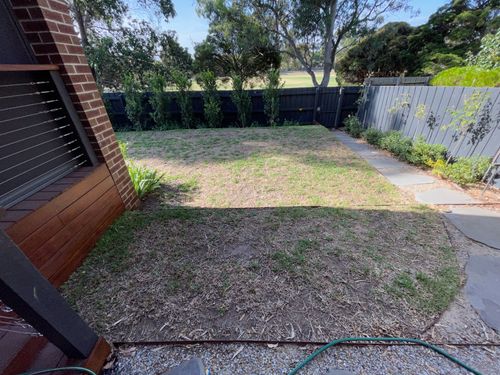
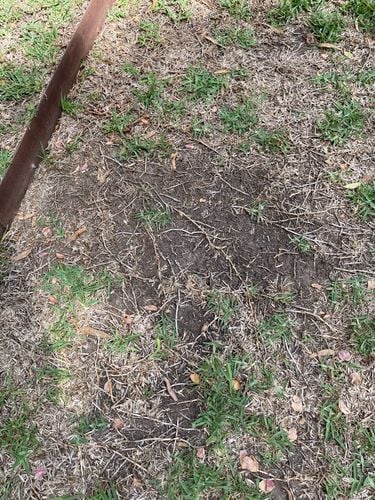
My buffalo lawn is not doing well. I’ve neglected it. Lots of bare and dry spots. Areas under shade is doing better. Wondering if it can be revived with lots of love and care or should I start again and returf my lawn? If I can revive it, please let me know what to do. There’s some weeds and there’s a patch of a different type of grass growing in some spots, one with a finer leaf. Thanks
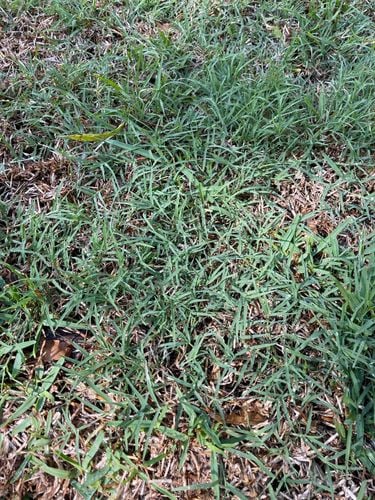
Fine leaf grass
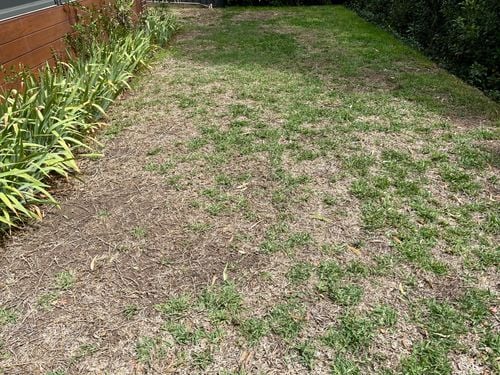
That's enough lawn feeder for now @waltercflui. It's important to base your watering schedule on the moisture retained in the soil. Since we are unsure if it's being overwatered, before you water it, stick your finger in the soil. If it's damp/wet, don't water if it's almost completely dry water.
Mitchell
Hi BW trust! I am hoping for a step by step guide on how to re-establish our lawn or welcome advice on whether it's just better to returf entirely. We inherited a very patchy, weed infested, uneven lawn from the previous owners of our house and since we've never had to do this before, our knowledge and tools need to start from zero. We are hoping to give it a go ourselves as our budget is limited.
Hence hoping for a kind soul, willing to walk us through the process, in lawn for dummies fashion, haha.
Some key things, to add info to the pictures (a but messy after heavy winds):
- Some areas still have buffalo
- The back area where the trees are keeps water stagnation and I was wondering with what yype of soil we could level it to create some natural drainage.
- There's a big eucalyptus currently to the side of the garden, however the lawn does get light. Its moisture though might be taken by the tree. However the buffalo seems to be surviving regardless.
- Ideally we'd like to lift the lawn up to the edge of our pergola tiles, as the soil sunk. Again looking for guidance as to how to level types of soil to achieve that.
- Is it a good idea to do this job now (Summer) or wait till spring?
Thank you so much in advance!!
Hello @Anka
Welcome to the Bunnings Workshop community. It's sensational to have you join us and thanks for sharing your question about re-establishing your buffalo lawn.
Re-establishing your lawn can be a rewarding project, and with a bit of planning and effort, you can achieve great results without blowing your budget. Since you're dealing with patchy buffalo grass, weeds, uneven levels, and some water stagnation, here's a beginner-friendly approach using readily available products from Bunnings.
Firstly, tackle the weeds by applying a selective herbicide designed for buffalo lawns, such as Weed'n'Feed products labelled as safe for buffalo grass. Follow the product instructions carefully, applying it on a dry day when no rain is forecast for at least 24 hours. Allow two weeks for the weeds to die off before progressing.
Next, assess the waterlogged area near the trees. For levelling and improving drainage, use a soil blend like Lawn Top Dressing or a sandy loam soil, both available at Bunnings. Spread a thin layer of soil to fill the low spots and rake it out evenly. To further assist with drainage, consider mixing in gypsum if the soil is clay heavy.
For the sunken areas, you can use the same top-dressing soil to bring the level up to your pergola tiles. Apply the soil in small amounts, gradually building it up and watering lightly after each layer to help it settle.
If the existing buffalo grass is still healthy in parts, you can give it a boost by fertilizing with a buffalo-specific lawn fertilizer, such as Scott's Lawn Builder for Buffalo Grass, which you can find at Bunnings. Water it in well to encourage vigorous growth. To thicken your lawn, consider oversowing bare patches with grass seed suitable for buffalo lawns, or if you want faster results, lay buffalo turf in those areas. Keep the soil moist until the new growth establishes.
Regarding the eucalyptus tree, its roots can compete for water and nutrients, so a slow-release fertilizer for lawns will help support grass growth. Water deeply and less frequently to encourage stronger root development in the grass.
Summer is a good time to work on your lawn since buffalo grass thrives in warmer temperatures but avoid extreme heat for laying turf or applying fertilizer. Early mornings or evenings are best for watering to minimize evaporation.
By following these steps, you can improve your lawn gradually, keeping costs low while creating a more even, lush lawn that complements your outdoor space.
Here are some discussions about lawn revival you might find useful.
If you need further assistance, please let us know.
Eric
Located in Melbourne. Laid this Sir Walter Buffalo turf from Bunnings back around mid-end of Sept. Didn’t seem to take particularly well like the other slabs I’ve laid in the past, but some parts are starting to thrive. Sun moves from right to left in these pics. It gets a bit of sun, but probably not as much as it would like (or as much as the rest of the lawn gets).
Used Scott’s lawn soil to prepare the surface and have done a couple of aerations.
Do I remove all the dead patches to let the established stuff spread out? Or just leave it be and it will sort itself out over time?
Went out yesterday and stabbed it a bunch of times with a pitchfork to aerate it. A lot (if not all) of the dead patches lifted up in their original turf slab cuts.
To me, I feel like I should just rip that stuff up, fill with nice soil and let the established stuff spread across. Or do I rip it up then buy another slab or two to cut out and patch the areas?
Hello @DaveTorr
Welcome to the Bunnings Workshop community. It's sensational to have you join us and thanks for sharing your question about buffalo lawn patch.
Your Sir Walter Buffalo turf looks like it’s facing some challenges, but with the right care, you can bring it back to its best. It’s a resilient grass variety, so you have a few options depending on how quickly you want results. From the photos and your description, it seems like the dead patches may not have rooted properly, especially since they lifted easily during aeration. If they haven’t established, removing them is a good idea.
Carefully lift those sections and replace them with fresh soil, such as Richgro Lawn Top Dress Mix from the store, which will provide a nutrient-rich base. This will give the healthy areas the best chance to spread naturally over time. Sir Walter Buffalo is excellent at self-repair and will gradually fill in bare spots if it’s in the right conditions.
If you’d like faster results, you could purchase another roll or two of Sir Walter Buffalo turf from the store, cut it to size, and patch the bare areas. Before laying, ensure the patches are firmly in contact with the soil beneath, and water them consistently to encourage rooting. Either way, keep the area well-aerated, as you’ve already done, and ensure the turf gets as much sunlight as possible, even if it’s not optimal.
For ongoing care, use a slow-release lawn fertilizer like Scotts Lawn Builder Buffalo Slow Release to promote healthy growth and root establishment. Regular but deep watering will also help the turf thrive, especially during the warmer months. With this approach, your lawn should recover beautifully, and those bare patches will soon be a thing of the past.
If you need further assistance, please let us know.
Eric
Thanks Eric! I’ll give this a go and see how it turns out!
Hi, I am looking for help with reviving this buffalo grass, any help appreciated. Located in WA.
Since summer has started it has got less green!
Hello @robert2mac
Welcome to the Bunnings Workshop community. It's sensational to have you join us, and thanks for sharing your question about your lawn.
Reviving your buffalo grass during the hot summer in Western Australia involves a few key steps. Buffalo grass can suffer from heat stress, water deficiency, or nutrient shortages, leading to browning and reduced vibrancy. First, ensure you water deeply and less frequently to encourage deep root growth, ideally in the early morning to minimize evaporation. Applying a balanced fertilizer like Scotts Lawn Builder Buffalo Slow Release Lawn Fertiliser will provide the necessary nutrients to strengthen the grass and promote a lush green colour. Using a soil wetting agent such as Yates Waterwise Soil Wetter can improve water penetration and retention, especially in sandy soils common in WA, ensuring the roots receive adequate moisture.
For severely damaged patches, consider repairing them with a buffalo grass seed blend or roll-on turf, such as Munns Buffalo Grass Patch Repair. It's also essential to adjust your mowing habits, keeping the grass slightly longer during summer to shade the soil and reduce evaporation. Avoid cutting more than one-third of the leaf blade at a time. If the lawn is compacted, aerating it with a garden fork or lawn aerator will improve air, water, and nutrient penetration.
I also suggest having a look at these guides - How to detect lawn problems by @Adam_W and How to repair a lawn by @Adam_W.
With consistent care and maintenance, your buffalo grass should recover and regain its lush, green appearance, remaining healthy and resilient throughout the warmer months.
If you need further assistance, please let us know.
Eric
Hello everyone,
My buffalo lawn is dying. There is one big empty patch and also at many places lawn is getting dry. I have tried beetle treatment, aerated lawn, lawn fertiliser etc... however, nothing worked unfortunately. Looking forward to receive your tips and solution. Please find the attached images for your reference. Thank you.
Hello @aapkahiren
Welcome to the Bunnings Workshop community. It's sensational to have you join us and thanks for sharing your question about your lawn.
It looks like your buffalo lawn is struggling, with a large bare patch and widespread dryness. Since you've already treated for beetles, aerated the soil, and applied fertiliser without success, other factors might be at play. One possibility is compacted soil, which can prevent water from reaching the roots even after aeration.
Using a wetting agent like Richgro Ezi-Wet or Yates Waterwise and deep watering in the early morning or late afternoon may help. Shade could also be a contributing factor, as buffalo grass tolerates some shade but struggles in heavily shaded areas. If trees or structures are blocking sunlight, trimming them back slightly may promote better growth.
Fungal diseases, such as brown patch, can also cause thinning and dry patches, especially if there are signs of mould or a distinct ring around the affected areas. If a fungus is suspected, a treatment like Yates Mancozeb Plus may be beneficial. Additionally, watering habits can impact lawn health; frequent shallow watering can cause roots to stay near the surface, making the lawn more vulnerable to drying out. Instead, watering deeply two to three times a week is recommended. If water is not penetrating well, applying a soil wetting agent may assist.
Soil health also plays a crucial role, and testing the pH can provide insight into potential issues. Buffalo grass thrives in a pH range of 6 to 7, so if the soil is too acidic, adding dolomite lime can help, while an alkaline imbalance may be corrected with sulphur or organic compost. To encourage regrowth in the bare patch, spreading a thin layer of sandy loam mixed with compost and keeping it well-watered should help stimulate new growth.
If the area isn’t recovering, replacing it with buffalo turf runners or rolls from Bunnings may be necessary. Even though you've already treated for beetles, it might be worth checking for other pests like armyworms or fungal gnats, especially by inspecting the soil at night. If you're still experiencing issues, let me know more about your watering routine and soil conditions so we can troubleshoot further.
If you have any other questions we can help with, please let us know.
Eric
Workshop is a friendly place to learn, get ideas and find inspiration for your home improvement projects
We would love to help with your project.
Join the Bunnings Workshop community today to ask questions and get advice.