
The Bunnings Workshop community can help with your home improvement projects.
- Bunnings Workshop
- >
- Discussion
- >
- Garden
- >
- How to revive Buffalo lawn?
How to revive patchy Buffalo lawn?
- Subscribe to RSS Feed
- Mark Topic as New
- Mark Topic as Read
- Float this Topic for Current User
- Bookmark
- Subscribe
- Mute
- Printer Friendly Page
Share


- Mark as New
- Bookmark
- Subscribe
- Mute
- Subscribe to RSS Feed
- Highlight
- Report Inappropriate Content
How to revive patchy Buffalo lawn?
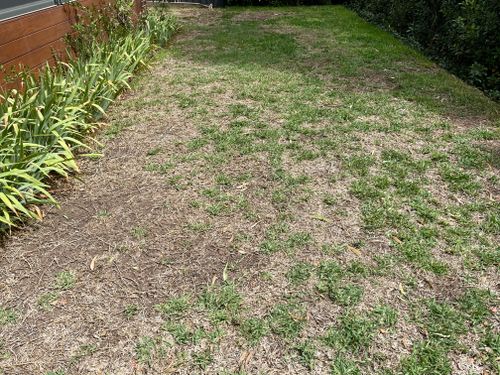
My buffalo lawn is not doing well. I’ve neglected it. Lots of bare and dry spots. Areas under shade is doing better. Wondering if it can be revived with lots of love and care or should I start again and returf my lawn? If I can revive it, please let me know what to do. There’s some weeds and there’s a patch of a different type of grass growing in some spots, one with a finer leaf. Thanks
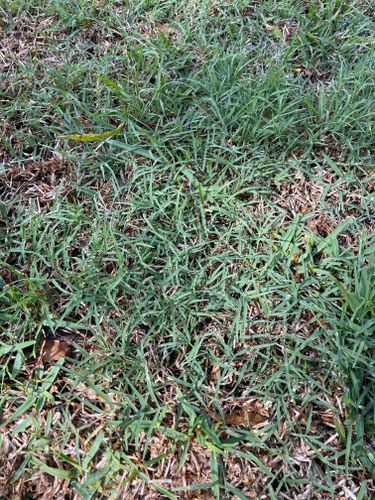
Fine leaf grass

- Mark as New
- Bookmark
- Subscribe
- Mute
- Subscribe to RSS Feed
- Highlight
- Report Inappropriate Content
How to revive new Buffalo lawn?


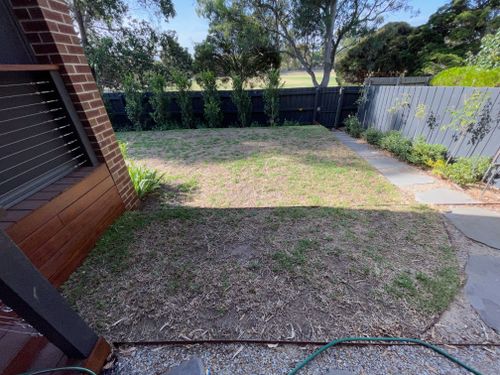
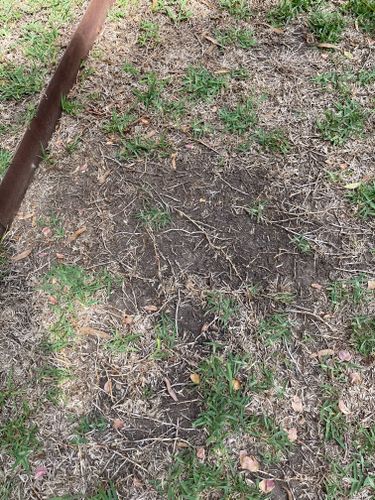
New to the lawn game. Laid sir Walter almost a year ago. Started off quite well and some areas have really gone down hill since. I know that it goes dormant over spring but what steps can I take to revive/improve it? I’ve seen a lot online however lots of mixed messages on ways to go about it, and knowing it’s spring, I’d love to get started
also, in the last photo, that is quite shady and it doesn’t grow well in that area, is there anything I can do for this?
thanks!


- Mark as New
- Bookmark
- Subscribe
- Mute
- Subscribe to RSS Feed
- Highlight
- Report Inappropriate Content
Re: How to revive new Buffalo lawn?
Hi @BlakeD,
Sir Walter and other varieties of buffalo will go dormant over winter but start bouncing back and actively growing in spring when the weather starts to warm up, so now is the perfect time to get started.
In patchy or weak spots, I'd suggest topdressing with a thin layer of sandy loam or a dedicated turf underlay soil mix like this Scotts Lawn Builder Organic Lawn Soil Topdress & Underlay. This helps level the lawn, encourages new shoots to spread, and fills bare patches. Check out How To Topdress Your Lawn for some guidance on this process.
With the areas close to the house and deck, you are likely having issues because of water pooling against them. Building them up with regular topdressing, so that water flows down away from these areas, will certainly help. They may also be experiencing some compaction due to the pooling water.
Aerating your whole lawn, with a focus on the patchy areas, will help air and nutrients get to the root layer, which will help everything, especially the struggling areas. Check out How To Aerate Your Lawn for some guidance.
As for the shady patch, Sir Walter is more shade-tolerant than most warm-season grasses, but it still needs about 3–4 hours of direct sun to thrive. If the spot gets less than that, unfortunately, you’ll always battle thin growth. You can try pruning back nearby trees or shrubs to let in more light, mowing higher so more leaf is left to catch what light is available, and feeding a little more often to support weaker growth.
On top of this, an application of a buffalo-friendly lawn fertiliser such as this Scotts Lawn Builder Buffalo Lawn Food would be a fantastic idea as the weather starts to heat up. This will ensure your lawn is getting the right nutrients to green up and thrive through the warmer months. Check out How To Use Lawn Fertiliser for some guidance on this.
Regular watering is also going to be vital. Check out How Much To Water Your Lawn Year-Round for some guidance.
Let me know what you think and if you have further questions, please don't hesitate to ask.
Jacob
- Mark as New
- Bookmark
- Subscribe
- Mute
- Subscribe to RSS Feed
- Highlight
- Report Inappropriate Content
Re: Lawn Help?
Thanks for the reply! Keen to give it a go.
how do I work out what soil type I have for the correct fertiliser?
also, should I thatch some of the areas prior?
- Mark as New
- Bookmark
- Subscribe
- Mute
- Subscribe to RSS Feed
- Highlight
- Report Inappropriate Content
Re: Lawn Help?
Hi @BlakeD,
Soil type affects how well fertiliser and water are absorbed, so it’s worth checking. Clay soil feels heavy, sticky when wet, and clumps together easily. Sandy soil is gritty, falls apart quickly, and dries out fast. Loamy soil, which is ideal, feels crumbly, holds its shape when squeezed but breaks apart easily, retaining moisture while still draining well.
A simple way to test is to grab a handful of damp soil and squeeze it: if it holds shape and feels smooth, it’s clay; if it falls apart immediately, it’s sandy; if it holds shape but crumbles when poked, it’s loamy.
If you have clay-dense soil, you can use Richgro Natural Gypsum Clay Breaker to help break it up. If you have sandy soils, you can add Richgro 2L Ezi Wet Hose On Soil Soaker to help with water retention. If you have loam, then you can celebrate because this is pretty much ideal.
Most lawn-specific fertilisers, such as the Scotts Lawn Builder Buffalo Lawn Food, are already balanced to suit Australian conditions, so it would be a pretty safe bet alongside the products mentioned above.
Thatching can also be worthwhile as it will remove the layer of dead grass, opening up space for new growth. The browner areas could definitely benefit from thatch removal. Check out How To Dethatch Your Lawn for some guidance.
Let me know what you think.
Jacob

- Mark as New
- Bookmark
- Subscribe
- Mute
- Subscribe to RSS Feed
- Highlight
- Report Inappropriate Content
How to restore lawn?
Hi all,
I’m looking for some advice on restoring a small patch of grass in my front yard. The grass seems to have died off (my first time dealing with lawn care), and I suspect I may have underwatered it.
I also tried using Yates weed killer, but I think that may have made things worse — especially since I’m not sure what type of grass it is. I’d like to see if I can recover this patch rather than fully replanting.
A few questions I could use help with:
-
What fertiliser or supplements would you recommend for reviving lawn grass?
-
How often should I be watering it (assuming standard conditions)?
-
The yard already has an old watering system underneath, but the previous owner disconnected it due to a leak that caused a high water bill. If I want to set up a new watering system, what options won’t get in the way when mowing?
Apologies if these are basic questions, but I’d like to get some guidance before I start buying products that may not work.
Thank you


- Mark as New
- Bookmark
- Subscribe
- Mute
- Subscribe to RSS Feed
- Highlight
- Report Inappropriate Content
Re: Need Help Restoring Front Lawn
Hi @SouthFieldSnoop,
Thank you for your question about reviving your front lawn.
It looks like you have a variety of buffalo grass, which means you need to use buffalo-specific weedkillers. If you did not do this before, it is likely a contributing factor.
These tufts of green grass look like they are winter grass (poa annua).
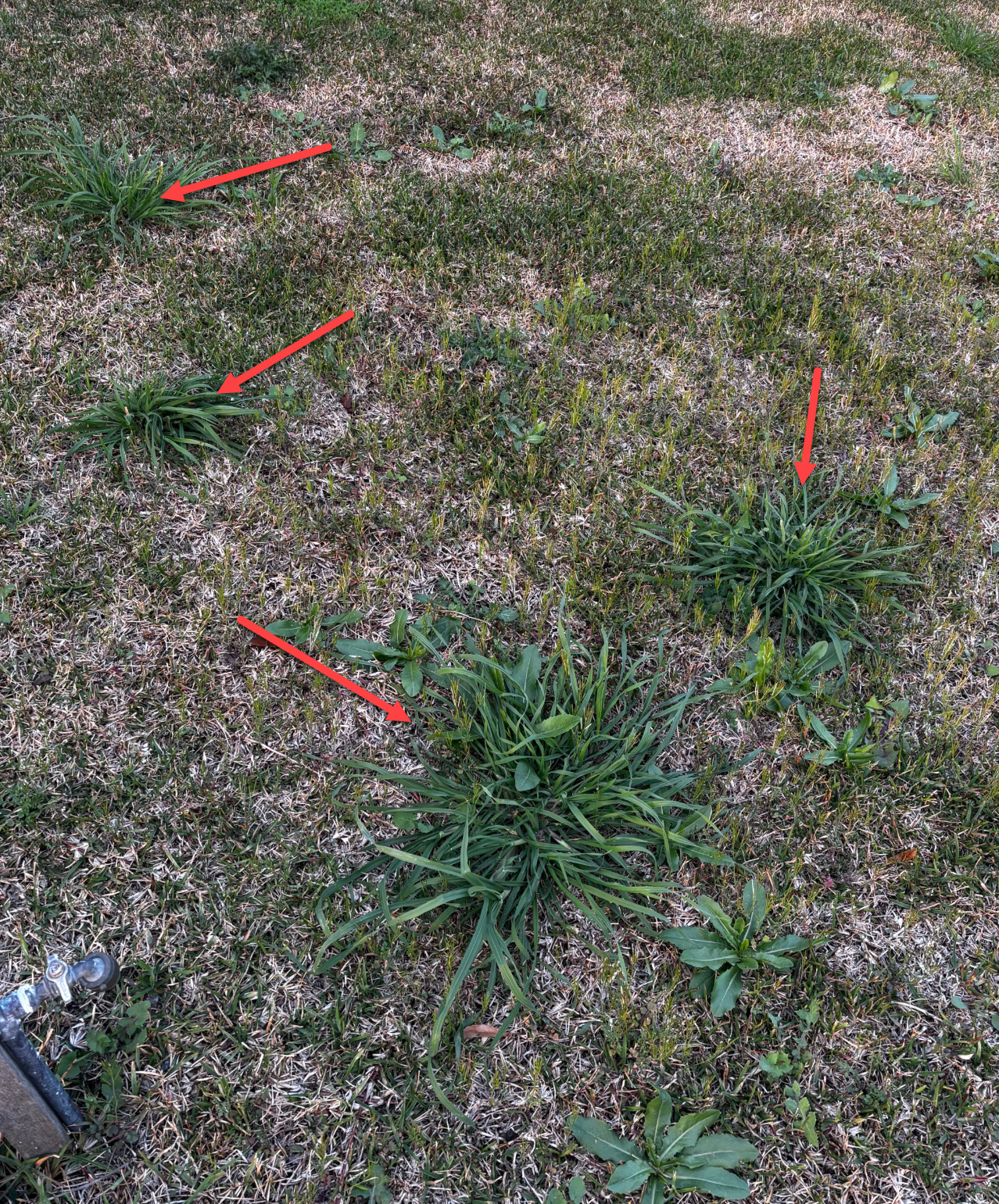
If there are only a few, then your best option is manual removal. You can use a weed puller to make it easier on your back. If there are lots, then you can use Munns Professional Winter Grass Killer Weed Control.
The rest of the weeds can be treated using a buffalo-specific product such as Yates 2.4L BuffaloPro Weed 'N' Feed Hose On Weed Killer. This is a combination weed killer and fertiliser which will kill the weeds and help your lawn bounce back.
Watering requirements can vary quite a bit based on your soil composition and your weather conditions, but you can check out How Much To Water Your Lawn Year-Round for some general guidance.
If you'd like to install new lawn irrigation that won't interfere with your mower, then a system utilising pop-up sprinklers would be your best option.
For further information on lawn care, have a look through the Lawn section of our D.I.Y. advice pages.
If you have any other questions, please don't hesitate to ask.
Jacob
- Mark as New
- Bookmark
- Subscribe
- Mute
- Subscribe to RSS Feed
- Highlight
- Report Inappropriate Content
Re: Need Help Restoring Front Lawn
Thankyou @JacobZ
You are right, I already bought a weed-n-feed that i used last summer and it clearly states its not suited for buffalo lawns 😅.
Love the idea of a popup sprinkler, ill check that out and some installation videos as well.
Do i need to do any other maintenence, i saw other posts mentioning topsoils refills and aerating the lawn? or are there specific care needed for the bufallo lawns.
Cheers

- Mark as New
- Bookmark
- Subscribe
- Mute
- Subscribe to RSS Feed
- Highlight
- Report Inappropriate Content
How to restore my patchy Buffalo lawn?
Hi guys,
I have Sir Walter lawn and have no clue what to do with it other than water and mow it. I would love some advice on how to restore it to its former glory. I’ve attached photos for reference but it’s essentially super patchy and full of weeds. I assume I start by removing the weeds but have no idea where to go from there.
Thanks heaps!


- Mark as New
- Bookmark
- Subscribe
- Mute
- Subscribe to RSS Feed
- Highlight
- Report Inappropriate Content
Re: How to fix my lawn
Hello @kpop
Welcome to the Bunnings Workshop community. It's sensational to have you join us, and thanks for sharing your question about your lawn.
It looks like your Sir Walter buffalo lawn is suffering from a combination of weed invasion, thinning coverage, and likely some soil or moisture imbalance. The good news is that it’s completely recoverable with a few focused steps. Below is a suggested guide to bring it back to health and thickness over the next few months.
Step 1: Weed Removal
Start by addressing the weeds, as they compete heavily with your buffalo grass for nutrients, light, and space. Hand-pull larger weeds to avoid damaging the buffalo runners. For smaller infestations or broadleaf weeds, use a selective herbicide labelled safe for Sir Walter lawns, such as Yates 700ml Click And Grow Bindii And Clover Buffalo Lawn Weed Killer. Avoid glyphosate (Roundup) because it will kill the grass too. Apply herbicide on a calm day and follow with a deep watering after a few days to help the buffalo recover.
Step 2: Dethatch and Aerate
Buffalo lawns can develop a layer of thatch that restricts new growth. Lightly dethatch by raking vigorously with a steel rake or using a dethatching machine if the thatch is thick. Once dethatched, aerate the lawn by poking holes into the soil using a garden fork or mechanical aerator to improve air and water penetration. This is especially important if the soil has become compacted.
Step 3: Top Dressing and Soil Improvement
Your lawn appears patchy, suggesting uneven soil or compacted spots. Apply a thin layer (around 1 cm) of top dressing mix made from washed river sand and composted organic matter. Work it into the holes created during aeration. This will improve drainage, promote microbial activity, and encourage the buffalo runners to spread evenly.
Step 4: Fertilising
Once the weeds are under control and the lawn has been aerated, feed it with a slow-release granular lawn fertiliser specifically designed for buffalo grass such as Scotts Lawn Builder 8kg Buffalo Slow Release Lawn Fertiliser. A balanced product with an NPK ratio around 20-5-10 is ideal. Apply in early to mid-spring and again in late summer. Water the lawn deeply afterward to activate the fertiliser.
Step 5: Overseeding or Encouraging Runner Growth
Buffalo doesn’t reseed well, but it spreads through runners. You can help this process by trimming back the edges of healthy areas and using plugs (small cut-out pieces of healthy turf) to fill the bare spots. Firmly press them into the soil and water regularly until they establish. Alternatively, if you prefer faster coverage, you can mix a small amount of compatible grass seed like a soft-leaf kikuyu blend just for the bare sections.
Step 6: Watering and Mowing Practices
Water deeply but infrequently, aiming for around 25–30 mm twice a week depending on your local weather. This encourages deep root growth. Mow regularly but avoid cutting it too short; keep your Sir Walter around 40–50 mm high, as this shade of height helps suppress weeds and retain soil moisture.
Step 7: Long-Term Maintenance
Repeat fertilising every season (four times a year), aerate annually, and spot-treat weeds as soon as they appear. In autumn, consider a winter fertiliser with higher potassium to strengthen the grass before the cooler months.
Here are some handy guides that will help:
Please remember to wear personal protection such as gloves, goggles and a mask when using chemical sprays.
If you need further assistance, please let us know.
Eric


- Mark as New
- Bookmark
- Subscribe
- Mute
- Subscribe to RSS Feed
- Highlight
- Report Inappropriate Content
How to revive Buffalo lawn?


I’ve got Sir Walter which needs some love. It has been treated for weeds, there was bindi and oxalis thoroughout which has left dead patches from the treatment. I can see some new smaller weeds coming through. The ground is uneven and soil quite compacted from dogs and foot traffic, as well as hole dug.
I was thinking of thatching then aerating followed by top soil, fertiliser and plenty of water. Will this help level out and how to fix the bare patches? Should they be turfed again? What would be the best top soil - mix of sand and soil? Also, are the manual aerator effective? I’ve heard mixed reviews.

Why join the Bunnings Workshop community?
Workshop is a friendly place to learn, get ideas and find inspiration for your home improvement projects
You might also like


We would love to help with your project.
Join the Bunnings Workshop community today to ask questions and get advice.