The Bunnings Workshop community can help with your home improvement projects.
Hi there!
I'm going to be installing some kitchen cabinets in our small pantry and need some advice about benchtops as it will need to fit an L-shape over the cabinets.
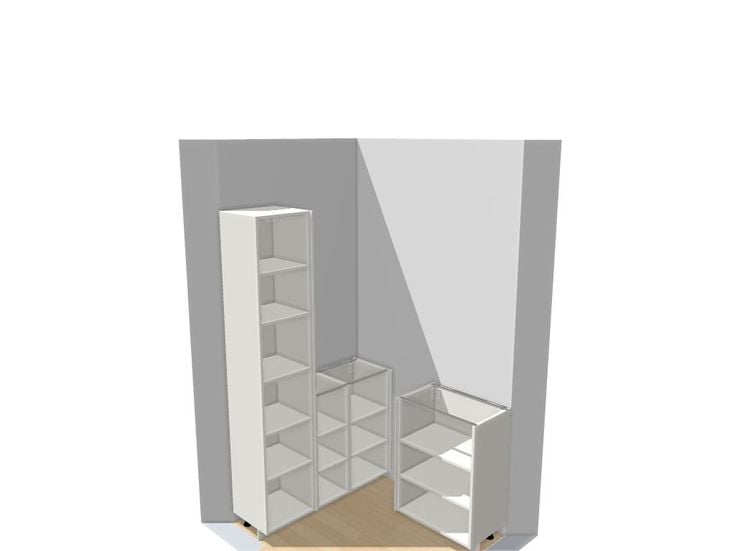
I'm thinking of a long bench top spanning across the wider pantry over the gap and onto the corner cabinet top. Then I'd complete the L-shape with a smaller panel over the remaining space over the cabinets (which will join to the high cabinet). The cabinets have a depth of 37mm. What's a recommended overhang for benchtops?
I was thinking of something like this panel (https://www.bunnings.com.au/specrite-1800-x-405mm-18mm-timber-panel-beech-fj-laminated_p8330198) with a couple coats of polyurethane.
What's the best approach to making the L look nice? I think I'll leave a 5mm (or less) gap to the walls and high cabinet and caulk those gaps, but what's the approach to join the two bench tops together. They will all be secured to the cabinets from the underside, but not sure how to deal with the butt joint part.
Thanks!
Solved! See most helpful response
Re-visiting this thread to close it off - thanks everyone for all the info!
I ended up using the Kaboodle kit and Acacia timber panels (2200 x 600 x 26) and butted them together on the cabinets, also butted the boards on some angle brackets for shelves above the cabinets.
I caulked the gaps the cabinet benchtops made with the wall, and just left the shelving boards as is because that's less visible. There were some/minimal gaps at the butt joints due to concerns of expansion (though I'm not sure how much of an issue that would be).
Here's the final look of the pantry:
Is this the same for larger 2200x600x26 bench tops also? Or can the be connected via square cut instead of 45degree cut?
Hi @jasonboz,
Welcome to the Bunnings Workshop community, it is wonderful to have you with us.
The 26mm thick panels don't appear to be chamfered in the same way as the 18mm ones, meaning a butt join would be a viable option.
If necessary, you can always sharpen up the edge using a block plane or planer before joining. This will ensure you get a nice, clean connection between your panels.
Let me know if you have any further questions.
Jacob
Thanks legend
Piggy backing here. I am recycling some 40mm thick hardwood table tops on my kaboodle cabinets. It is an L-shaped kitchen and I will use a butt joint. Are the joiners in the kaboodle joining kit still suitable?
Cheers
Hi @crisis,
Yes, they will work.
Thicker panels won't have any issues; thinner ones will have issues because of the depth that needs to be routed out to accommodate the joiners.
With your situation, you may have to route deeper into the underside of the benchtop so they are more central in the panel and the force is applied evenly through the panels, but this shouldn't really be an issue.
Let me know if you have any further questions.
Jacob
This is very good news. Thanks
The video on the previous page is interesting - recommending a wood glue joint.
Long time ago - but when we did our 'Masters' kitchen a neutral silicone was what they insisted on.
Not mitred though - small curve then a butt joint.
Maybe because it was close to a sink?
Timber Bench tops are in and joiners worked a treat. Due to my unstraight walls though I have a gap between wall and bench in one section that I’d like to fill before tiling. The gap is 2-8mm at its widest point and maybe 8cm long. The tiling will hide the gap but I’d still like to fill it. What caulk am I best to use for this? Pic to show bench tops, gap not visible
Workshop is a friendly place to learn, get ideas and find inspiration for your home improvement projects
We would love to help with your project.
Join the Bunnings Workshop community today to ask questions and get advice.