
The Bunnings Workshop community can help with your home improvement projects.
- Bunnings Workshop
- >
- Discussion
- >
- Outdoor
- >
- Re: low level deck
How to build a low level deck over pavers?
- Subscribe to RSS Feed
- Mark Topic as New
- Mark Topic as Read
- Float this Topic for Current User
- Bookmark
- Subscribe
- Mute
- Printer Friendly Page
Share


- Mark as New
- Bookmark
- Subscribe
- Mute
- Subscribe to RSS Feed
- Highlight
- Report Inappropriate Content
How to build a low level deck over pavers?
Hello
I realised this has been done to death but I'm in the planning phase of a low level deck. Just hoping to get some simple, sound advice.
The deck will be 8m X 5m and will replace our paved area in the alfresco. The part where I'm scratching my head is deciding to build on top of the existing paving or ripping the oavers up to gain a bit more height. I want to set the deck flush with the zero brick level, the measurement from paver to zero brick is 75mm but if the pavers get pulled the measurement will be 135mm. The tightest measurement that I can think of is using a builders edge pedestal foot at 35mm on a 50mm paver plus a 90 x45mm joist and the ekodeck board will be 23mm thick which in total will be 198mm.
Is it just a simple case of losing sand to make it higher or can the pedestal foot rest on something thinner than a 50mm paver.?.
Kind regards


- Mark as New
- Bookmark
- Subscribe
- Mute
- Subscribe to RSS Feed
- Highlight
- Report Inappropriate Content
Re: low level deck
Unfortunately, given the measurements you’ve provided @Heath1980, it’s unlikely you’ll be able to construct a deck without removing the existing pavers. To achieve the total height you need of roughly 200 mm, you’d have to remove the current pavers and excavate the area further. Assuming your pavers are 50 mm thick, you would need to dig down an additional 80 mm after taking them out. This will give you enough depth to lay new 50 mm pavers flush with the soil and correctly position the pedestal feet, joists, and decking so that the finished surface sits flush with your brick level.
There isn’t really a way to bypass this excavation if you want a stable, level deck. Pedestal feet need a solid, level base to rest on, and using something thinner than a standard paver could compromise stability. By removing the pavers and preparing a proper base, you’ll ensure the deck is safe, durable, and correctly aligned.
Please let me know if you have any questions.
Mitchell

- Mark as New
- Bookmark
- Subscribe
- Mute
- Subscribe to RSS Feed
- Highlight
- Report Inappropriate Content
Re: low level deck
Thanks for your response, very helpful
2 more questions, what would be the minimum paver thickness for the pedestal feet?
And what would be the most efficient way to remove 80mm of sand for that sized area?.........I'm assuming a good old fashioned shovel and wheelbarrow
Kind regards
- Mark as New
- Bookmark
- Subscribe
- Mute
- Subscribe to RSS Feed
- Highlight
- Report Inappropriate Content
Re: low level deck
A paver of 30 - 50mm would be sufficient @Heath1980. And, yes, a shovel and wheelbarrow would likely be the most efficient way. The good old bait and switch of inviting a few mates around for a BBQ and beverages, and getting them onto it, is another option worth considering.
Mitchell
- Mark as New
- Bookmark
- Subscribe
- Mute
- Subscribe to RSS Feed
- Highlight
- Report Inappropriate Content
Re: low level deck
Hello again.......
The patio has been cleared , I have 170mm clearance from brick to slab. The slab is protruding about 150mm from the house as well.
Is this situation can I hang the joists from the house to get the sufficient height and support as close to the house as I can and then go with paver, pedestal for the rest of the area .
What are your thoughts



- Mark as New
- Bookmark
- Subscribe
- Mute
- Subscribe to RSS Feed
- Highlight
- Report Inappropriate Content
Re: low level deck
Hi @Heath1980,
We typically advise keeping things separate, as we cannot know with certainty if your brick structure is capable of supporting the additional load that attaching a deck would impose on the structure. If you wanted to tie your deck to an existing structure, we typically recommend that this be done in consultation with a professional, such as a builder or engineer, to ensure that the forces exerted on the existing structure will not cause issues in the future.
The other thing to note is that at that level, there are weepholes in your brick.
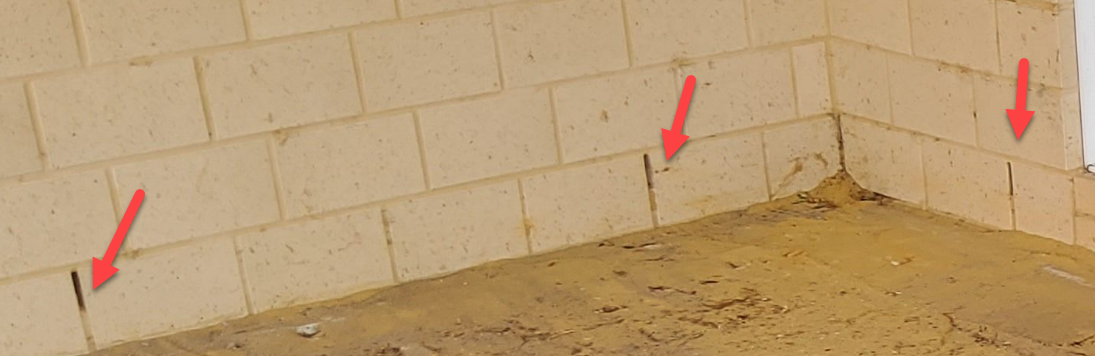
Tying the deck frame to your house through the use of a ledger board would almost certainly block these weepholes, which is certainly not ideal.
In your situation, I would suggest that you stick with pedestals for simplicity's sake, and you ensure that the outermost framing members have enough clearance from these weepholes to ensure that they are able to function as intended.
Which way were you hoping to run your decking boards in relation to the door? I could certainly help you design something that should work if you can advise.
Let me know what you think.
Jacob
- Mark as New
- Bookmark
- Subscribe
- Mute
- Subscribe to RSS Feed
- Highlight
- Report Inappropriate Content
Re: low level deck
Hey Jacob
Thanks for your input and pointing out about the weep holes, now I understand what they do and the issues it can cause if they are blocked.
The deck I want to build is 7610 L X 46r0mm W with 40mm pavers, pedestal feet, 90x45 timber and ekodecking running parallel to the rear stacker doors.
I thought a ledge board would be a great solution to get the right height for the joists with attached joist hangers to begin with then adding pavers and then pedestal feet to run level.
I just don't have the necessary clearance near the brickwork to make it work without a ledge board.
But yes very happy to hear any suggestions you might have
Thanks
- Mark as New
- Bookmark
- Subscribe
- Mute
- Subscribe to RSS Feed
- Highlight
- Report Inappropriate Content
Re: low level deck
Hi @Heath1980,
As long as the ground beneath the pedestal foot is compact and stable, so that it doesn't move, you don't necessarily need to use a paver. Pavers are just recommended when you are placing them over soil, as they provide a quick and easy foundation.
If you can't excavate any further because of the foundation, this means you already have a stable base for the pedestal feet to sit on; you would just remove the paver from the setup and use a taller adjustable pedestal foot that sits directly on the concrete foundation. As you have 170mm of clearance from the top of the brick to the slab, and you are using 90x45 with 23mm thick Ekodeck, you have a total thickness of 113mm. Without the paver, you would have 57mm of clearance to the slab beneath, so you could use these Builders Edge 35 - 60mm Smallfoot Pedestal Feet wherever the foundation is in the way.
Keeping the weepholes open is really important, so where your deck runs up close to the wall, my suggestion is to run your last framing member 45mm away from the wall and install 100mm long blocks of your 90x45 every 450mm along the outside of that framing member, ensuring none of them line up with the weepholes. The decking boards would then still be supported at the correct intervals, without the framing blocking the weepholes. These blocks could be attached to the joist using 75mm batten screws.
It would end up looking something like this.
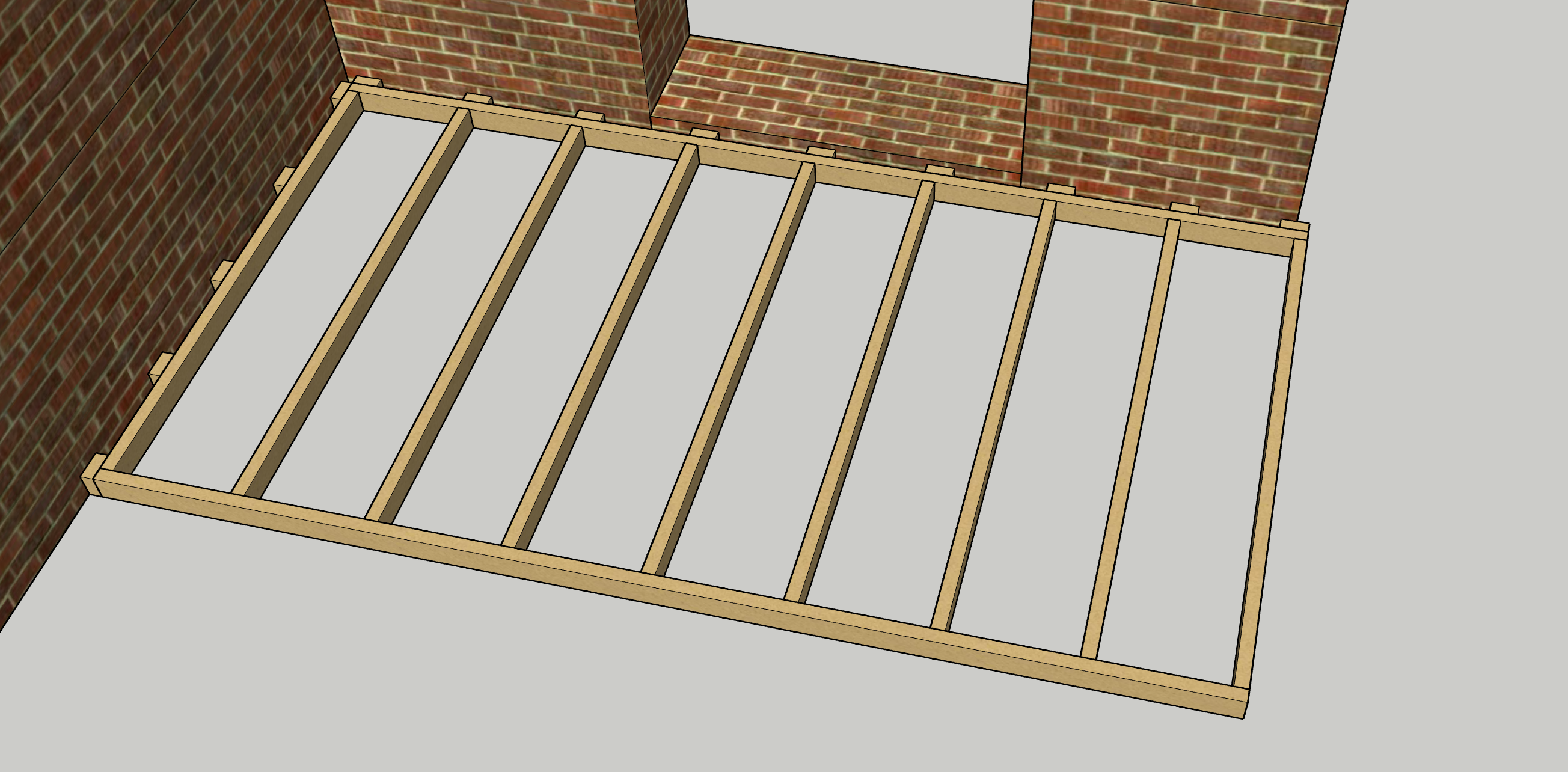
Let me know what you think and if you have further questions, please don't hesitate to ask.
Jacob
- Mark as New
- Bookmark
- Subscribe
- Mute
- Subscribe to RSS Feed
- Highlight
- Report Inappropriate Content
Re: low level deck
That's great mate........so good having a visual as well.
The whole area is sand though, just trying to explain that the house slab is protruding about 150-170mm past the brick line. But looking at your design with the battens installed the protruding slab can be avoided....yay.
So the framing isn't fixed to the house at all ?, just resting up against it?
Also I wanted to do a picture frame, would I have to do a double joist around the edges?
I most likely would compact it and use a paver, I have some I need to use up anyway.
Thanks again
Heath

- Mark as New
- Bookmark
- Subscribe
- Mute
- Subscribe to RSS Feed
- Highlight
- Report Inappropriate Content
Re: low level deck
Hi @Heath1980,
Even with the blocks on the outside of the framing, you couldn't entirely avoid the slab without redesigning the deck. The blocks would only be 45mm wide, so the centre of the bearer would be around 60mm away from the wall. That is why I recommended getting rid of the paver and using a taller pedestal on the concrete, because you can't really avoid having the pedestal over that concrete if you're running a bearer along that edge. As long as that taller pedestal sits firmly on the concrete, it shouldn't be an issue. You can still use the paver and pedestal for the other areas where further excavation is possible.
With the picture frame, yes, you would still need a double joist on the left and right sides of the deck. You only need them on the sides where the decking boards run parallel with the joists. This is so they are supported on both edges and the ends of the regular decking boards have a framing member to sit on against the picture frame.
I hope this clarifies things a bit, but if you need further explanation, please let me know.
Jacob

Why join the Bunnings Workshop community?
Workshop is a friendly place to learn, get ideas and find inspiration for your home improvement projects
You might also like


We would love to help with your project.
Join the Bunnings Workshop community today to ask questions and get advice.