
The Bunnings Workshop community can help with your home improvement projects.
- Bunnings Workshop
- >
- Discussion
- >
- Bathroom and Laundry
- >
- Re: Water seeping behind bathroom
How to fix water seeping behind bathroom?
- Subscribe to RSS Feed
- Mark Topic as New
- Mark Topic as Read
- Float this Topic for Current User
- Bookmark
- Subscribe
- Mute
- Printer Friendly Page
Share


- Mark as New
- Bookmark
- Subscribe
- Mute
- Subscribe to RSS Feed
- Highlight
- Report Inappropriate Content
How to fix water seeping behind bathroom?
Water seeping behind the bathroom wall, as seen in the picture. Any idea what causes it as I haven't noticed any crack on my floor tiles. Removed the tap and pictured below. However, noticed some grout surrounding the tap were gone, but cannot confirm if water has seeped through as if was not wet.


This is the wall(next to shower) directly behind the external picture where leak detected.
- Labels:
-
Plumbing
-
Repairing
-
Tools and Materials


- Mark as New
- Bookmark
- Subscribe
- Mute
- Subscribe to RSS Feed
- Highlight
- Report Inappropriate Content
Re: Water seeping behind bathroom
Hi @gavin16,
There is quite a bit going on in your photos, so it helps to step back and look at what the visible signs actually tell us. The moisture you can see on the concrete slab below the damp course is not in itself proof of a leak. That area is already a damp environment, which is why you are seeing algal growth. If water were escaping from inside the wall cavity, you would normally expect to see signs above the damp course, such as staining or damp patches on the bricks, and your bricks do not appear affected.
The more meaningful clue is the white powdery residue visible between the floor and the wall tiles, which is efflorescence. That occurs when moisture travels through cement based materials and brings salts to the surface. Efflorescence in that location suggests that water is leaving the shower recess and escaping into the wall or floor junction.
If water is leaving the shower area, that usually indicates a compromised waterproofing membrane. Water constantly weeps through grout, which is normal, but a properly functioning membrane should capture it and direct it back to the drain. When the membrane is damaged or incomplete, water can migrate out of the shower through cracks in grout, corners, or any failure point in the base.
The tap cavity you exposed does not look freshly wet, so that reduces the likelihood of a spindle leak, although it does not entirely rule it out. It is still worth checking whether any grout or silicone has failed around the shower, especially in the lower corners and at the hob or wall junctions.
If you have not had a leak detection specialist inspect the area, that is the next sensible step, because you will want a clear diagnosis before committing to repairs. If the membrane is the issue, the solution is unfortunately a full rebuild of the shower base, removing tiles, redoing the membrane, and then retiling. If the leak is in plumbing behind the wall, that would require the wall to be opened for repairs.
Start by confirming the exact source of the moisture so you know which path you are dealing with.
Please let me know if you have any questions.
Mitchell

- Mark as New
- Bookmark
- Subscribe
- Mute
- Subscribe to RSS Feed
- Highlight
- Report Inappropriate Content
Re: Water seeping behind bathroom
Thanks Mitchell, by the way how do I check if the grout or silicon failed? The silicone is transparent in colour.
- Mark as New
- Bookmark
- Subscribe
- Mute
- Subscribe to RSS Feed
- Highlight
- Report Inappropriate Content
Re: Water seeping behind bathroom
Hi @gavin16,
Since your silicone is transparent, it can be a bit tricky to see at a glance, but there are a few clear signs to check whether either the grout or the silicone has failed. First, run your finger along the silicone line gently. If it feels soft, crumbly, sticky, or has started pulling away from the surface, it’s likely failing. You can also look for small gaps, cracks, or areas where water has pooled. Water getting behind the silicone is a big sign of failure.
For the grout, inspect the joints between tiles carefully. If the grout is cracked, powdery, missing in spots, or has discoloured to black or brown, it may no longer be sealing properly. Another good test is to splash a small amount of water on the area and watch: if water beads and stays on the surface, the seal is probably fine, but if it soaks in or you see it underneath the silicone or grout, that’s a clear indication it’s failed.
Mitchell
- Mark as New
- Bookmark
- Subscribe
- Mute
- Subscribe to RSS Feed
- Highlight
- Report Inappropriate Content
Re: Water seeping behind bathroom
Thanks Mitchell, I haven't committed to a leak test yet. Thought I wanna try DIY to seal the floor corner first, if that still leaks, will get the specialist. To recap, what do i need to purchase to repair grout & replace the silicon? Can i use the same grout or use different grout to patch the hole between the spindle & wall ?


- Mark as New
- Bookmark
- Subscribe
- Mute
- Subscribe to RSS Feed
- Highlight
- Report Inappropriate Content
Re: Water seeping behind bathroom
Hi @gavin16,
If you wanted to replace the silicone at the wall-to-floor junction, you would start by removing the old silicone with a utility knife, ensuring you wear gloves and long protective clothing to reduce the risk of lacerations. If it is particularly troublesome or there is leftover residues, you can use some Selleys Sealant Remover alongside a Scotch-Brite Non-Scratch Scourer Pad to remove the remainder.
Once removed, use a silicone sealant such as SikaSeal Kitchen And Bathroom Silicone Sealant, following the process shown in How To Silicone a Gap.
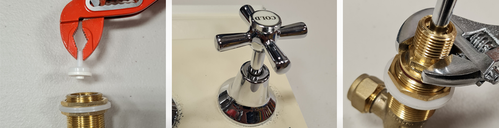
You can use the same silicone sealant for the gap alongside the spindle. Just make sure to cover the breech, which is the threaded piece in the wall, when doing so to prevent any silicone from getting into the thread.
Make sure you have a bucket of water and some rags handy so you can clean things up as you go. Silicone is much easier to remove when it is still wet, so if any mistakes are made, they should be cleaned up quickly.
Let me know if you have any further questions.
Jacob

Why join the Bunnings Workshop community?
Workshop is a friendly place to learn, get ideas and find inspiration for your home improvement projects
You might also like







We would love to help with your project.
Join the Bunnings Workshop community today to ask questions and get advice.